👋 Hey there, I’m Mike. Each week I share AI articles at the intersection of tech, business, society and the future. If you want to support the channel or gain full-access to my work, go here. Read Archives | See Substack Notes | Visit our community Chat | Visit Homepage. I’ve been tracking the U.S. vs. China dynamics of AI and its future for nearly six years.
How do you summarize the heat that is July, 2026 in the AI industry? It’s been a very bizarre and multi-layered drama. We are witnessing history.
Geopolitics and AI on the Front Burner 🔥
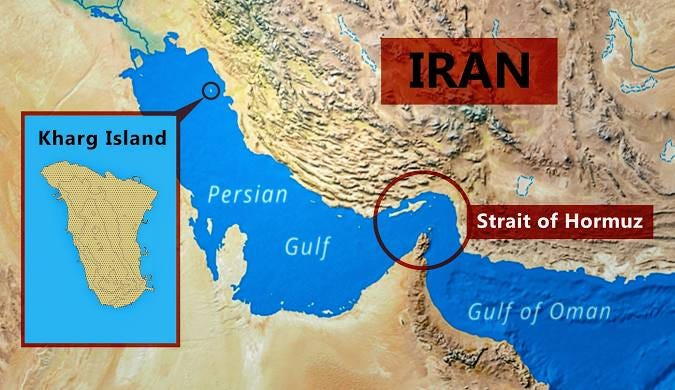
As you likely know, Chinese company Moonshot AI released a new version of its Kimi model called Kimi K3 that is causing a lot of Enterprise AI to switch to open-weight models. It might be one of the biggest AI moments of 2026. With the Iran war unresolved in the strait of Hormuz and the Tech heavy NASDAQ 100 in freefall, it’s becoming a geopolitical and Trump Administration catch-22. There are no clear solutions in war and AI, as it turns out.
Generative AI models are evolving, but likely slowing the revenue growth of AI behemoths OpenAI and Anthropic. With American hyperscalers approaching negative free cash flow via incredible AI capex and datacenter investments, you have to wonder whether it’s all worth it - if Chinese models that are getting larger and more efficient and can replicate the performance while under cutting the cost. It has the potential to become an AI crisis in the stock market even as the Semiconductor boom seems to have hit a bear market correction, after the U.S. listing of South Korean HBM leader, SK Hynix. South Korea (the KOSPI) is now a leading indicator.
With Chinese DRAM maker CXMT about to go public in Shanghai, it’s a very charged China vs. U.S. setup in the future of AI. With DeepSeek’s stunning funding rounds and planned IPOs for DeepSeek, Moonshot, OpenAI and others in 2027, it’s shaping up to be quite a year next year too. DeepSeek raised around $7.4 billion in June last month. We have to assume Databricks has also been one of the beneficiaries of this pivot of Enterprise AI to routing and cheaper tokens of open-weight players in a world where Databricks announced a new round of funding that values the company at $188 billion.
Google’s Gemini 3.5 Pro has been crucially delayed at the worst possible moment. The launch of SpaceXAI’s new model Grok 4.5 was completely overwhelmed by the Kimi K3 moment. Anthropic Fable 5 confusion has given China the ultimate return of that DeepSeek moment vibe back from the dead of January, 2025. OpenAI’s own GPT 5.6 Sol release has also been nearly entirely overshadowed.
The Trump Administration quick to restrict Mythos class models has a serious problem, what if Chinese models are able to approach those same capabilities with open-weight models that were thought to be many more months behind? The Trump administration is showing signs it could ban Chinese cutting-edge models and take drastic steps to try to curtail China’s rise in AI. I thought they were not going to regulate the AI industry. So much for global free market capitalism.
The Brave New World of Token Efficiency Looks Chinese
With Microsoft, Amazon, Meta and even Google behind the Big 7 hyperscalers have lost some of their AI talking points and credibility in this cycle. The mishandling of Mythos class models by the Government and the rise of Kimi K3 type models is the perfect storm that is seeing many Enterprise companies pivot to more rational token usage that’s radically more cost efficient.
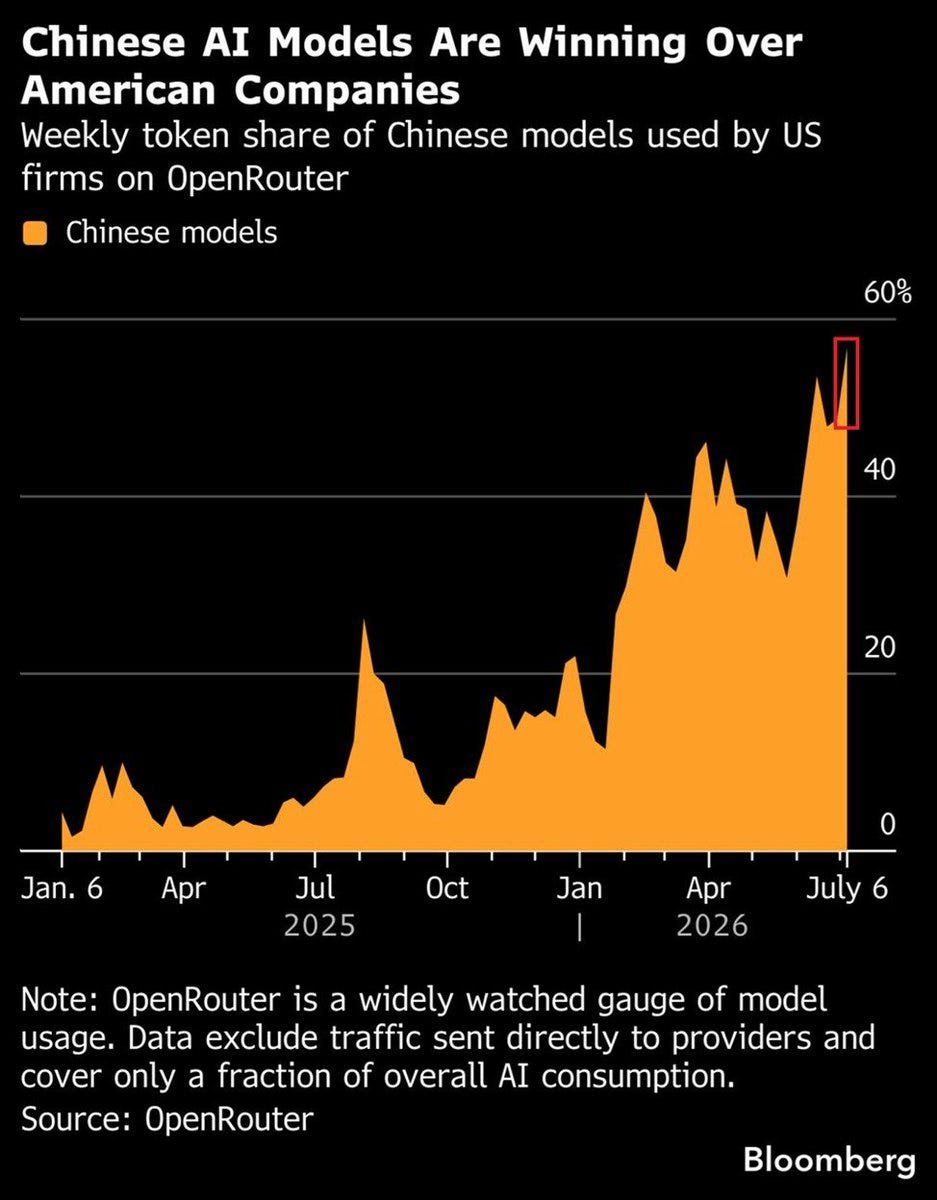
While Open-Router isn’t representative of the entire situation, it’s an interesting data sampling point of the overall macro trend: it appears like cheaper open-weight models from China are winning over marketshare.
In my opinion, some of the best Open-weight models from the U.S. are Thinking Machine’s Inkling (about a week old), and whatever Reflection is likely to put out soon. Nvidia’s Nemotron is an often cited alternative to the previous leadership by Meta. The problem is the real lack of leadership in open-source AI in the United States. For America this is a potential disaster in its AI leadership on the frontier of models, tokens and Enterprise adoption.
To make matters even more peculiar, Chinese President Xi Jinping’s most significant recent remarks on artificial intelligence were delivered via a keynote address at the World Artificial Intelligence Conference (WAIC). President Xi Jinping attended in Shanghai the opening ceremony of WAIC 2026 and delivered a keynote speech titled “Joining Hands to Build a Just and Equitable System for Global AI Governance.” China appears to be more advanced in AI governance and regulatory leadership than the U.S. trying to actively build global collaboration around the theme.
Alibaba’s own Qwen 3.8 Max (preview) will also have an open-weight component with an aggressive international token pricing plan. Kimi K3 is not aimed at hobbyist developers but at Enterprise customers in order to ramp ARR before they also IPO in about six months time. The U.S. and China competition in models, even at a time when there are few great application layer products is exaggerating the demand for compute at a time when China has both cheaper token generation and more abundance energy. At a time when the Trump Administration’s key mandate appears to be keeping the AI boom on the stock market rolling for the financial elite and business class. Meanwhile everyone from Anthropic to Moonshot AI are positioning themselves to maximize their IPO hype and revenue sales momentum.
Do Ranking Models even Matter Any Longer?
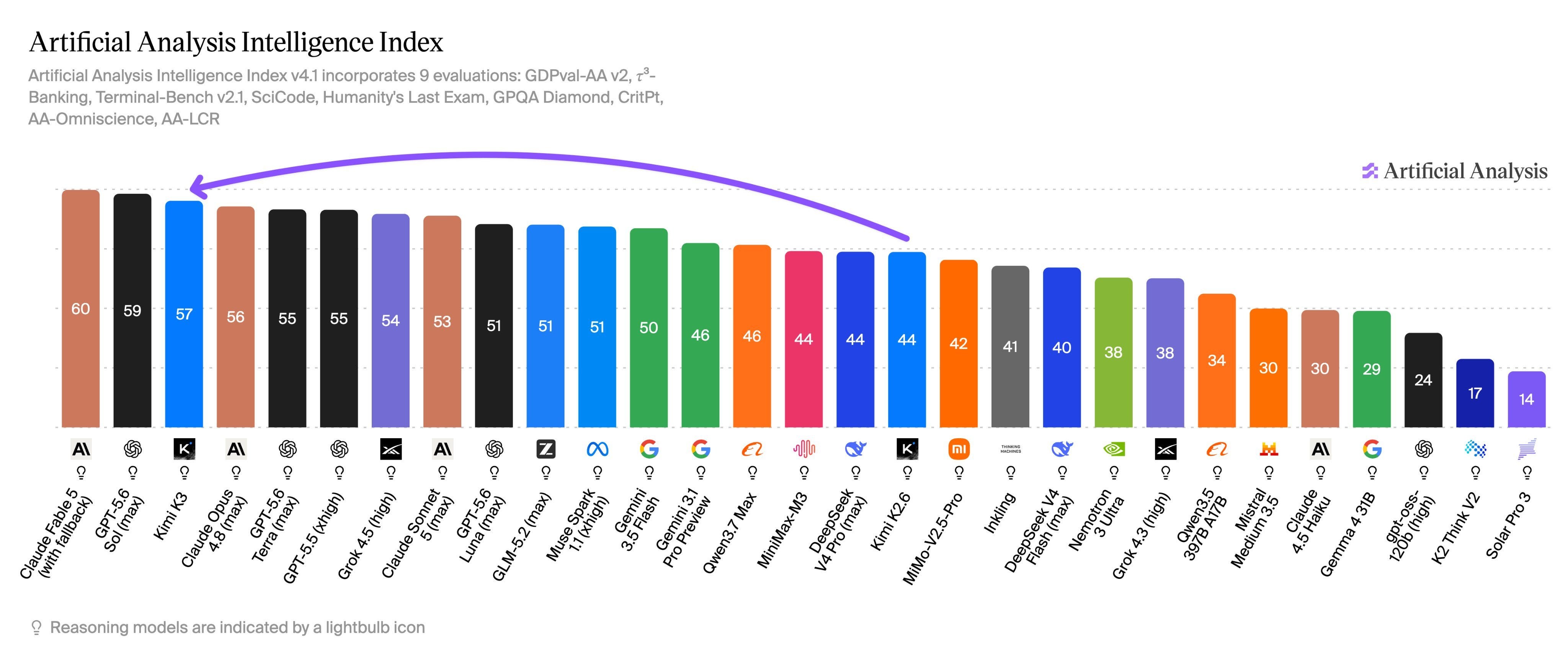
If you go by Artificial Analysis Intelligence Index, and rank by smartest model, the ranking is:
The state of affairs on peak model performance is roughly as follows:
Anthropic – Claude Fable 5
OpenAI – GPT 5.6 Sol
Moonshot AI – Kimi K3 (open weights*)
SpaceXAI – Grok 4.5
Zhipu (Z.ai) – GLM 5.2 (open weights)
These lists and benchmarks that they models are trained to perform on are fairly artificial and likely to change next week and certainly by next month.