


Good Morning,
I want to do a visual tour of some of my favorite infographics and updates of the AI Index report. I think it would be fair of me to suggest that this year’s report emphasizes that while AI capability is accelerating, the governance and safety frameworks meant to manage it are struggling to keep pace.
The reason this exists is the AI Index came out of a project of the One Hundred Year Study on AI at Stanford to serve as a faster-paced annual lens on advancing AI capabilities.
The jagged frontier speaks of a quickly developing industry that is a great lens on the State of AI over the past year 2025-2026 and the big picture. While a lot of the AI reports I read are from Venture Capital funds whose job it is to make AI look amazing, with an academic institution we can hope to find a less biased snapshot. I am not sure if that turns out to be true however. The AI Index that was established in 2019 as an independent project claiming to provide unbiased, rigorous data on the progress of AI. You can follow the Stanford Institute for Human-Centered AI (HAI) here. View their latest news here.
AI News in a Nutshell
Last week Anthropic released:
Claude Opus 4.7
What to use Claude Design For?
Initial test use cases for the tool are as follows:
Realistic prototypes: Designers can turn static mockups into easily-shareable interactive prototypes to gather feedback and user-test, without code review or PRs.
Product wireframes and mockups: Product Managers can sketch out feature flows and hand them off to Claude Code for implementation, or share them with designers to refine further.
Design explorations: Designers can quickly create a wide range of directions to explore.
Pitch decks and presentations: Founders and Account Executives can go from a rough outline to a complete, on-brand deck in minutes, and then export as a PPTX or send to Canva.
Marketing collateral: Marketers can create landing pages, social media assets, and campaign visuals, then loop in designers to polish.
Frontier design: Anyone can build code-powered prototypes with voice, video, shaders, 3D and built-in AI.
You can also use Cursor for Designers that integrates with Figma.
Opus 4.7 is built to be a "digital employee" rather than just a chatbot, not the same as the Mythos model they are still studying. In general, Anthropic recommends Opus 4.7 for demanding use cases where you need frontier intelligence — particularly production-ready code, sophisticated AI agents, and complex document creation. In particular I will note that Opus 4.7 seems to have improved a lot in:
Opus 4.7 as the first “Digital Employee” Type Model
Instruction following.
Improved multimodal support: like vision.
Real-world work; like Finance.
Memory and using file-system based memory.
Long-running tasks.
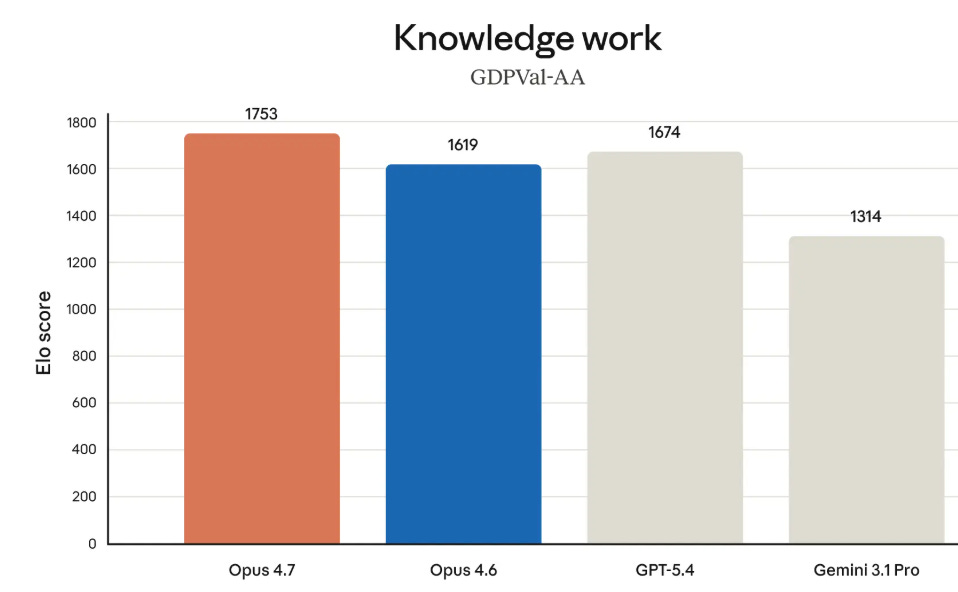
Opus 4.7 is a “Doer”
Opus 4.7 handles complex, long-running tasks with rigor and consistency, pays precise attention to instructions, and devises ways to verify its own outputs before reporting back and as such its fine-tuned to be especially good at agentic coding and related tasks.
It’s likely to be one of the more capable global models of the Spring of 2026.
At its best, the AI Index is a distillation of thousands of articles, research papers, and model data, carefully organized and synthesized.
Want to understand the current state of AI? Check out these charts. (MIT)
Which Companies are Leading in AI?
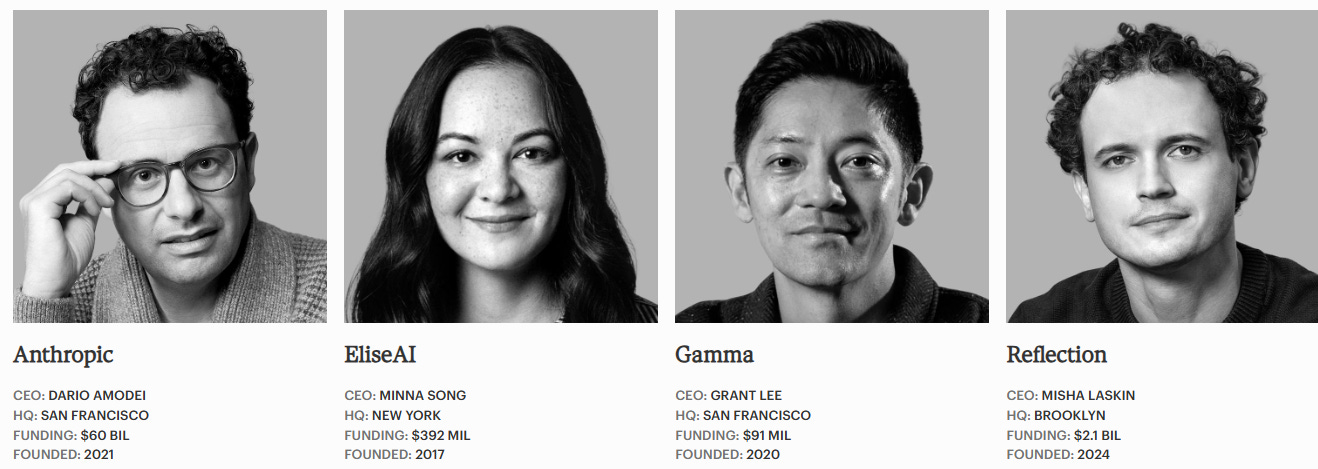
Furthermore Forbes just released their 2026 (8th annual) edition of their “AI 50” read it here. Supposedly, the iteration of the Forbes 2026 AI 50 list highlights a significant shift in the industry, as leading startups demonstrate a transition from experimental technology to sustainable, revenue-generating businesses. Indeed a few on this list will go public in the next 18 months.

A lot of these have indeed seen ARR growth in the last year that’s surprising to say the least and/or seen valuations grow very quickly. I’m going to link to their LinkedIn profiles so you can quickly learn a bit more about them:
1) Legora - legal automation software (Stockholm)
2) Cursor - AI coding platform (Bay Area / NY)
3) Reflection - open source AI models (NY)
4) Physical Intelligence - AI models for robotics (Bay Area)
5) Speak - AI language tutor (Bay Area)
6) Chai Discovery - AI drug discovery (Bay Area)
7) Black Forest Labs - Image and video generation software (Freiburg)
8) World Labs - Spatial AI model developer (Bay Area)
9) Skild AI - AI systems for robotics (Pittsburgh)
10) Sierra - AI agents for customer service (Bay Area)
11) Mistral AI - Open source AI model developer (Paris)
12) Mercor - Data labeling service (Bay Area)
13) Lovable - AI app and website builder (Stockholm)
14) Listen Labs - AI market research tools (Bay Area)
15) Thinking Machines Lab - AI research and products (Bay Area)
16) Genspark - AI tools for knowledge workers (Palo Alto)
17) Decagon - AI agents for customer service (Bay Area)
18) Together AI- AI cloud provider (Bay Area)
19) Suno - Music generation software (Cambridge)
20) Rogo - AI finance tools (NY)
21) Perplexity - AI search engine (Bay Area)
22) OpenEvidence - AI search for doctors (Miami)
23) krea.ai - Image generation software (Bay Area)
24) HeyGen - AI video generation (LA)
25) Harvey - Legal automation software (Bay Area)
26) Fireworks AI - AI app development software (San Mateo)
27) ElevenLabs - Voice generation software (NY)
28) Safe Superintelligence - AI research (Palo Alto)
29) Midjourney - Image generation software (Bay Area)
30) fal - Generative media infrastructure (Bay Area)
31) Cyera - AI data security (NY)
32) Notion - productivity software (Bay Area)
33) Surge AI - Data labeling service (Bay Area)
34) Gamma - AI graphic design tools (Bay Area)
35) Glean - Enterprise search engine (Palo Alto)
36) Cohere - AI model developer (Toronto)
37) Baseten - AI app deployment software (Bay Area)
38) Runway - Video and image editing software (NY)
39) Crusoe - AI data center builder (Denver)
40) Abridge - AI notetaker for doctors (Bay Area)
41) Synthesia - AI avatar and video generator (London)
42) SambaNova - AI chipmaker (San Jose)
43) EliseAI - AI agents for housing and healthcare (NY)
44) Clay - AI go-to-market tools (NY)
45) Applied Intuition - Self-driving software (Sunnyvale)
46) Cognition - AI coding agents (Bay Area)
47) Replit - AI app and website builder (Foster City)
48) OpenAI - AI models and products (Bay Area)
49) Anthropic - AI models and products (Bay Area)
50) Databricks - Data storage and analytics (Bay Area)
My own take on the slides may include text from the slides and my own commentary at times. I might at times also include slides from other sources that may be related which I will credit. I often will add subtitles to the slides themselves to help the reader orient themselves and to make an editorial point that may differ from the original.
When possible I will show the infographic in a wide-view, resolution permitting. To make it a bit easier on the eyes.
As AI advances rapidly, can the systems built around it keep up?
Let’s begin the first iteration of the summary.
The AI Index 2026
INTRODUCTORY SLIDES:
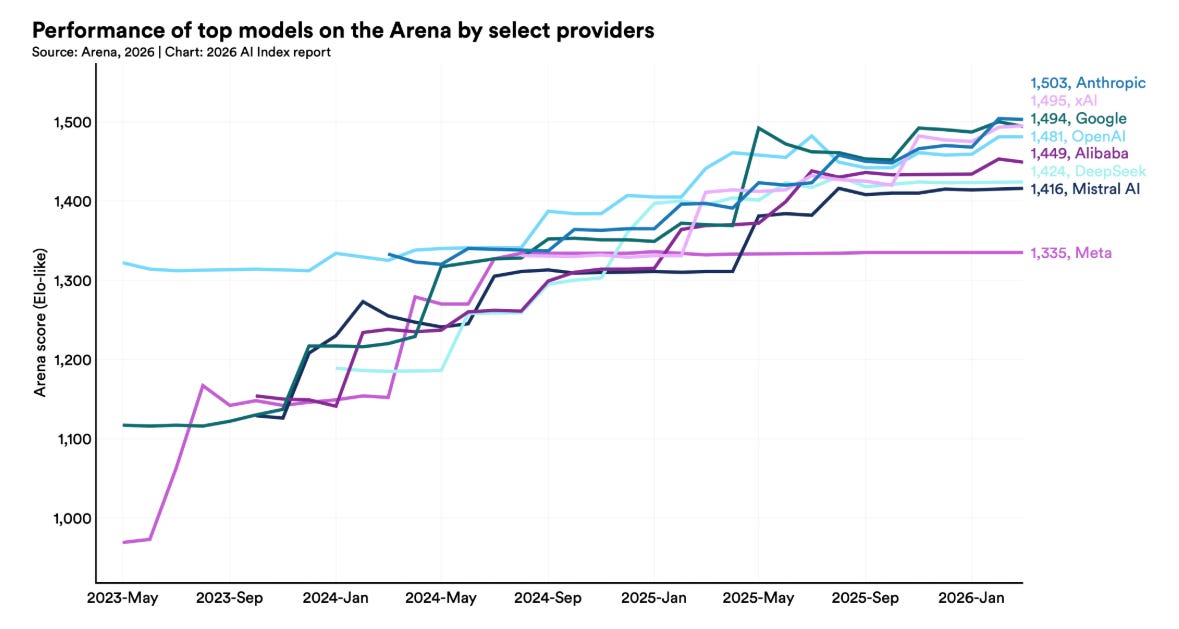
Three Years into the Generative AI Era, a Multitude of Models Perform Exceptionally Well and are Frontier (SOTA, i.e. state of the art)
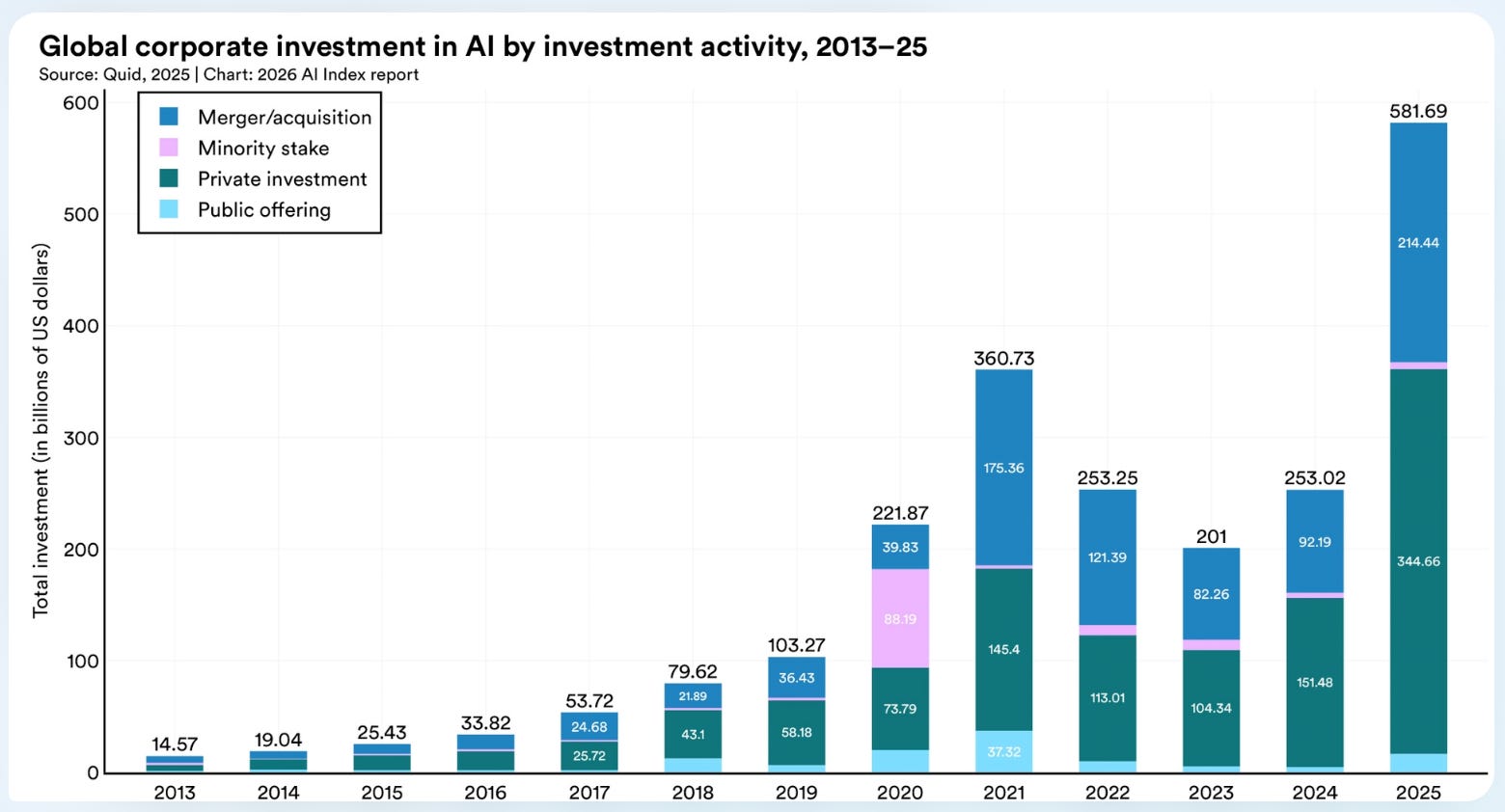
OpenAI, Anthropic and xAI Funding Skewed the Charts for 2025 in Private Investment
M&A finally picked up. 2026 and 2027 are widely considered IPO years of note.
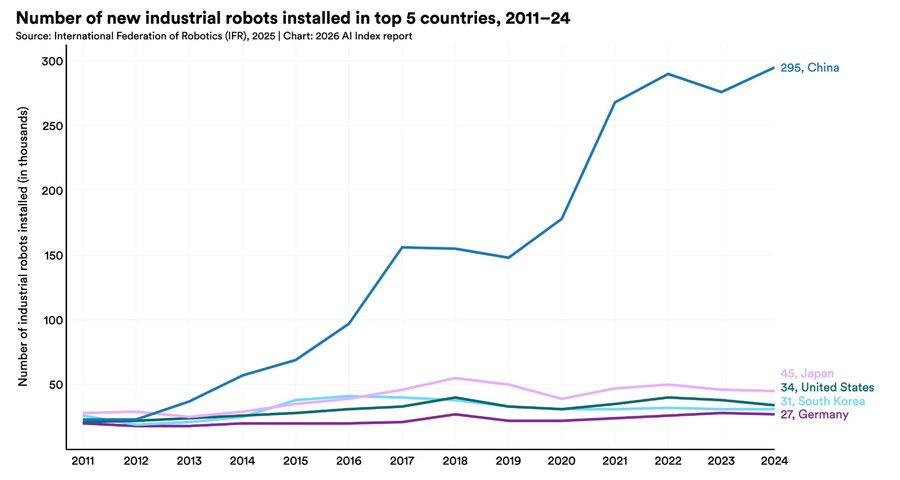
While U.S. Leads in Closed Models, China leads in Robotic Companies and humanoid robotic products
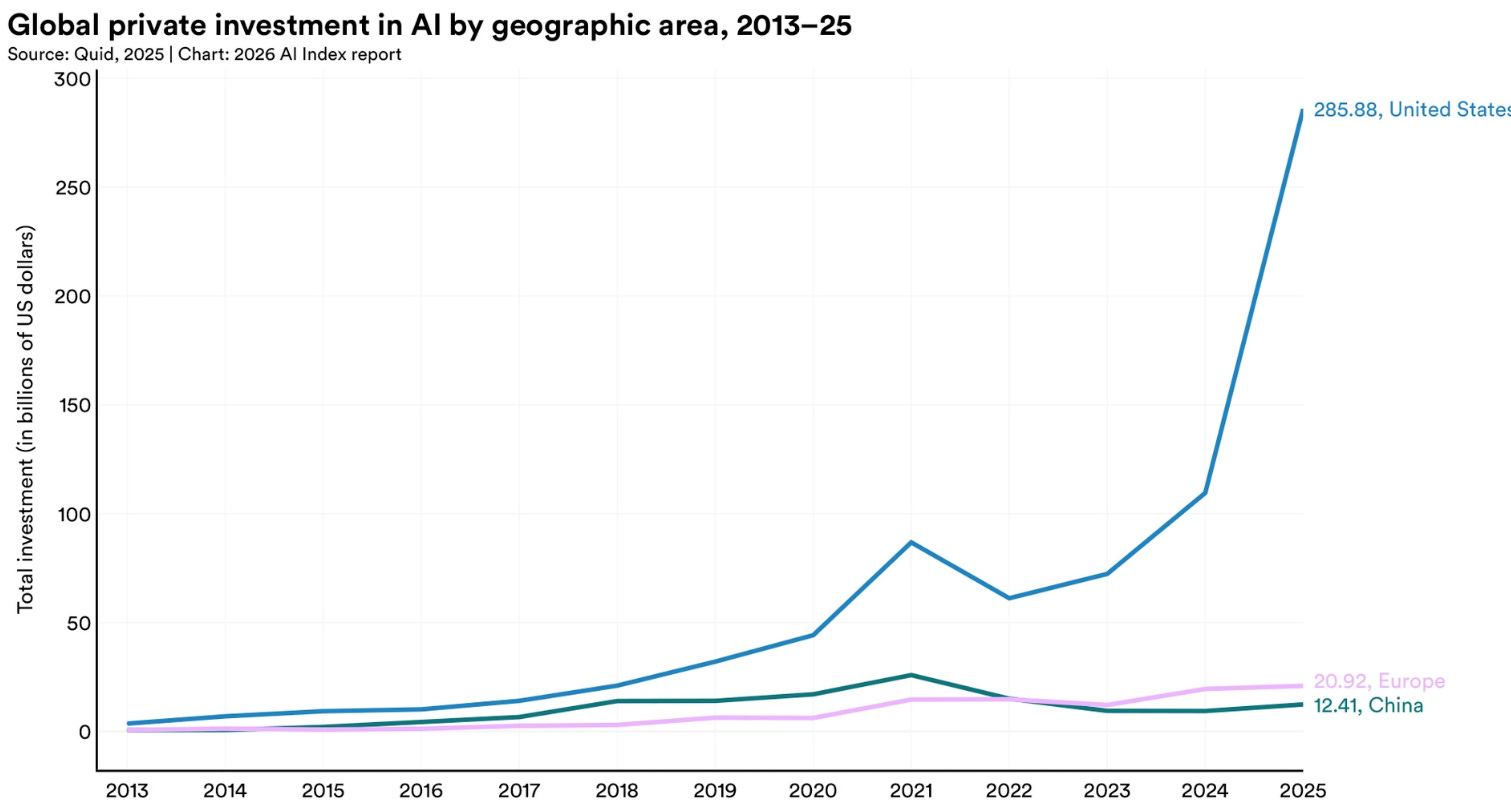
U.S. Lead in Venture Capital Private Investments in AI is Significant 2013 to 2025:
Yet China leads in Open-source LLMs and while it has vastly less AI infrastructure, it has more Energy (that’s considered a bottleneck)
However the above graph is deceptive because of how funding takes place in China. That is, the private investment figures likely understate China’s total AI spending, as government guidance funds have deployed an estimated $184 billion into AI firms between 2000 and 2023.
The AI Index is one of the best annual resources for tracking real progress beyond the headlines.
Which Industry leaders do you trust? 👀
See the results of a version of this Poll on LinkedIn.
I hope you enjoy the exploration and AI landscape of insights that it provides. 🗺️
