Codex, Cursor and the Great Beyond
OpenAI will be put under pressure by Meta AI, SpaceXAI and China - not just Anthropic's Enterprise AI momentum.

Good Morning,
AI Supremacy is also a Newsletter where we track the intersection between BigTech and BigAI and the best AI startups competing for future marketshare.
Incumbents will be put under pressure. Microsoft backed OpenAI, is sort of in incumbent territory already. Today, let’s take a closer look into Codex.
In March we learned that OpenAI want to create a “Super-app” that combines ChatGPT and Codex. With just a few months before a supposed IPO, that’s an awkward pivot for OpenAI, where ChatGPT no longer even has a 50% marketshare.
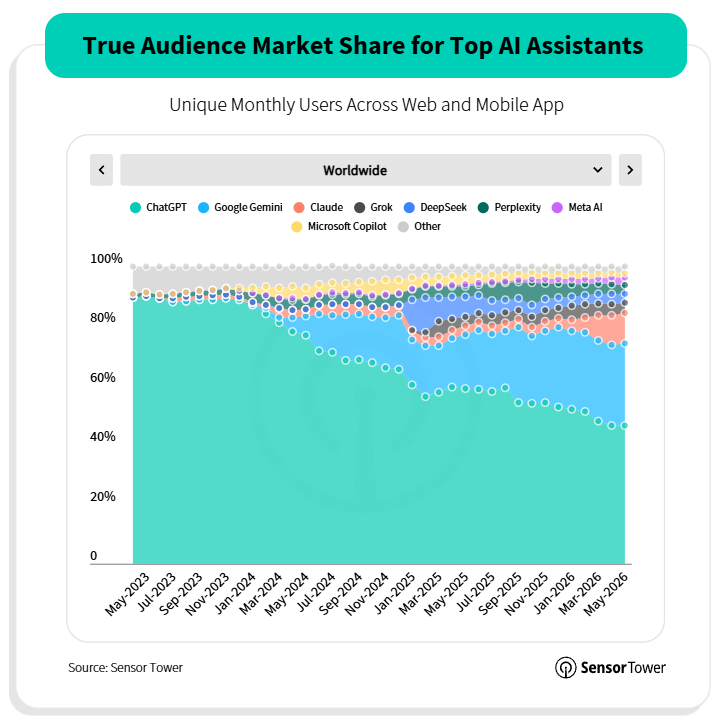
Until January, 2026 ChatGPT commanded over 50% market share, but by May's end, it had fallen to 46.4% thanks to the rise of Gemini (27.7%) and Claude (10.3%). Now with Meta’s AI app gaining momentum, who knows where it will even be by year’s end. There’s also a problem with OpenAI’s pivot to Enterprise AI, SpaceX just finished the acquisition of Cursor.
“For the past few months, SpaceXAI has been jointly training a model with Cursor, which will be released in Cursor and Grok Build soon.” - SpaceX
Why OpenAI is Under Pressure in Marketshare
Meanwhile all the while the Meta AI app is experiencing a massive surge in momentum, driven by deep integration into Meta's 3.5 billion daily active users ecosystem, standalone mobile app growth, and aggressive rollouts of new native features like "AI Mode" across Facebook. How fast can that increase?
On the Enterprise AI side outside of Anthropic’s dominance, Cursor’s ARR hit $4 Billion in June. OpenAI thus has competitive pressures both in B2C and B2B. This means OpenAI’s execution risk in merging ChatGPT with Codex is high and the result might determine what kind of future the business will have in such a competitive market.
Jeff Morhous is the author of The AI-Augmented Engineer. He will be covering the Codex section of the article.

Cursor’s acceleration of revenue and entry into AI agents makes it an ideal fit to help scale SpaceXAI’s bold ambitions to scale Enterprise AI customers that makes up a generous part of SpaceX’s speculative TAM (total addressable market in its S-1) to say the least. While ChatGPT has hit a supposedly 1 Billion users, it’s losing marketshare very rapidly.
I really enjoyed this SenseTower report, they are not an affiliate.
ChatGPT’s 3.5 Year First Mover Advantage is Shrinking
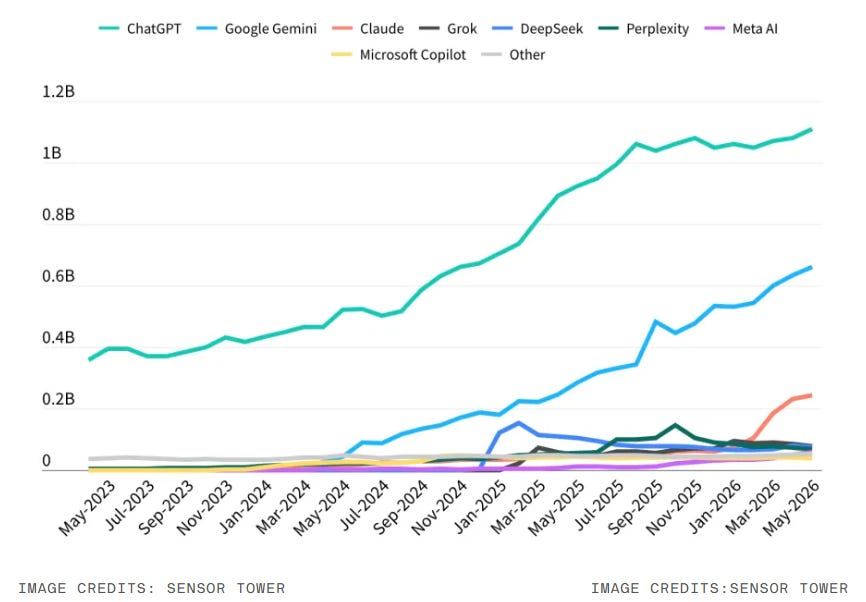
Sensor Tower’s State of AI Report also found that users are increasingly willing to switch between assistants. ChatGPT will be put under pressure by Google’s Gemini, Claude, SpaceXAI, Meta AI as well as a well funded DeepSeek, Alibaba Qwen, Moonshot AI and Z.AI and ByteDance that are evolving rapidly.
Sense Towers State of AI Report has a lot of tidbits as well for those of us who follow AI closely. Like for instance, that Anthropic’s Claude earns more revenue per user than ChatGPT does, and that’s a problem.
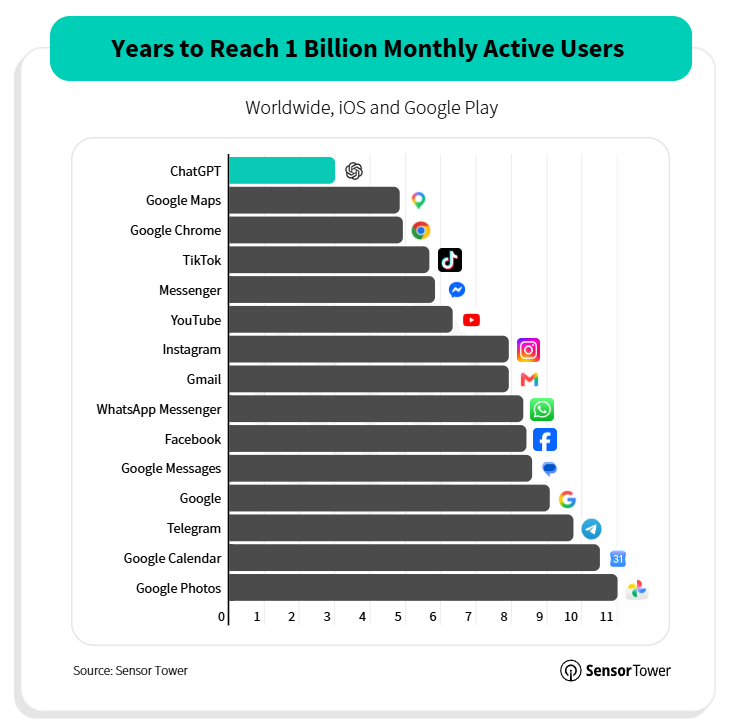
ChatGPT fast to 1 Billion MAUs but Trouble is Ahead
Claude’s average revenue per user on mobile in the US rocketed from under $0.50 last September to $2.76 in May.
Today’s article will have many interesting OpenAI Codex related links.
Read: Codex wants to work on more than just code
Using NotebookLM to learn new things
The ultimate guide to Codex goals
How OpenAI prompts Codex for the best results
Meanwhile both contemporaries and younger AI startups are getting serious funding that will challenge OpenAI’s dominance. I project China’s AI ecosystem to have a really breakout 2027.

SpaceXAI Acquiring Cursor (Anysphere) for $60 Billion
SpaceX expects the merger to close during the third quarter of this year and they are already collaborating rapidly on new coding models. This gives what was formerly xAI (a relative failure vs. cash burn), a serious boost in revenue and momentum. It also entirely changes the landscape and puts more pressure on OpenAI, given the wild success of the SpaceX IPO. At time the time of writing ticker SPXE 0.00%↑ is up 31% since its IPO last Friday with a market cap that overtook Amazon and even briefly reaching the market cap of Microsoft.
I had already believed Anthropic and Google were putting pressure on OpenAI and had overtaken them in certain ways. Now the rise of SpaceXAI and Meta AI via their AI app means OpenAI is highly likely to continue to struggle.
All of this totally changes the future of AI.
Cursor exits with a $4B in run rate growing 7x YoY. It’s hard to find such an MIT startup success story in the history of technology. The four 25yo MIT founders will make ~$2.7B (each) in a span 4yrs and first 50 startup hires ~$20-500M each. It’s an AI coding exit for the ages.
They could have gotten another round in funding where before SpaceX came knocking, Cursor was on track to close a $2 billion funding round from the likes of Andreessen Horowitz, Thrive, and Nvidia that would have valued the AI coding startup at $50 billion. But that never materialized, getting a compute deal with SpaceX quickly escalated into an acquisition deal. With the costs of compute, Cursor was burning cash too fast (at that point in time) even with its meteoric growth. SpaceX can absorb those types of loses.
Where to learn more about working with Codex
The OpenAI Academy (not an affiliate) has a lot of workshops and live sessions on using Codex. OpenAI’s spending on marketing and education has been considerable the past few years, but then again Codex might evolve into a useful general purpose tool. If OpenAI ever hopes to have a path to profitability, Codex needs to shine.
⚡ Codex for everyday use
🖥️ Building websites with Codex Sites
💐 Codex for creative building
ChatGPT’s marketshare is declining rapidly
The Generative AI trend is a story of rapidly shifting business and consumer preferences and more and more options.
I am Obsessed with AI and Trust - Public Poll:
I conducted similar polls on LinkedIn and Substack Notes and there appears to be a growing consensus. In the above poll I add SpaceX as the Cursor acquisition changes xAI’s abysmal execution and performance substantially.
The story of OpenAI’s Codex plan is even more particular. I’ll turn it over to Jeff Morhous now.
What’s new in OpenAI’s Codex
Codex used to be easy to explain.
It was OpenAI’s tool for developers. You pointed it at a repo, gave it a coding task, and it helped you turn ideas into working software. If you’ve heard of Claude Code, it was just OpenAI’s version of that tool.
But something weird is happening. Codex is starting to outgrow code.
OpenAI is turning Codex from a developer tool into a general-purpose agent for knowledge work. Gmail, Calendar, PowerPoint, computer use, and even an upcoming merge with ChatGPT.
Codex is no longer just where software engineers go to automate coding tasks. It’s becoming the place where OpenAI wants work to happen.
Codex has historically been for developers
Until recently, Codex was OpenAI’s flagship tool for writing code. I’m a developer, and my progression with AI tools has been pretty linear. I started using ChatGPT when it came out for question-and-answer help. Instead of searching Google for things like “how to write a for loop in Python”, I started querying ChatGPT for this.
This was incredibly useful, but why? To get a Google result that helped you through a programming issue, someone has to have had that programming issue already and posted a solution online. Usually, this meant a Google search would lead you to Stack Overflow, a Q&A site for developers.
With ChatGPT, you could get an answer faster, and you didn’t need to find an exact match on Stack Overflow. Writing a for loop is common enough that you could find help pretty easily, but what about a niche issue like an additional 200 millisecond latency when adding error logging to your app? Incredible amounts of programming problems require far more context than a Google search could ever help with.
With ChatGPT, you could put tons of context into the chat and get an answer on how to fix it pretty quickly. This was so much more useful in fact, that it has all but killed Stack Overflow.
So where does Codex come in?
ChatGPT tells you how to fix your code. Codex writes code for you. That’s the difference between chatbots and agents.
Codex is mostly used as a Mac app, but there’s a terminal option just like Claude Code. Rather than ask a chat tool to tell you how to fix a bug, you can just ask one of these agentic tools to fix the bug for you.
Codex is ChatGPT’s agentic tool for software engineers, or at least it was.
Codex is becoming the everything app
Codex has been quite successful, and OpenAI product leadership is heavily focusing on it. They’ve killed the Sora team (RIP) and doubled down on enterprise contracts and Codex.
But only so many enterprises have a genuine need for an agentic software tool. Knowledge work is absolutely not limited to making software, so why should agentic AI tools?
After Anthropic saw the success of Claude Code, they were quick to release Claude Cowork, an app for agentic work on things like documents, presentations, and spreadsheets. I think OpenAI would like Codex to be this tool.
They’ve added Codex plugins for Gmail, Google Calendar, Powerpoint, and tons of other tools that knowledge workers produce their value in.
The most immediately useful plugin to me is Google Calendar, which lets Codex be more generally useful to me as an AI assistant.
This is a big leap from a coding tool! With Computer use, you can let Codex control other apps on your computer, extending its usefulness to all of the apps on your computer. That’s a little nuts, and I’m still grappling with what this means for jobs that are done on a computer. If a huge portion of human labor can be done by an LLM, then what happens to people doing that work today?
I think there will continue to be incredible value created by the human mind, but we can’t continue to work like we used to. It’s exactly why I write The AI-Augmented Engineer - to show software engineers how to use AI tools effectively to become more valuable.
Merging Codex with ChatGPT
One interesting bit of news in the Codex world is the upcoming merge with ChatGPT. This is a natural continuation of Codex being generally useful beyond software development. If for all sorts of work, why a second app at all?
If you look at both apps, it shouldn’t be a surprise that a product leader would wonder why they are two different things.
Anthropic has already merged its desktop apps into one product. Today, you just use the Claude Desktop app to access chats, Claude Code, and Claude Cowork.
At OpenAI’s recent Intelligence at Work event, their product leadership shared that they’re “very excited to share that in the next few weeks we are going to put Codex into ChatGPT”.
So what will this look like?
The stated goal is for “your agents to be available wherever you do work” - that means desktop, web, mobile, and maybe even some other integrations.
My hot take is that this is the worst thing they could do for developers, and the best thing they could do for a general user. Codex is so loved by the developers who use it because it’s fine-tuned for a developer workflow. Integrating it into ChatGPT will inevitably cause it to no longer be a tool for making software. Maybe that’s good for OpenAI, and maybe it’s even good for you, but it’s not great for the developers currently using Codex.
Comparing Codex to Claude Code
If you’re going to compare Codex and Claude Code, it’s really important to understand the difference between a model and a harness. The model is the thing that’s doing the thinking. Tokens go in, and tokens go out.
Model lock-in
Anthropic has all of the Claude models, like Claude Haiku 4.6 or Claude Opus 4.7. OpenAI has GPT models, like GPT-5.5.
The harness is the tool that sits between you and the model. It’s an interface that adds functionality to the model, and it’s more meaningful than you’d guess.
If you’re trying to decide between Codex and Claude Code, you are mostly making a harness decision. But each of these harnesses locks you into that company’s models, so you’re making a model decision by proxy.
When it comes to agentic work, Anthropic and OpenAI models are generally pretty comparable. Many folks find Claude models better for agentic work, but tinkerers online have reported getting better results for long-running tasks out of OpenAI models.
Overall, I think the model choice is far less important than the harness choice, so my recommendation is to pick based on harness features and experience rather than model benchmarks.
Meaning, pick Claude Code or Codex because of the tool, and assume that the models are similar for many use cases.
If you really don’t want to be locked into a model family, then use a tool not provided by a major lab, like Cursor or even OpenCode.
Terminal or App?
Both Claude Code and Codex have options for terminal interfaces (TUIs) and desktop apps (GUIs). More people use Claude Code in the command line than in the Claude desktop app, so the experience is much better there.
On the other hand, Codex is mostly used in the desktop app rather than in the terminal, so you’ll get a better Codex experience in the app. Plus, if you want to do some of the cool non-coding stuff mentioned earlier in the article, you have to use the app.
If you’re choosing a terminal-based tool, my recommendation is to go with Claude Code. If you’re choosing an app-based tool, I like Codex better.
Brief bio for Jeff Morhous
Jeff is a senior software engineer and developer educator. He writes The AI-Augmented Engineer to teach people how to use AI to write better code, ship faster, and level up their careers.
My best posts
Thanks for reading!
Addendum
Here are some are some of my own field notes to continue the look into the report and so forth.
While Meta AI is pushing its AI app hard, it’s engineering culture is taking a hit. Zuckerberg is having to walk back some of his harsh treatment of all of those AI re-orgs and fairly dystopian working conditions, which is not surprising with Alex Wang there. Meta poaching AI talent from elsewhere and making all of these plans for Superintelligence, isn’t going so well.
Google Gemini Going Mainstream
Google’s global growth over ChatGPT has been remarkable in the past 18 months. According to the Semi Tower report Google Gemini has steadily expanded its footprint, particularly across Europe, the US, Japan, and South Korea, supported by strong Android integration and broader ecosystem distribution across Google's services.
AI users are also voting with their chatbot usage:
The Pragmatic Engineer goes over Meta’s painful working conditions for AI researchers and their huge engineering team.
Claude has emerged as the fastest-growing challenger in 2026, with True Audience up 452% YoY in May and US market share rising from 4.4% to nearly 14% over the same period. - SenseTower
What exactly will BigAI do to incumbents and first movers like OpenAI, it’s getting increasingly obvious.
Amazon is Winning Gen AI Retail Traffic
There’s no doubt Amazon and Meta are seeing substantial ROI from Generative AI based traffic in advertising and E-commerce sales.
Walmart’s Sparky is also doing well.
Generative AI is Reshaping Discovery and Ads
If OpenAI’s marketshare is declining this rapidly, its execution on Ads might determine its eventually outcome but this means competing directly with the likes of Meta, ByteDance and Google.
Check out the Full Report
One of the best “State of AI” reports of 2026 for sure.
Unfortunately Generative AI is mostly showing ROI of business models that already dominate the American internet and that subsequently accelerates monopoly capitalism. How it accelerates Cloud computing and Ads revenue is really a case in point.
Generative AI Diffusion and Global Adoption Continues
Global time spent on GenAI apps projected to reach 36 billion hours in H1 2026, up from 17.2 billion hours in H1 2025.
But consumers aren’t using these AI chatbots as much as you’d think:
ChatGPT engagement reached ~215 minutes per user per month, while Gemini (+14 → 100 minutes) and Claude (+40 → 120 minutes) saw rapid gains in usage intensity.
These companies are spending a ton on marketing: GenAI ad spend more than tripled in the US in Q1 2026, led by OpenAI (+800% YoY) and Anthropic (+1,184% YoY) as competition for users intensified.
The application layer is still nascent (of Generative AI) but starting to ramp up in new verticals:
Apps mentioning AI-related terms are on track for nearly 10 billion downloads in H1 2026, with adoption expanding across Health & Wellness, Finance, Education, and Utilities.
There’s so much other interesting AI news I want to cover, but I’m out of time and space.


