


Hey Everyone,
This is the free version of one of our most recent Claude equity research plugin guides.

Does using AI for Stocks make Sense?
Whether you care about investing or personal finance, try and keep an open mind to using AI.
Using Claude for Equity Research and Stocks
Today’s guest post is the third in our most recent series:
The Claude in Equity Research Series
Here are our guides so far:
How to use Claude AI for Investing and Equity Research
How to Build Your Own Equity Research Analyst with Grok Bot
Today’s post a thematic report: Can Claude do an analyst’s job?
With more guides on the way.
First some fields notes, please be aware of what’s already available from this young company that makes the best LLMs in the world around Finance. We should note that 2026 and especially 2027 will be big years for how Generative AI is changing Finance including equity research.
Personal Finance in Claude: A built-in hub (available to US Pro, Max, and Ultra subscribers) that connects read-only to up to 16 bank, credit card, and investment accounts via Plaid. It lets you query spending habits, track upcoming bills, and generate interactive budgeting dashboards without using your financial conversations for model training. Claude Support Use Guide.
Third-Party Personal Finance MCP Connectors: Users outside the US or on free tiers can link budgeting apps via the Model Context Protocol (MCP) to log expenses, track balances, and automate monthly spending reviews directly inside chat.
Claude for Financial Services: An enterprise suite tailored for investment banking, equity research, private equity, asset management, and insurance. It includes SOC 2 Type II and FedRAMP compliance, source-linked citations for auditability, and specialized workflows for credit underwriting, portfolio reporting, and actuarial reviews. View Cowork and Plugins for Finance. Also view Marketplace examples with plugins.
Financial Agent Skills: Modular instruction packages that equip Claude to autonomously execute standard Wall Street workflows, such as comparable company analysis (Comps), DCF modeling, earnings call transcript analysis, and initiating coverage reports. Also see more about this here.
Open-Source Financial Services Plugins: An Apache 2.0-licensed repository on GitHub containing customizable agent templates, slash commands, and vertical add-on plugins for investment banking, equity research, private equity, and wealth management.
Claude for Financial Advisors. Learn more about it. Claude for Financial Advisors is a specialized enterprise and wealth-management solution (available as a Claude Cowork plugin and integrated workflow package) launched by Anthropic in September 2026.
Our focus for today is of course Claude in Equity Research.
If you are reluctant to use Generative AI in many walks of life, I totally get it. From privacy concerns to an aversion for slop. But are there critical areas of life where the adoption of AI is justified for the personal potential for ROI? But knowing how to use AI around your money, investing and personal finance management and that of your family might be a good idea. Obviously none of this is investment advice but very broad strokes for educational, informational and entertainment purposes. I just want all of you to know what’s out there.
Now let’s turn it over again to Michael Fritzell, but first a short introduction.

One Reader said: “Borderline Life-changing”
See more Thematic reports by Michael. If you are new to Asian Century Stocks, check out his newly arrived Substack. He publishes 20 deep dives on underfollowed Asian equities each year, focusing on value stocks. His coverage of lesser known markets is impressive, one reader said it was borderline life changing.

In a Nutshell why use Claude Equity Research Plugin
Claude has released an equity research plugin that allows you to generate:
Screener
Initiation Report
Sector Report
Model Update
Earnings
Earnings Preview
Catalyst Calendar
Thesis
Morning Note
Here are the nine skills with their nine commands.
So here we can rapidly get timely info:
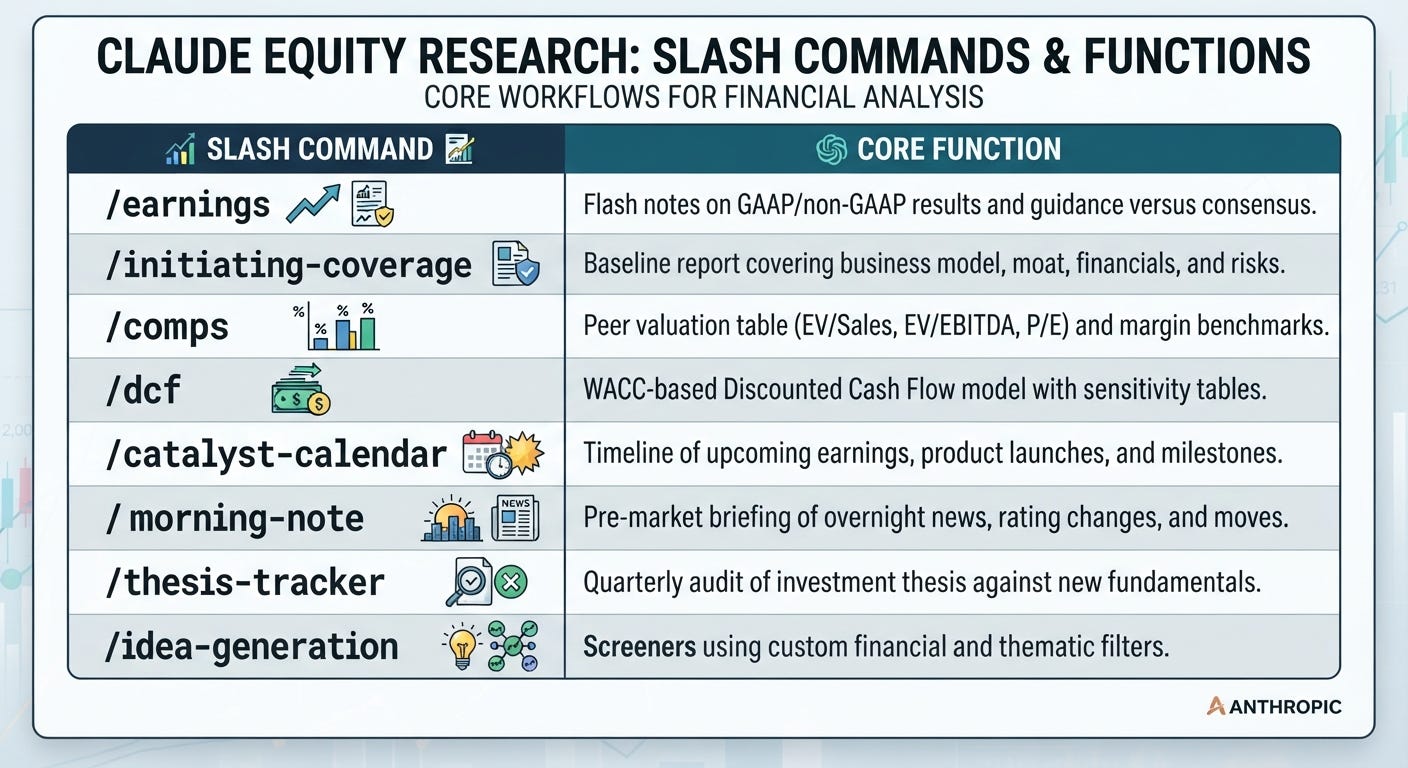
Slash Commands - What they do?
/initiate(Initiating Coverage): Drafts comprehensive initiating coverage reports featuring bull/bear valuation frameworks, business model breakdowns, competitive positioning, and financial projections./earnings&/earnings-preview(Earnings Cycle Workflows): Builds pre-earnings positioning notes with estimate models and scenario frameworks (/earnings-preview), then parses quarterly releases against consensus estimates to generate post-earnings update notes (/earnings)./model-update(Dynamic Model Refreshing): Ingests new quarterly filings, management guidance, or macro revisions to adjust estimates, recalculate valuation multiples, and flag material variances./morning-note(Morning Meeting Notes): Summarizes overnight news, rating changes, macro prints, and trade ideas across your coverage universe in a concise, 7:00 AM desk-ready format./thesis(Thesis Tracker): Maintains a living record of your investment thesis for portfolio positions or watchlist names, tracking key milestones, KPIs, and whether the core rationale remains intact./catalysts(Catalyst Calendar): Builds and updates an event calendar across your coverage list—tracking upcoming earnings dates, investor days, product launches, and regulatory decisions./screen(Idea Generation): Combines quantitative screening criteria with thematic research to surface new long and short investment ideas./sector(Sector Overviews): Generates thematic research pieces and industry primers for client requests or new vertical coverage.
As you can imagine this could be useful for certain kinds of retail investors and analysts.
Visualizing how easy it us to use the Slash Commands
Can Claude do an analyst’s job?
This plugin includes nine commands that let users generate initiation reports, earnings updates, and more. It’s an excellent way to create institutional-grade reports at the click of a button. Let me show you how.

To use the plugin, you’ll need a paid Claude account. Go to claude.ai and sign up for the US$20/month plan. Then log in to your account.
To install the plugin, click Customize on the left-hand side of the screen, type “equity-research” in the search bar, and click “Add”.
Claude will now show “equity-research” as one of your installed plugins:

To use the commands included in the plugin, start a new chat by clicking “New” at the top-left corner of the screen.
You’ll find the commands when you click “+” at the bottom-left corner of the screen, then “Plugins”, “equity-research” and finally click on the report or model that you want Claude to generate:
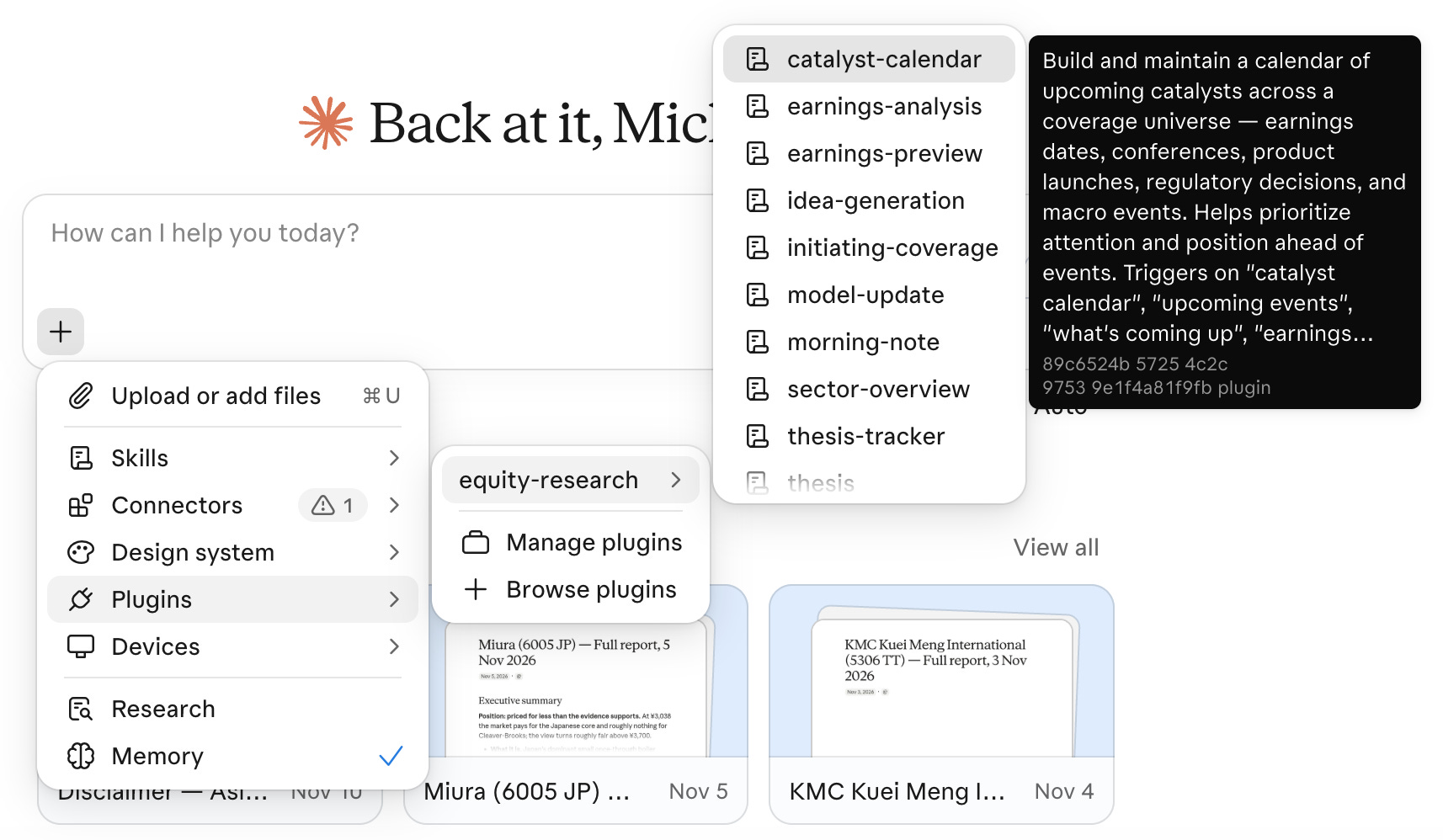
The plugin currently offers nine commands:
Screen
Initiate
Sector
Model-update
Earnings
Earnings-preview
Thesis
Catalysts
Morning-note
Once you’ve clicked on a command that you want, you’ll be presented with the following screen (just as an example):
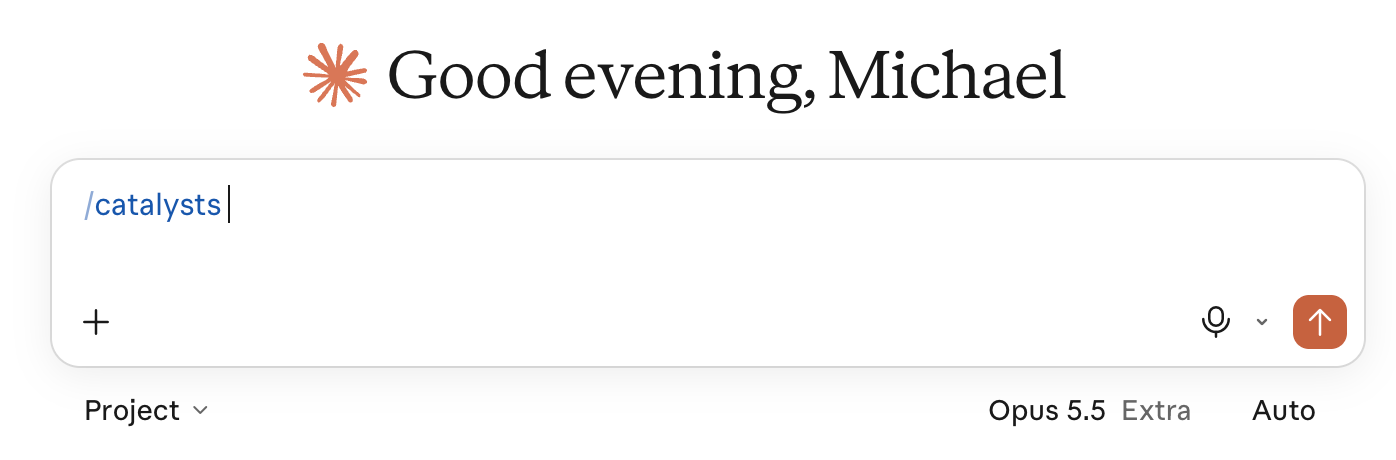
You can also just type “/catalysts” followed by the space bar to make the text go blue. After the command, type in the stock ticker and press Enter. Claude will now prepare your report.
Let me now go through exactly what you get in each of the nine commands.
To make the instructions more lively, I’ll use a real-world example of a stock that I’m currently researching: Korean body composition analyzer maker InBody (041830 KS — US$388 million).
The company seems to be benefiting from increased GLP-1 drug usage worldwide, but I have questions about its corporate governance. Let’s see what we can learn.
Table of contents:
1. Screener
2. Initiation Report
3. Sector Report
4. Model Update
5. Earnings
6. Earnings Preview
7. Catalyst Calendar
8. Thesis
9. Morning Note
10. Conclusion
Disclosures: As of 18 November 2026, I own shares in Air Water (4088 JP), which appears in the morning-note example. I do not own shares in InBody (041830 KS) or any other company named in this post or its attachments, and do not intend to subscribe to Anthropic’s IPO. I have received no payment, free access or other benefit from Anthropic or any company named here. Asian Century Stocks is published by Delante Media Pte Ltd, Singapore, which is not licensed by MAS to provide financial advice. This post reviews a software tool. The downloadable files are AI output from Claude, with valuation figures removed. They do not represent my views or those of Asian Century Stocks, have not been verified, and are not a recommendation to buy, sell or hold any security.
1. Screener
First, let’s talk about Claude’s screener tool. It lets you search for ideas across any sector, region, or market cap range.
In Claude’s main prompt window, simply type in:
/screen
Claude will ask you a few questions about what kind of screen you want to build.
Alternatively, you can ask for a more specific screen. Since I’m interested in the GLP-1 industry, I might type something along the following lines:
/screen Asian GLP-1 beneficiaries
I then get a 10-page report, with seven stocks listed up front:
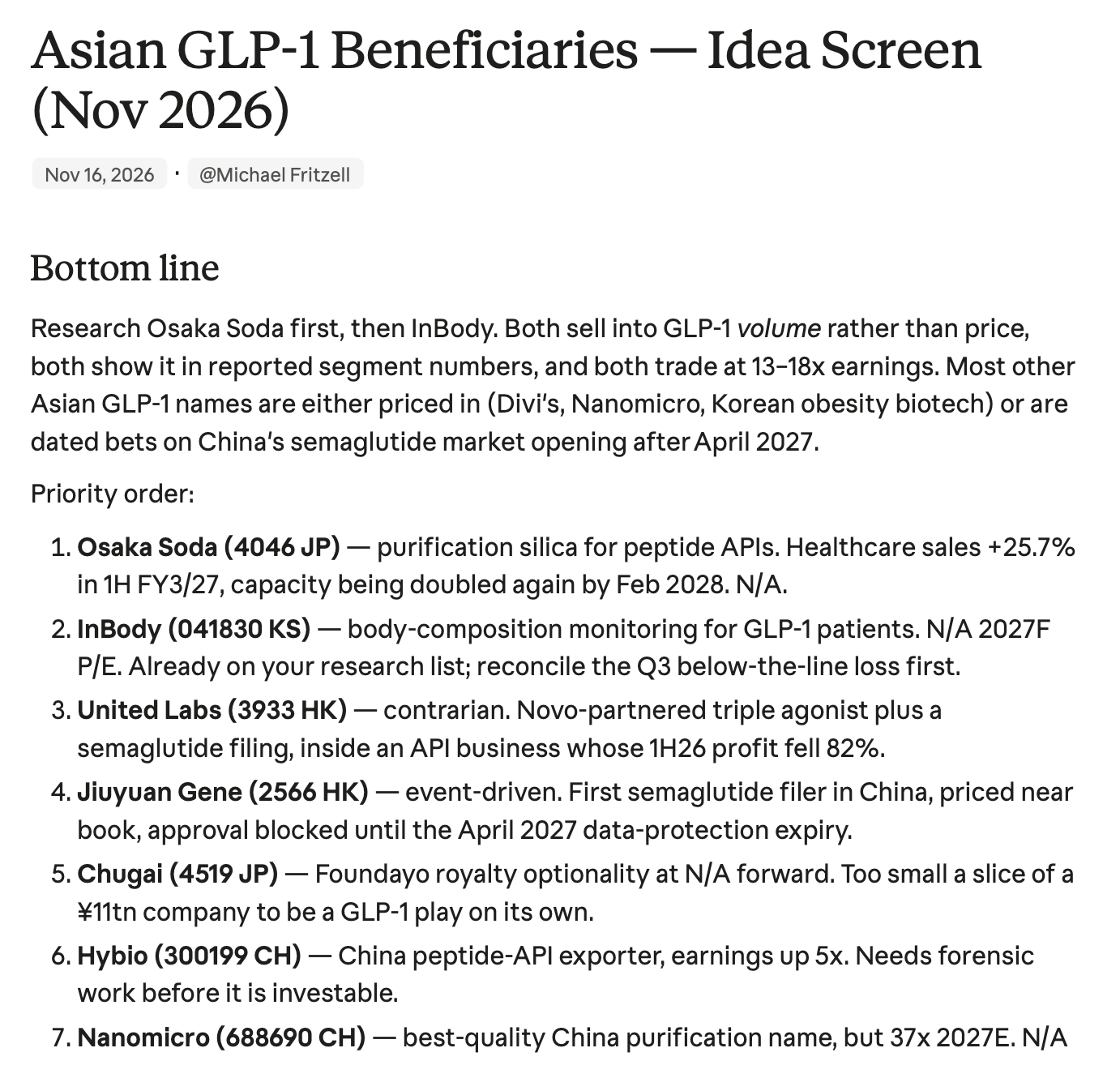
The names include InBody at spot number two, and Chinese pharma company United Labs, which coincidentally had a large insider buy in July.
In the report, Claude argues that GLP-1 volumes are likely to rise, so it suggests a picks-and-shovels approach. But it also warns of potential pricing pressure, as we’ve seen in India.
You can download the full GLP-1 screen here:
I think this is an excellent way to unearth new ideas. Of the seven names, five are completely new to me. So I much prefer this type of screen to a quantitative one.
Be aware that the data comes from regular web searches. So if you want higher-quality output, connect Claude to existing paid data sources such as FactSet, LSEG, Capital IQ, etc. To connect these, you may need to install Claude’s financial analysis plugin as well.
2. Initiation Report
Next, we’ll try Claude’s initiate command for initiation reports.
Its initiation reports are typically 6,000 to 8,000 words and cover the company’s history, management team, products, industry, competitive landscape, and risks. It can also give you a financial model with a 5-year projection.
To create an initiation report, simply type in:
/initiate InBody (041830 KS)
I then click “Task 1” to tell Claude to create a report rather than a financial model.
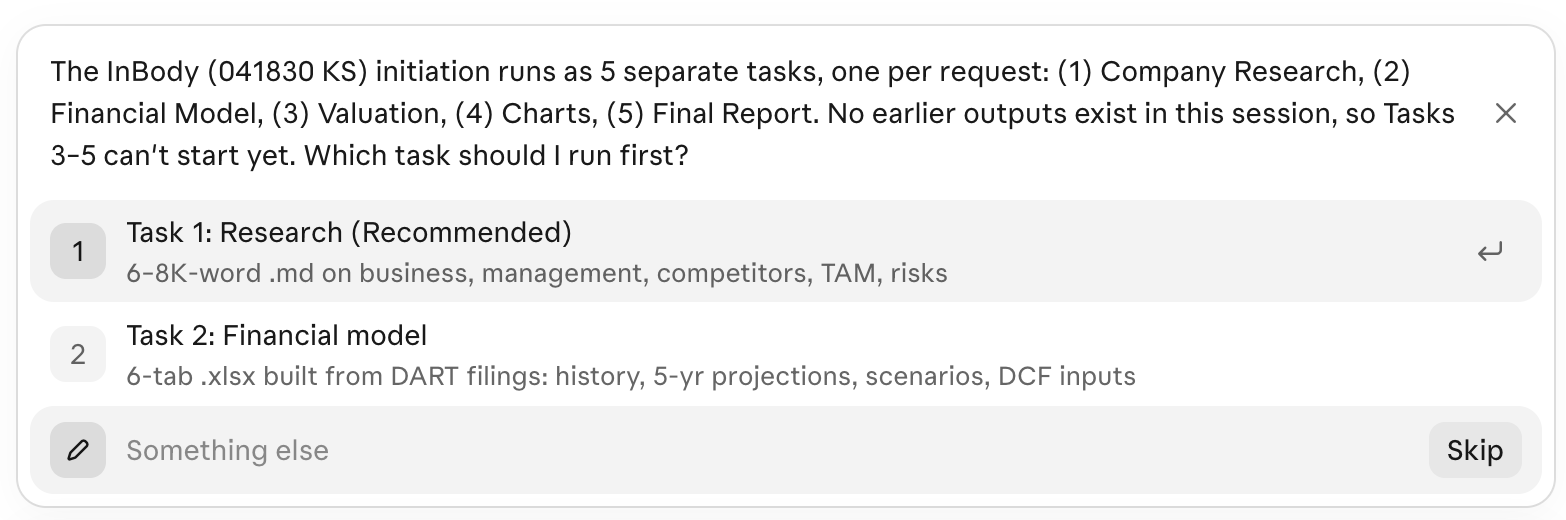
This is the output I then get: a 28-page report with a company overview, company history, and information on the management team, the company’s products, customers, the industry, competitors, and risks.
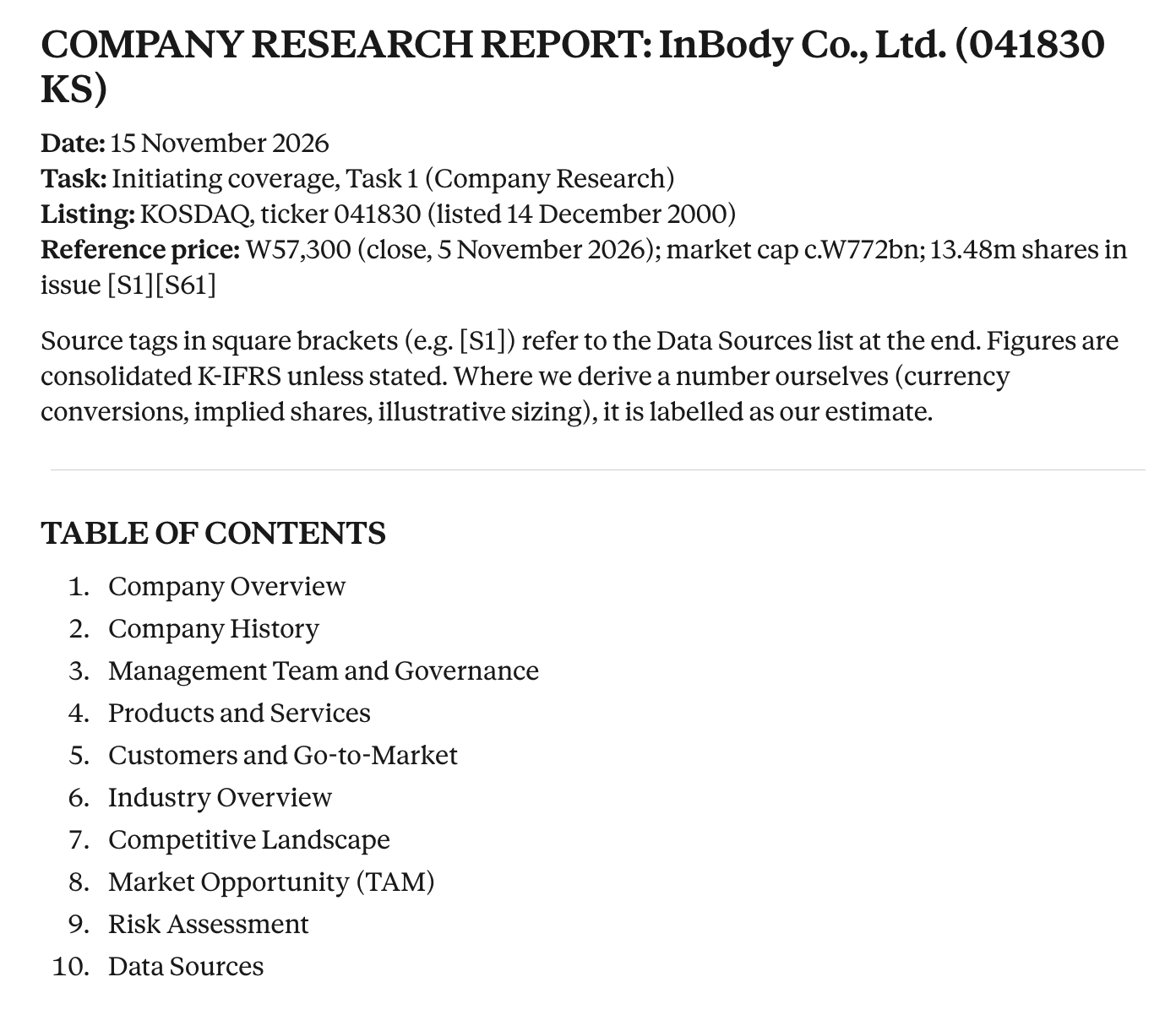
Beyond the basic report, you can also ask Claude to continue with:
Task 2 (financial model)
Task 3 (valuation)
Task 4 (charts); and
Task 5 (final report)
From the document, I learned that InBody dominates the market for body composition analyzers, which assess weight, muscle, visceral fat, and water levels. I also learned that the company is still run by its founder and chairman, Cha Ki-chul. As it expands in the US, revenue growth has accelerated to a double-digit level. At the same time, Claude points out that there’s new competition from Chinese companies undercutting it on price. But at the higher end of the market for body composition analyzers, InBody seems to be taking market share. The entire industry is also seeing a wave of new demand from GLP-1 patients trying to manage muscle loss.
The report is decent. What’s missing is an analysis of past stock price movements, ownership changes, and what the market might be getting wrong. It failed to mention Naver’s new 8.5% ownership. But it’s a good start.
3. Sector Report
You can also get Claude to generate a Sector Report. Just type
/sector
followed by the sector you’re interested in.
For example, I’m interested in the body composition analyzer industry. So to understand it better, I simply type:
/sector body composition analyzers
Here’s the report I’m then presented with:
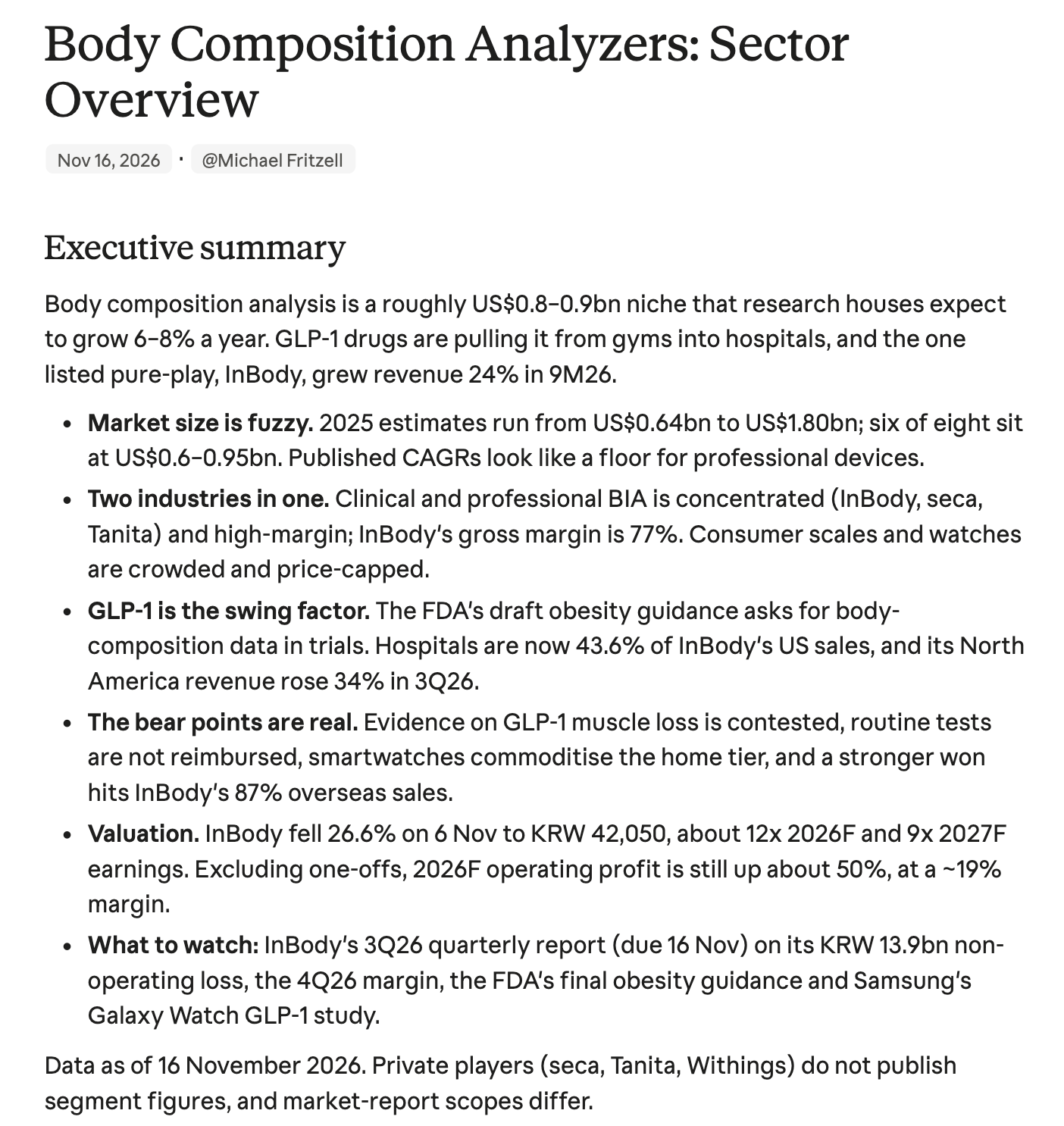
If you’re interested, you can download the full report here:
The report estimates how fast the industry is growing (about 6-10% per year), the different solutions competing for consumers’ attention, and the companies operating in the sector.
I find the report super useful, as it helps me understand each competitor’s strengths and whether InBody is at risk of commoditization. Claude’s answer: potentially, yes.
4. Model Update
Next, we’ll generate a financial Model for the stock.
Just type in:
/model-update InBody (041830 KS)
Since I haven’t created a model for InBody yet, I click “Build model now” when prompted, and then ask for an “Excel file” to be generated:
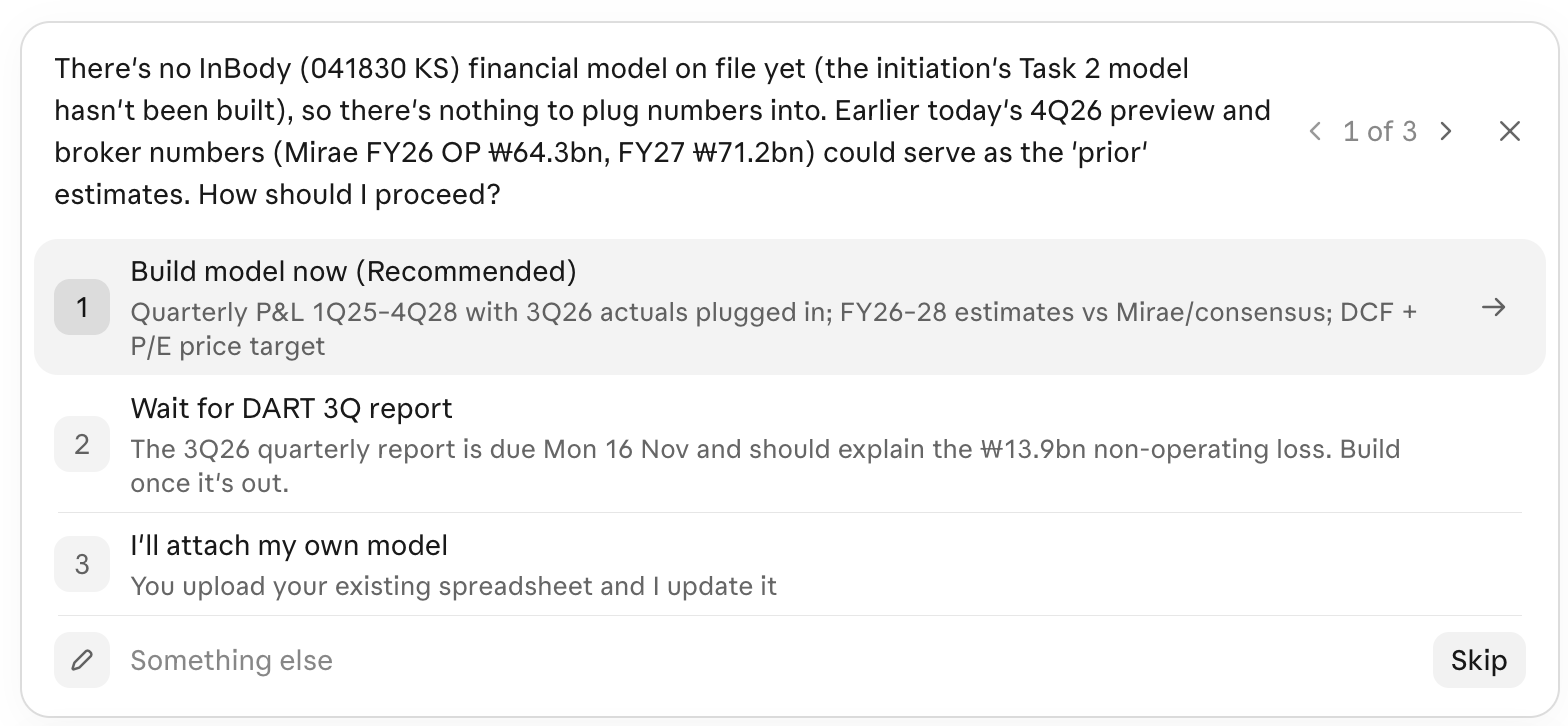
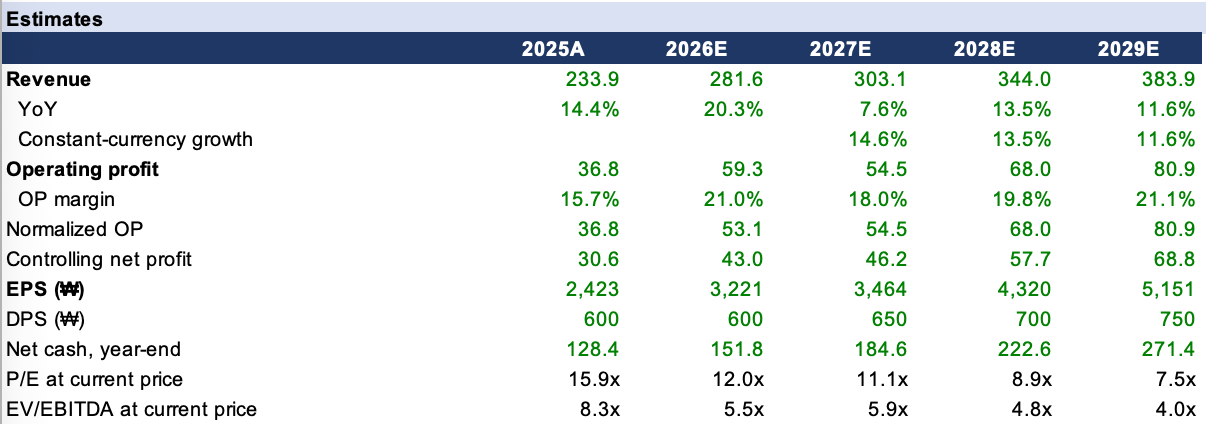
Here’s a screenshot from Claude’s financial model on InBody:
You can download the full model here:
Claude’s model assumes gross margin stays at 76%, which I find a bit aggressive given the risks of competition from Chinese brands. But if Claude’s 2029 earnings-per-share estimate is correct, InBody trades at a 7.5x P/E 2029e earnings.
So can Claude replace a financial analyst for modeling? To some extent, yes. It’s not a full 3-statement model, but it does project future earnings and future cash on the balance sheet.
The problem with Claude’s output is that its estimates are almost identical to those generated by the sell-side analysts that cover the stock. So if you want a variant view on a stock, Claude is unlikely to deliver.
5. Earnings
Claude’s Earnings command is a quick way to analyze a company’s latest earnings report. It collects data from public filings, earnings call transcripts, and consensus estimates.
To generate an earnings report, simply type:
/earnings InBody (041830 KS)
I then get the following output:
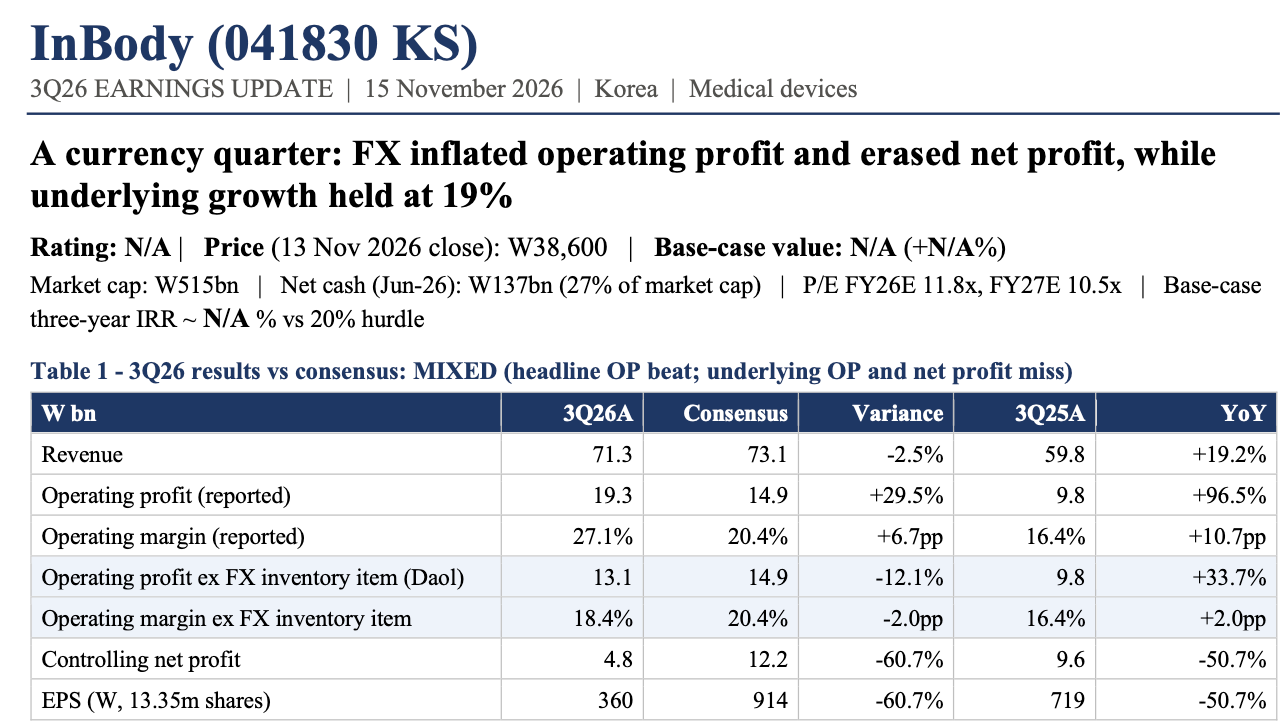
This report is about 3,000 to 5,000 words and includes a summary, an analysis of the results, a discussion of margins and guidance, what’s changed in the thesis, and, finally, a valuation with internal rate of return estimates.
You can download the report here:
I learned that the USD/KRW exchange rate is a key driver of InBody’s quarterly earnings. Furthermore, Claude projects 13% annual revenue growth for the next four years. It also expects a slight rebound in InBody’s margins. The P/E ratio is low, but the dividend payout ratio is minuscule, and its gift tax issues remain unresolved.
I find the reports a bit lengthy, but exhaustive. I’m sure many of you will find them useful.
6. Earnings Preview
The next command, Earnings Preview, helps you prepare for future earnings results. It gives you the reporting date, the consensus estimates, and what management said on the previous call.
To generate an earnings preview, simply type:
/earnings-preview InBody (041830 KS)
And then press Enter. You’re then presented with the following output:
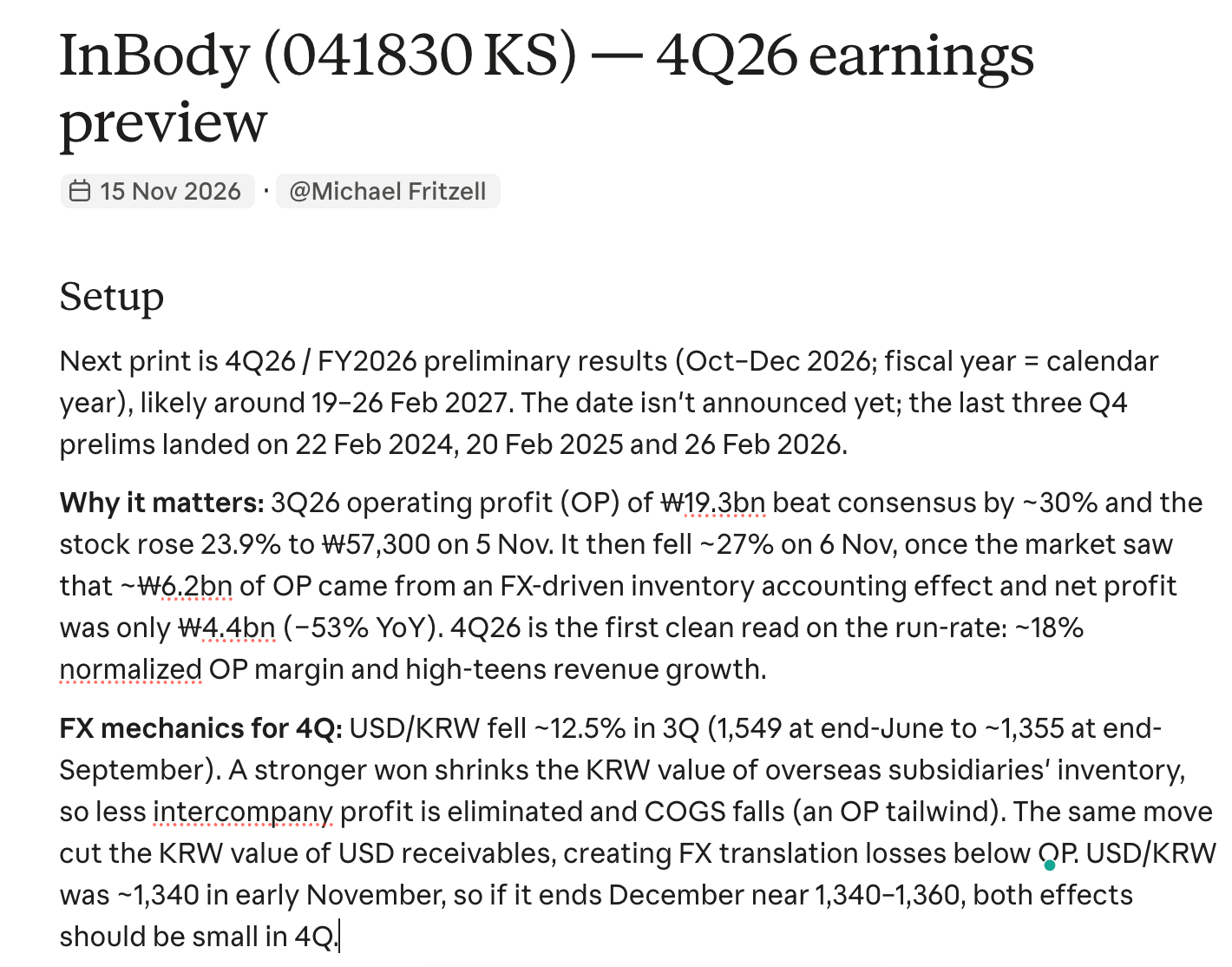
You can download the full report here:
In InBody’s case, it covers factors that will affect the next quarterly result, including the USD/KRW exchange rate. It covers what brokers are forecasting and what might happen to their earnings estimates. For example, many see future GLP-1 partnerships in China and the US hospital segment driving growth.
I personally don’t find these reports particularly helpful, because I don’t trade quarter-to-quarter. But pod shops or traders might find value in them.
7. Catalyst Calendar
Claude’s Catalyst Calendar generates a calendar of future events that are worth tracking.
You can give Claude a single ticker, or an entire portfolio. And specify whether you want it to include macro events or not.
In my case, I type:
/catalysts InBody (041830 KS)
I then get the following catalyst calendar:
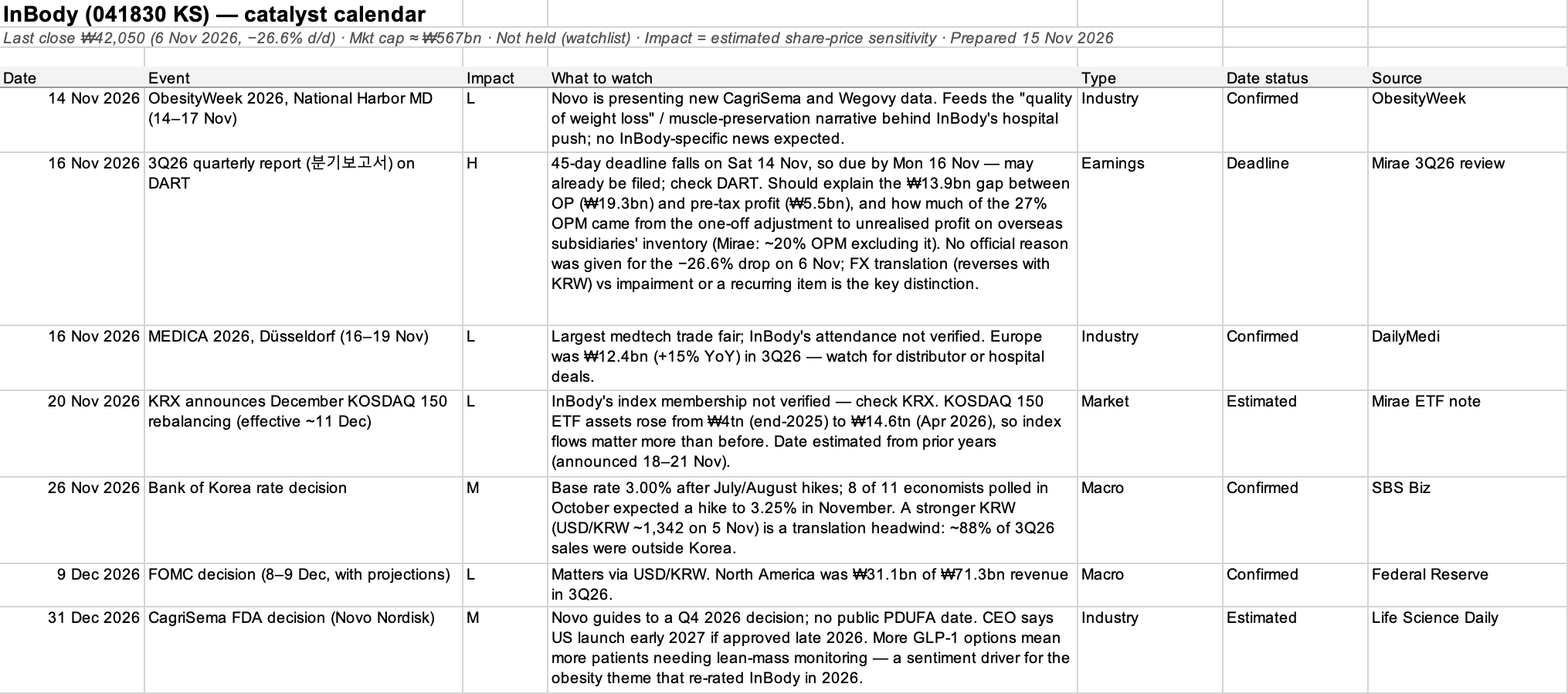
These events include the full 3Q2026 earnings (now out), future trade fairs, index rebalancing dates, Bank of Korea/Fed interest rate decisions, and a potential FDA approval of a new Novo Nordisk GLP-1 product.
You can download the full spreadsheet here:
For InBody, I didn’t find this catalyst calendar particularly helpful. But for other stocks, the catalyst calendar has given me great ideas on what to look out for over the next few quarters.
8. Thesis
The Thesis command gives you a tracking tool for a particular investment thesis.
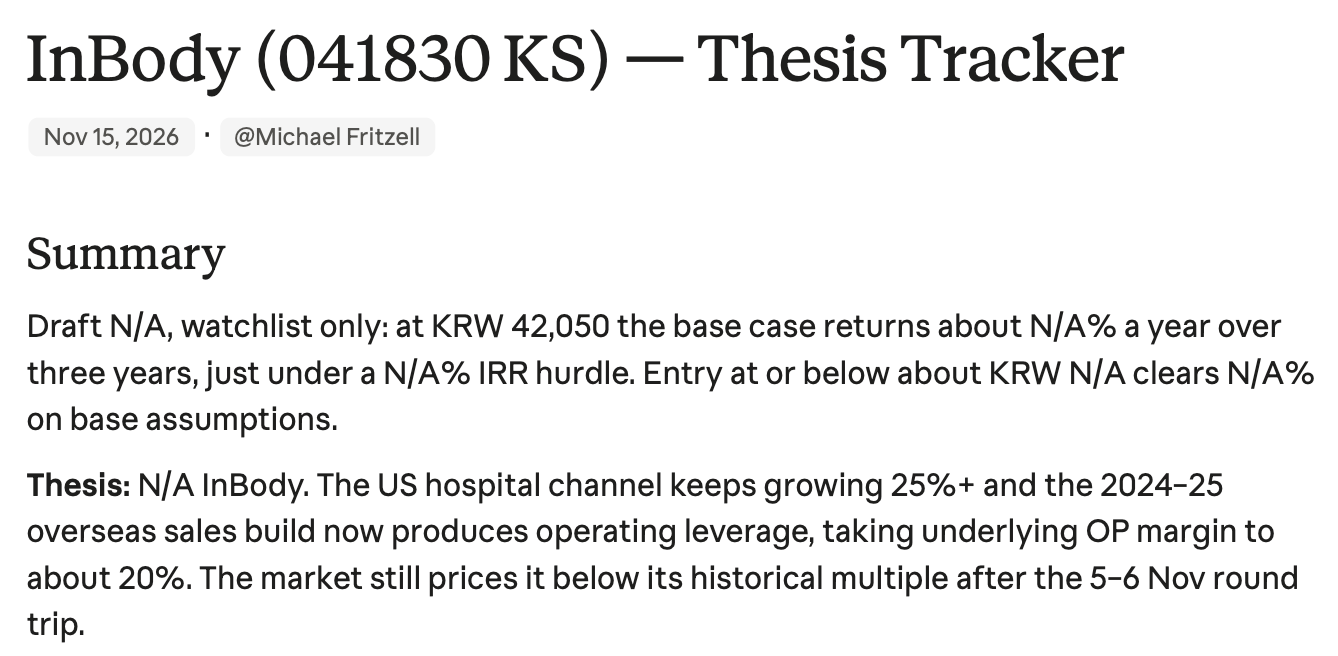
It gives you a recommendation (long/short), a 1-2 sentence thesis, 3-5 supporting points, and 3-5 risks, along with catalysts, a target price, and an exit trigger.
To generate a thesis tracker report, I type in the following:
/thesis InBody (041830 KS)
And then get the following output:
Download the full report here:
If you want to update the thesis at any given time, just write “update thesis for InBody (041830 KS): Q3 EPS KRW 12345”, or whatever the new information might be.
From this report, I learned that InBody’s US hospital channel is growing 25% annually and that its US business should now have operating leverage. Claude also argues that increased GLP-1 usage should lead to greater demand for body composition analyzers. Claude sees the Korean won, the costs of hiring additional expats in the US, corporate governance, and Chinese competition as key risks.
9. Morning Note
Finally, Claude has a Morning Note command that gives you a one-page daily note for a morning meeting.
To generate a note, I type in:
/morning-note
Claude then pulls together the latest news on all of my portfolio holdings. Here’s what the output looks like for me:
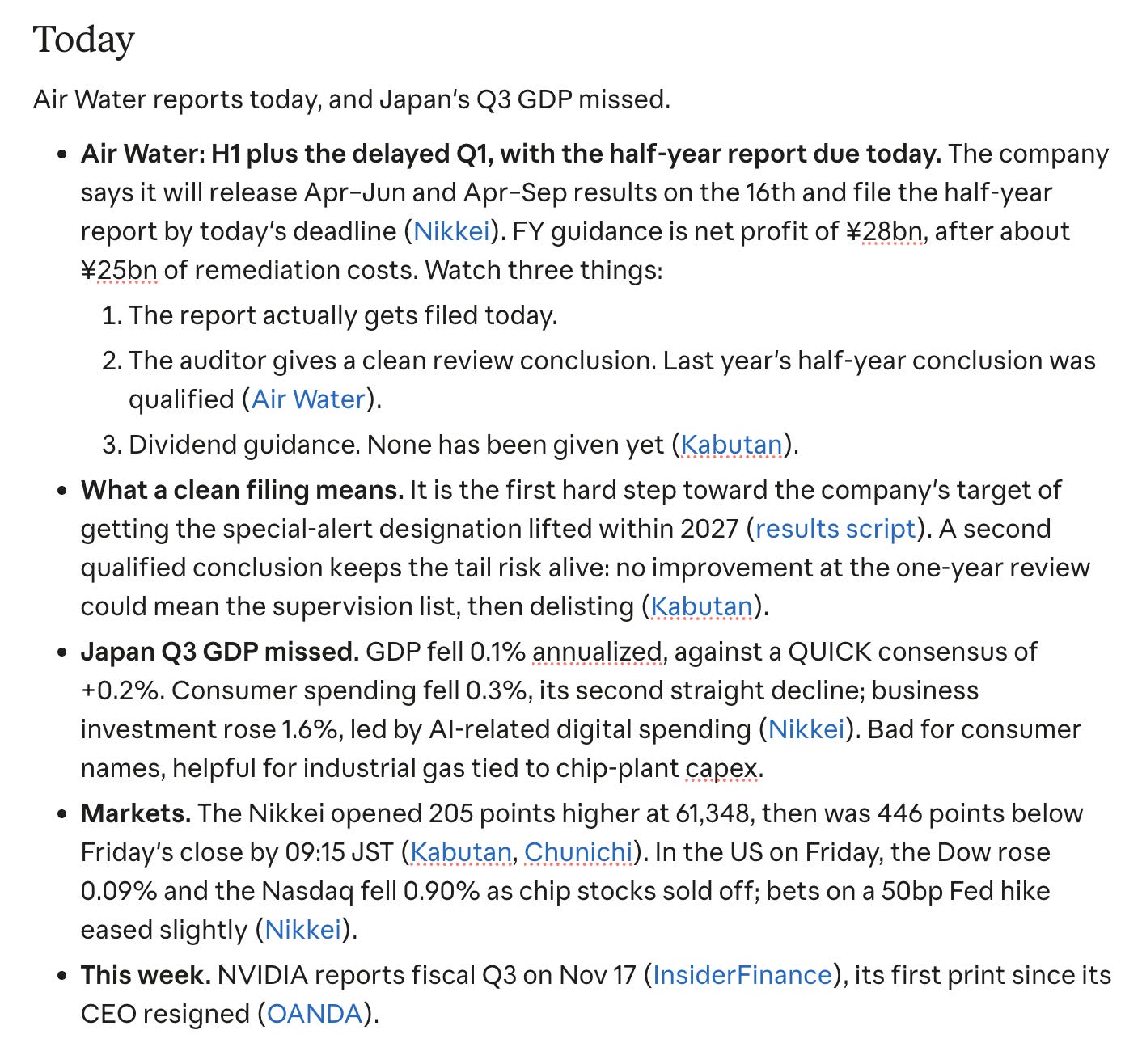
The note reminded me about Air Water’s earnings result. It also reminded me about Mercari’s first-quarter result, which sent the stock tanking.
10. Conclusion
Absolutely. All the grunt work that used to require an actual human — screening for new ideas, writing initiation reports, building financial models, writing morning notes — can now be replaced by Claude and tools like its new Equity Research plugin.
We’ll see how many analysts lose their jobs. I think it’s more likely that fewer analysts will be hired into the profession.
And the analysts who are employed will spend less time on grunt work and more time scanning for new ideas. They’ll then present these ideas to their portfolio managers, who are trying to manage an overflow of information from all sources.
I also believe Claude and other generative AI tools are empowering retail investors in a way never seen before. There are now hordes of retail investors who are just as informed – if not better-informed – than the fund managers they compete with. So there will now be thousands of analysts covering even the smallest stocks. Competition will certainly heat up.
Of Claude’s Equity Research skills, I was particularly impressed by the sector report, the thesis tracker, the catalyst calendar, and the screener. You’ll still need to question what you read and exercise judgment. But Claude can certainly replace much of what we humans have focused on over all these years.
How do you use Claude for research or investing? Let me know in the comment section below:
This article was originally posted here on November 18th, 2026 with some minor edits and additions. This article goes out to all my free readers at a later date.
Finally, learn more about Asian Century Stocks, the publication of our guest contributor today. Supporting other independent bloggers and analysts since 2022.
Addendum note on Agents in Banking
This is not banking advice but many to most Banks have blocked personal assistants, and for good reason. Like Meta’s Muse. I do not personally recommend giving any AI agent access to your bank account, e.g. using them for shopping activities yet. I know this is confusing for the shopping season, but the technology isn’t there yet.
Citibank, the third largest commercial bank in the United States, changed its terms of service this week, telling customers who use third-party AI tools for personal finance that anything that goes wrong is their problem — even if they get hacked. Be aware of the risks. Know the terms of your banks. This requires almost a warning statement.
AI agents, ranging from frontier lab models to purpose-built personal finance tools, can be given the credentials to your bank account and other online financial portals, with the idea that they can analyze spending and investment decisions, offer advice, and even handle transactions and bill payments.
At the current time when cybersecurity is not able to keep up with AI, this is not recommended. If financial institutions aren’t thrilled with the unreliable AI actors in their systems, and are telling customers that they won’t be held responsible for reversing an intentional or unintentional transaction made by automated assistants.
Anthropic’s approach is telling: The personal finance tool it launched earlier this month is explicitly billed as “read-only” and “can’t move, manage, or invest your money.” Beyond cybersecurity concerns, banks also view efforts to enter their franchise as a competitive threat so proceed with extreme caution of how you use AI with anything to do with your money, or investing decisions. These tools are extremely nascent, and you should experiment with them only on an ad-hoc and project basis as one tool in your human judgement and those of the professionals who serve your best interests.
For retail investors, analysts and DIY stock pickers, I still think AI and personal finance tools can be extremely valuable. While agentic AI in investing apps are in Beta, you should not rely upon them. For example, Robinhood launched native Agentic Trading and an official Model Context Protocol (MCP) server in mid-to-late 2026. However, there is a wide gap between an AI mechanically executing trades and an AI reliably generating alpha without blowing up an account. I’m not an expert but never allow AI to shop or invest for you, without human-in-the-loop safeguards to the max. Until this technology is fully fleshed out, which may take a while.
I’ll be diving more into Anthropic in future articles, on the IPO performance and the historic impact of this startup in AI in particular. Luckily the community on Subsack has no shortage of these analyses.