


Just a reminder I’ll be working on my Emerging Tech Investments Newsletter a lot more in 2026 to discover speculative high-growth and buy the dip opportunities. The cadence of that Newsletter should increase in the weeks and months ahead. There I’m exploring themes like Neo Clouds, Space-tech, micro cap AI related names, Quantum computing SPACs and more.
Good Morning,
This is going to be a long report with a lot of infographics and context.
Analyzing Friday jobs data, nonfarm payrolls fell by 92,000 in February, according to the Bureau of Labor Statistics, far below consensus expectations of roughly 50,000. It was the third time in five months that the economy lost jobs in the U.S. Outside of Healthcare jobs, there’s really not much growth at all with low hiring. We are in a “jobless” growth economy, with K-shaped characteristics.
With the U.S. putting the breaks on immigration and Tech companies doing agentic AI pilots, more layoffs in the Tech sector are highly likely. Oracle needs to shed at least 30,000 jobs due to the debt they have taken on for OpenAI’s compute facilities. Even as OpenAI’s Stargate facility won’t be expanding any time soon.
A Low Hire Economy with Grave Consumer sentiment
Hiring is down 20% lower compared to the pre-pandemic baseline of 2019 according to Karin Kimbrough of LinkedIn, their head economist.
People are staying unemployed for 7 months on average.
AI is Lowering Entry Hiring in the Most Exposed Professions
Anthropic economists say they have developed a new way to track how AI will upend the workforce.
Their economists Maxim Massenkoff and Peter McCrory are selling a pre-IPO pitch, that exposed knowledge workers could be more impacted by the technology that Anthropic building. As Alberto Romero has pointed out, they are pulling old data and making some huge rationalizations. The likes of Anthropic and OpenAI say the red will inevitably fill the blue. But how likely is that really?

According to Anthropic, AI is far from reaching its theoretical capability: actual coverage remains a fraction of what’s feasible. Occupations with higher observed exposure are projected by the BLS (Bureau of Labor Statistics) to grow less through 2034.
While the circle graph went viral on social media, the bar graph is an easier way to visualize this:
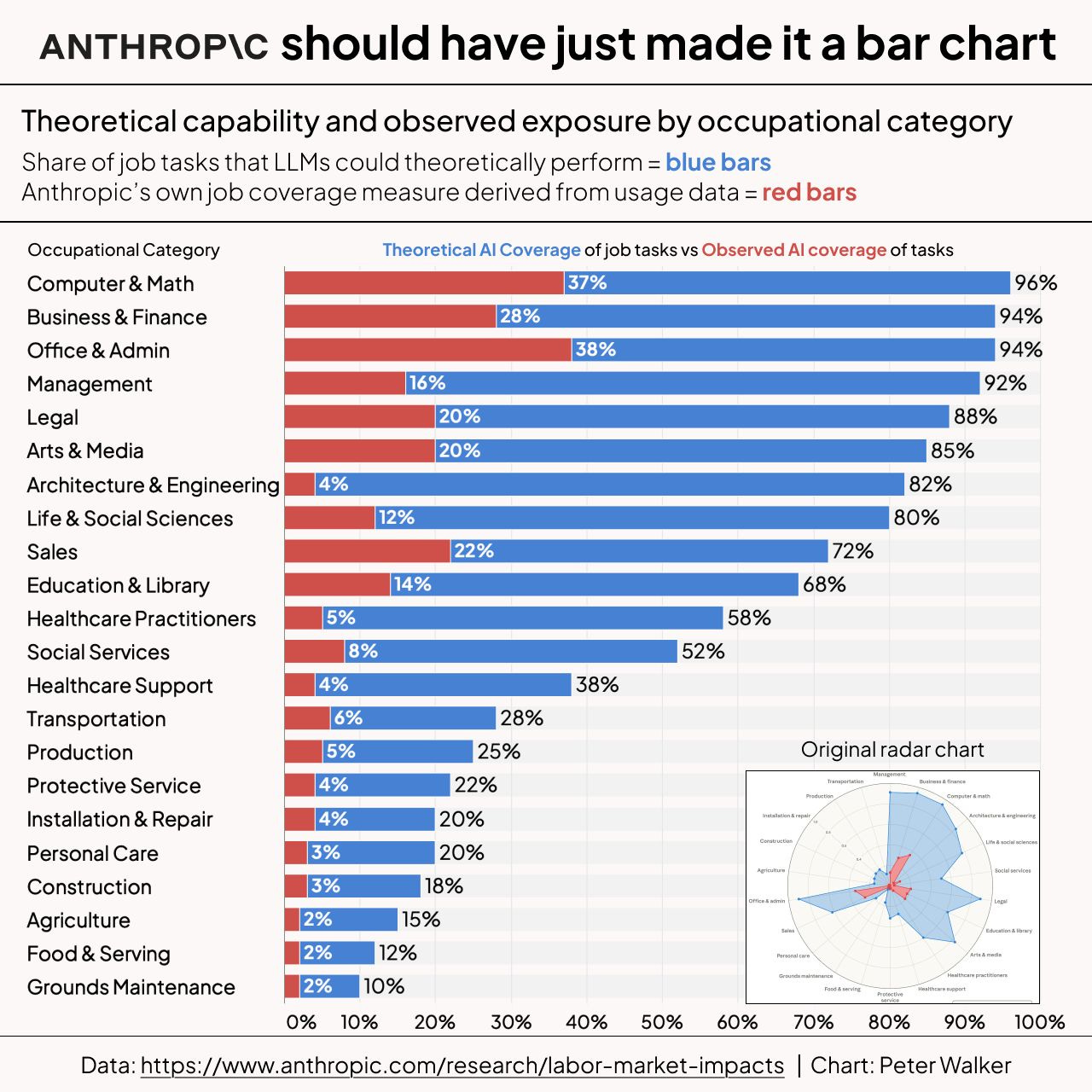
Outside of coding, and some aspects of administration and finance, Generative AI doesn’t seem very capable of automating tasks in most areas of knowledge work. The deeper problem appears to be that the tech is not a meaningful job creator or increasing productivity outside of a few roles even in technology companies. While massive layoffs are not occuring, some redesigning of jobs internally at tech companies have been noted. Less managers, more hybrid roles, more product managers and designers doing vibe-working on the job.
Hiring slowed in January, 2026 significantly with U.S. hiring falling 3.3% from December and is down 5.7% compared to January 2025. - source. Hiring in 2025 was already anemic.
Generative AI does not appear to be a Job Creator
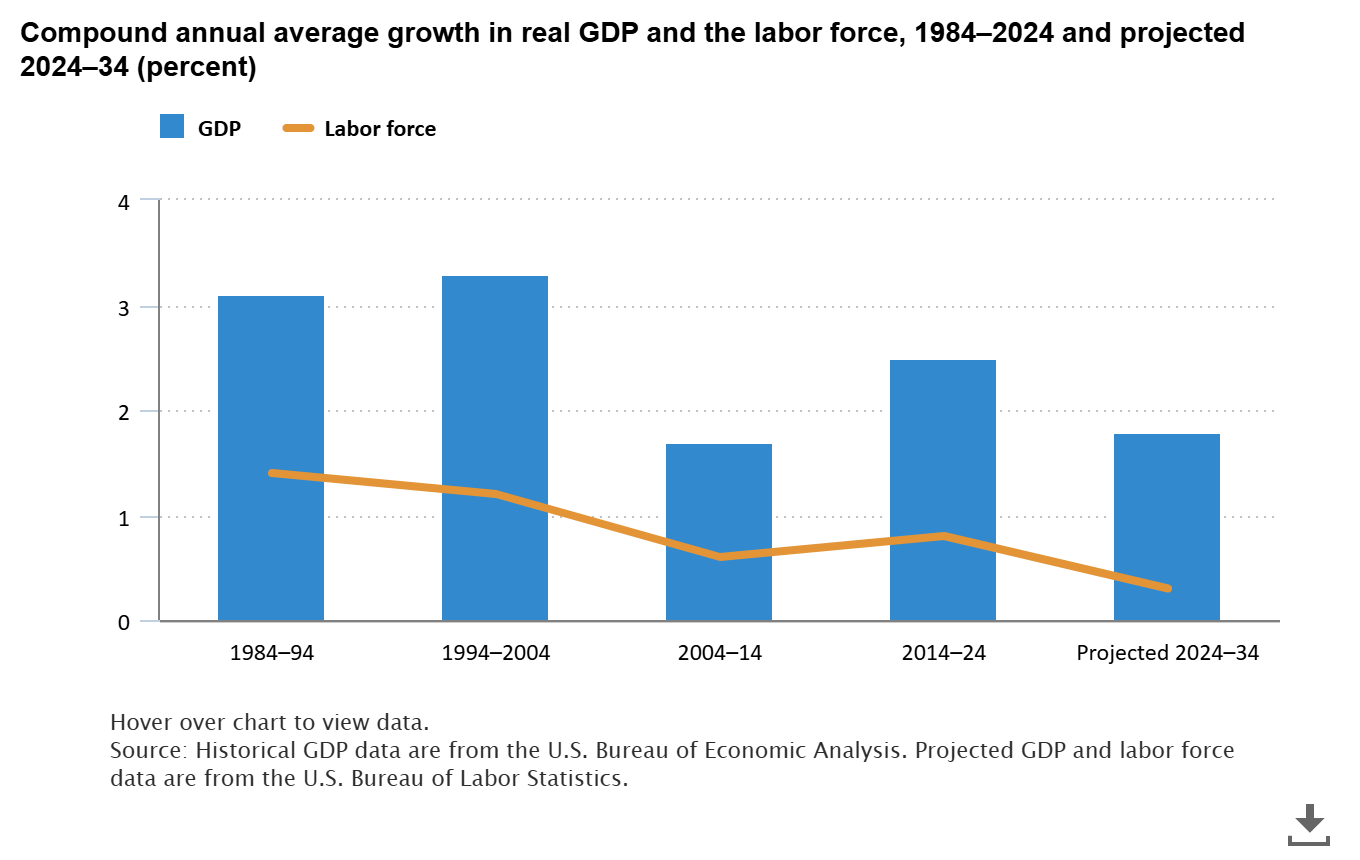
The GDP gains of the investments going to datacenter, inference and compute campuses and building isn’t being spread equally in the U.S. economy. The low-hire labor environment has other issues as well.
Monthly U.S. Job Creation is Nearly Non-Existent outside of Healthcare in 2025 & 2026
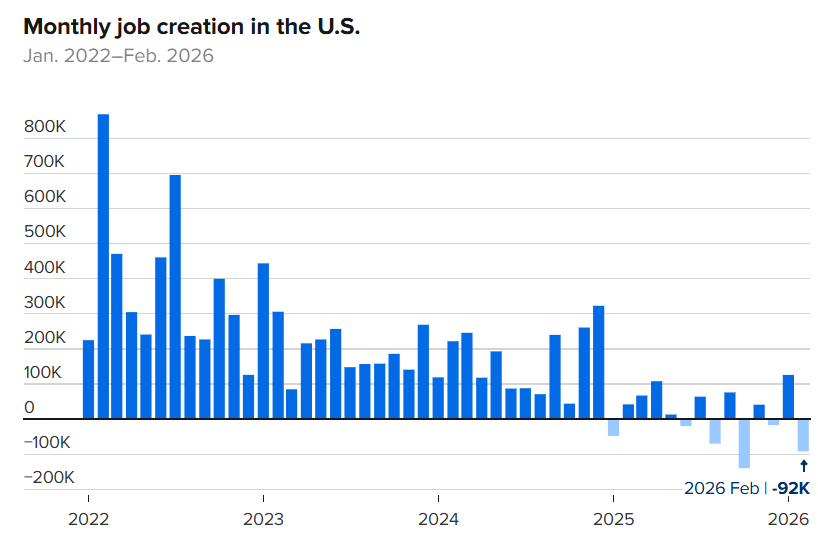
Healthcare is the main driver of new jobs created in 2026.
Cognitive displacement, labor talent and youth deskilling (College) and “cognitive surrender” are now AI risks are that are moderate to high in such an environment.
A broader measure of unemployment that includes discouraged workers and those holding part-time positions for economic reasons moved lower, to 7.9% or 0.2 percentage point below the January level. Where the 4.4% unemployment rate is deceptive, compared to the low-hire environment job seekers are facing.
Then there is the AI pressure on hiring. Young people have reason to be more nihilistic or discouraged with regards to the current U.S. labor market trends.
