

🎧 Audio version (or download audio for later):
Good Morning,
Dermot McGrath is an Irish entrepreneur and advisor based in Shanghai with over a decade in China. He recently founded a research and strategy advisory firm focused on AI, robotics, energy and advanced manufacturing.
ZenGen Labs Newsletter
Dermot and his team report on the ground in Shanghai and beyond, on how technology actually gets identified, built, and scaled.

Recent Articles by the author
From Turbines to Tokens
Space as a Service: China's Alternative to the SpaceX Model
Building Trust at Grid Scale
The Printer Maker That Built a World Model
For more deep dives like this, consider supporting AI Supremacy and our numerous guest contributors. We’ve lowered our subscription price for a limited time.
Consider sharing this article if you know someone interested in the future of Physical AI, robotics, embodied AI and China’s role in its future.
The State of Chinese Physical AI
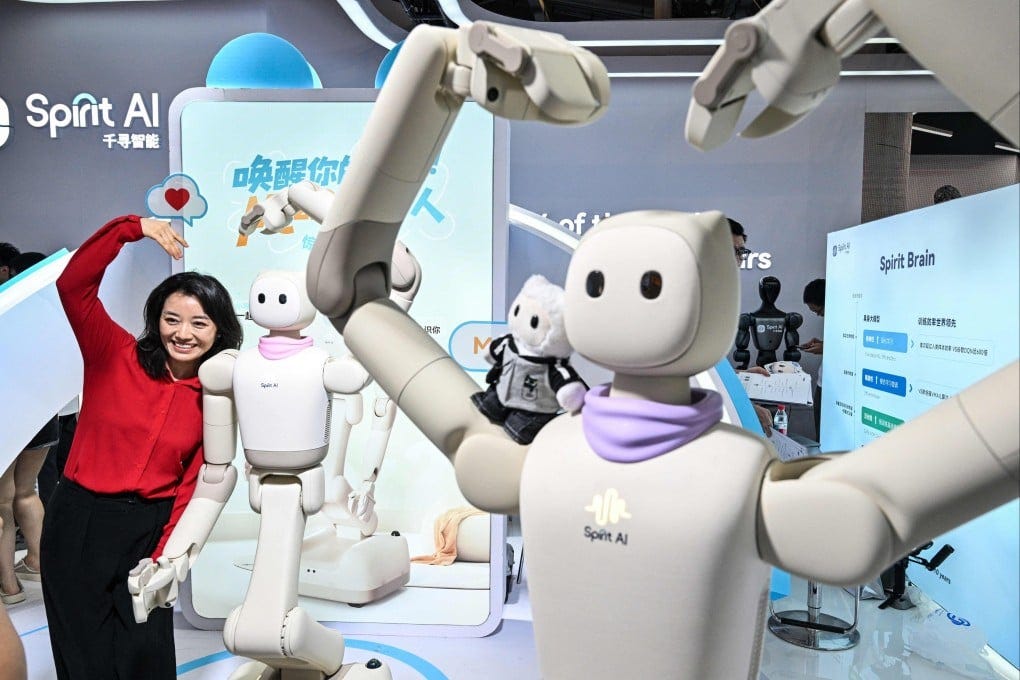
Five years ago a humanoid robot was a clumsy research tool that cost about the same as a new house. Today, for the price of a used car, you can order a humanoid that does kung fu and parkour, from a company in Hangzhou. That company is called Unitree (宇树) and it went public on the Shanghai stock exchange in August 2026 at a valuation of $50 billion.
Morgan Stanley estimates that by 2050 there could be more than 1 billion humanoids on the planet deployed in a range of scenarios including: * running the night shift in factories * stocking the shelves of your local supermarket * running warehouse fulfillment * cooking, cleaning and looking after the elderly at home.
To get anywhere near that future, someone has to build these bots. If current trends continue, most of them will be built in China.
Humanoids are one part of a much larger field now known as physical AI. These machines can perceive what is happening around them, reason about what to do, then act, all in the physical world. It spans self-driving vehicles, industrial robots, drones, quadrupeds, dexterous robotic hands, as well as the AI models that control them and the data systems used to train them. The Chinese term for this industry is 具身智能 (”embodied intelligence”, also called “embodied AI”).
China already leads in many of these fields. It is the world’s largest market for industrial robots, and DJI leads the global commercial-drone market, according to market research firm IMARC. China now operates the world’s largest combined robotaxi fleet, spread across companies including Baidu (百度), Pony.ai and WeRide. Crucially, its factories produce many of the motors, sensors, batteries, and precision components these machines rely on.
Humanoids get most attention, and most of the capital, because they make the loftiest promises. A robotaxi is built to drive, an industrial arm to perform tasks at a workstation. A humanoid, however, promises a general-purpose machine that can move from the factory floor to the warehouse, the shop and the home, carrying bricks, threading needles and everything in between.
But it takes more than just brawn. Despite the promise of a machine that can do almost any job, most humanoids still rely on human remote control or preset programs, according to Chinese technology publication TMTPost.
The companies that make them are raising obscene amounts of money anyway.
Half a century ago China was among the poorest countries on earth. Today its companies ship more humanoid robots than the rest of the world combined, supply many of the components other robot makers need, and are spending billions to teach these machines to think.
In this piece, we will examine how we got here, the current state of play from the body to the brain, where the money is going and what the future may hold.
First, how did China get so good at building these machines?
The Workshop of the World
When Deng Xiaoping, then China’s leader, began opening China in 1978, the path out of poverty was well trodden: industrialize. Leverage abundant labor and low-cost land to build factories and make the things the world needed. It had nearly a billion people and a long coastline where factories could ship to the world. Over the following decades it attracted foreign companies and accumulated infrastructure, manufacturing capacity and supply chains at extraordinary scale.

