


Good Morning
I don’t usually nerd out on non-LLM machine learning announcements. But extraordinary claims have been made. I hope you are in a curious mood.
Now that agent swarm consumer products like Meta’s Muse are going mainstream, we are on the cusp of models that will make machine to machine (M2M) processing and communications faster and more efficient. In my humble opinion that in a nutshell is what Jev is.
So what is this Jev AI exactly?
Jev has gone Semi-Viral as new kind of Model
About a week ago on September 15th a former OpenAI employee, Diogo Almeida, announced Jev:

Jev: A Probabilistic Classifier with a Manifesto
Jev is a classifier that generalizes very well. Almeida is credited with being one of the co-inventors of reinforcement learning from human feedback (RLHF) and thus a co-inventor of some of what which became ChatGPT. Jev has potentially the ability to make some aspects of agentic AI more cost efficient while it gets its name, Jev, after Jevons paradox.
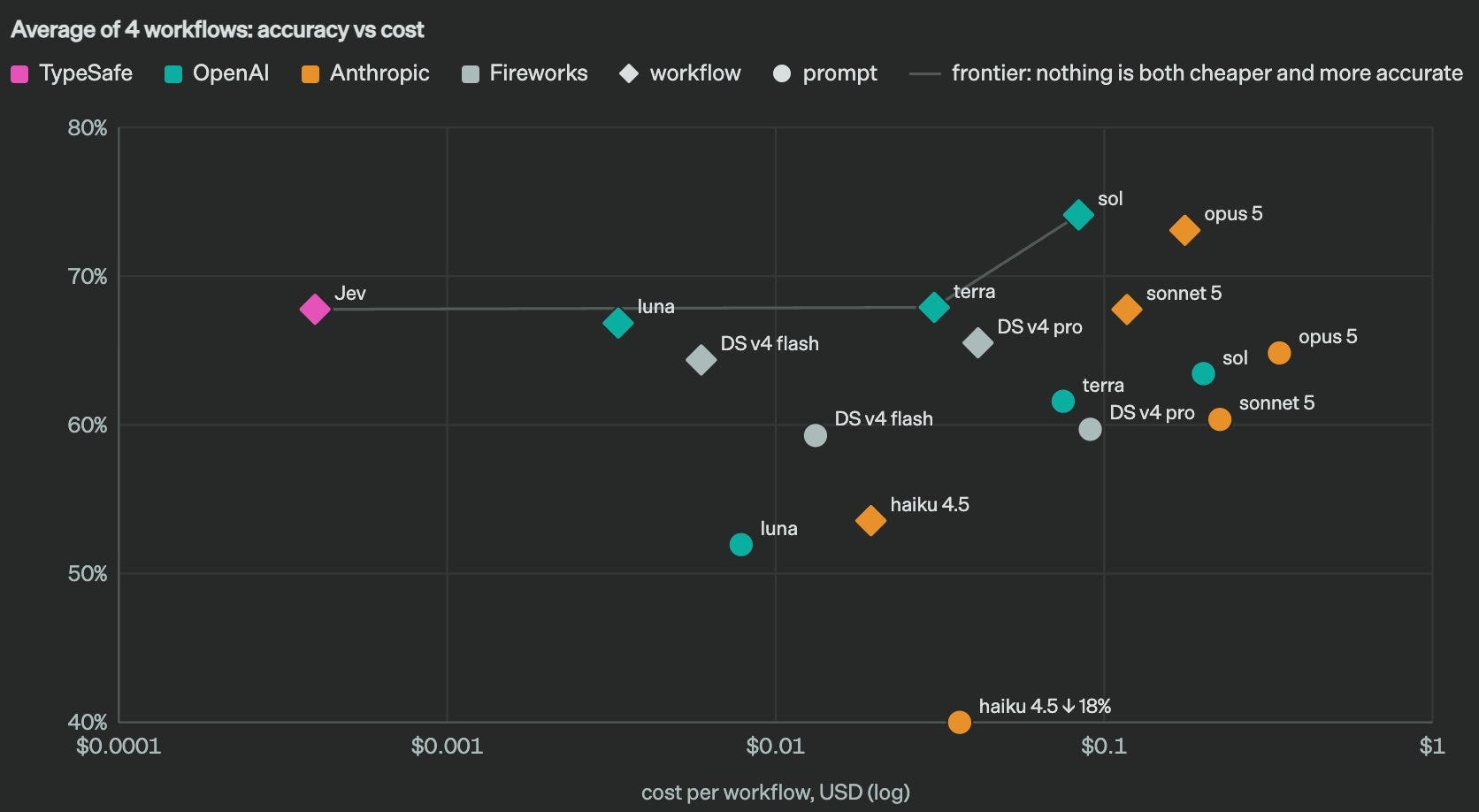
We still know very little about Jev's internal architecture, training setup, and model size. TypeSafe.ai have raised $40 million Seed and built a product called Jev that is an AI model built for fast, structured decisions rather than open-ended text generation. So you feed it state + typed questions (Choice, Score, or yes/no), and it returns calibrated decisions in 70–500 ms at almost zero cost ($0.042/M input tokens). You can read their manifesto here.
System-1 Might be useful for Agentic AI
Jev is Typesafe AI's new System-1 model that skips token-by-token generation for instant decisions and the internet the past week have found all kinds of use cases for the technology. According to Nicolas Bustamante what we might be witnessing in AI is - err, well, a textbook example of Clayton Christensen’s Innovator’s Dilemma playing out in AI. We are at that weird stage where the market is commoditizing the bottom of the ML market: think classifiers, routers, scoring and context triage. So is Jev viral AI non-sense or something useful? I think that remains to be seen.
Almeida left OpenAI two years ago to start TypeSafe AI and release a transformer based model that is not an LLM that produces probabilistic calibrated decisions. That is, Jev is what Typesafe calls a “System 1” model: it outputs decisions directly, as probabilities and confidence scores, rather than autoregressively predicting the next token. It’s certainly making debate about advances in classifiers sound more sexy.
It’s a model that is garnering significant interest from developers. That is, Jev appears most useful for software automation. It might turn out that consensus among software developers will see it as a cheaper and more robust way to incorporate intelligence into their code. In a world where agentic swarms are using more and more of the total demand for inference compute, that kind of makes sense. This a generalist model that might be useful for swarms of agents to become even faster and less costly.
Almeida claims Jev is built for the decisions inside software. Now Jev has been released in early access and its stimulating the open-source community. Typesafe’s selling point is that Jev is up to 100 times faster and 100 times cheaper than conventional LLMs for certain tasks.

The Era of Hundreds of Auxiliary Specialized kinds of Models is Coming
In today’s world developers can embed Jev in products for high-volume, low-latency decisions such as classifying/routing support tickets, scoring leads or content, safety/flagging checks, verification steps, agent routing, or other “if-statement–like” logic inside automated pipelines with likely hundreds of potential use cases that have at least some business value. Jev is a sign of things to come in probabilistic AI and one one of the many new kinds of (often open-source) models that can make products better.
In an AI boom it’s interesting what becomes a potential product. Classification, scoring, routing, and intent detection are not new machine learning problems. What TypeSafe AI is doing differently is building a model specifically around these kinds of typed, probabilistic decisions, rather than taking a general-purpose LLM and prompting it to behave like a classifier.
Typesafe AI claims that at $42 per billion input tokens and free output, intelligence becomes a resource accessible to all.
A week after launch, Jev has already been added by popular model gateway platforms such as Vercel, Cloudflare, LangChain, and Langfuse to their stacks. Jev is like a weird viral decision-making AI in September, 2026 and yesterday they announced that Jev is now available to everyone, without a waitlist, with access starting at $5 in credits, equivalent to roughly 120 million tokens. This is not a sponsor, but you can create your account here. Jev is also anticipated to be useful in agentic AI tasks like model routing.

Jev can use Far Less Tokens than Incumbent LLMs for some Tasks
Jev is very similar in spirit to zero-shot classification and seem to be able to do things a bit better and a lot more cheaply. I’m super interested in how Jev could make agentic AI faster, smarter and more efficient. In that fundamentally Jev is an AI model optimized for “machine-consumable decisions” rather than human-readable conversation and therefore likely better positioned as infrastructure for software rather than a chatbot/LLM. Jev is closer to the essence of what machine learning is but powered by the transformer architecture and perhaps made more powerful in an era where LLMs are so prominent.
Jev is described as non-autoregressive and might be based off of the work or related to the work of others. This work was done previously in part by Nandakishor Mukkunnoth and which he explains in a LinkedIn post. There have also in the past week been many spin-off versions of Jev that have gone open-source or been announced. He also shared his story on Hacker News here. Jev doesn’t reduce hallincations per se but delegates them to the user in a sense. Anything that reduces token usage is bound to go viral more easily in the current climate of AI compute.
TypeSafe AI has re-designed zero shot classification substantially since the time it was popular (2019-20) and added multiple structured decisions, probabilities, parallel inference, and a new calibration-focused training approach all in terms that are fairly familiar for NLP engineers. Six years later saying it’s a new kind of model isn’t 100% correct, but it’s certainly re-packaged in ways that are relevant to the era of Agentic AI and the challenges developers and product managers face.
Jev Reminds us that LLMs are not all We Need
TypeSafe AI attributes Jev's efficiency to its specialized architecture, parallel sampler, and calibration-focused training. It’s a generalized model for much narrower tasks designed to make structured decisions directly and in parallel. Immediately it can help AI agents decide which tool to call next and whether to retry the task, by answering those questions in under half a second for $0.042 per million input tokens. Output is free. It makes you wonder how in the near future different kinds of transformer models will combine, complement and improve what LLMs are capable of doing today. What will the decisions trees and probability matrices of the future even look like? Jev really unlocks the imagination of what will become possible.
“You can break a workflow into individual judgments, run them in parallel, and combine them however you want.”
Jev is an architecture is optimized specifically for fast, structured decision-making and will radically reduce the cost of some layers of the product for developers all over the world. Think about what that means? Jev could arrive just at the time to become an important part of the decision-making layer underneath a growing ecosystem of AI agents.
The model is named after William Stanley Jevons, the 19th-century economist whose eponymous paradox describes how the falling cost of a commodity can lead to it being used more and more. Jevons paradox has indeed been that whisper witty water-cooler response moment on repeat all during the AI boom.
Models such as Meta's facebook/bart-large-mnli have long been used for lightweight zero-shot classification. But the developer tool kits keep getting refined.
“The problem is we are optimising for human language. We have been super good at human language for four years, but it’s not useful for automation because computers speak a different language.” - Diego Almeida, TypeSafe AI
Jev is most likely built upon an open-weight LLM, i.e. most likely a Chinese model. Almeida says Jev is trained exclusively on synthetic data using a technique he calls “reinforcement learning from calibrated decisions.” TypeSafe AI reports Jev at around 68% (accuracy) on its own workflow evaluation - which is to say we have no idea how accurate these results are on real-world tasks. Jev’s general accuracy is very much now being debated and time will tell.
News Models are Boosting what Developers can do
I think Jev is super interesting especially for developers who are builders working on real-time systems, games, agent loops, or anything that currently avoids LLMs because of latency or cost. I’ve seen an impressive amount of use cases online in just the past week being mentioned.

RLCD stands for Reinforcement Learning for Calibrated Decisions, the training method TypeSafe AI says it developed for Jev. In essence this makes classifiers more useful. Think about it RLDC here refers to training methods in which a computer program not only learns to make good decisions, but also to realistically assess how confident it is in doing so. The goal is a system whose self-confidence matches its actual hit rate.
A standard RL agent might assign a 98% probability or preference to an action that only succeeds 60% of the time. Here they are trying to correct this and for narrower tasks it could make sense. If Jev’s accuracy and confidence improves it could end up being a rather useful model. The online speculation around Jev’s architecture (this blog by Archer Hume) is also fairly fascinating.
“What I like about Jev: for years, large generalist models sucked almost all the oxygen out of AI.
But there are huge opportunities in much more specialized and customized models, built for specific tasks and languages and as a result, orders of magnitude cheaper, faster and more optimized. There are 3 million of them publicly available on HF” - Co-Founder of Hugging Face.
I believe Jev is just a beginning for new kinds of non-LLM models that are made for more specialized workflows, tasks and use cases. Many of these specialized models are trained on open-weight Chinese models and you can see how open-source AI is stimulating complementary machine learning and models to complement and make up for some of the limitations intrinsic to language based models, or LLMS.
Not only are LLMs compounding with compute but more specialized models are doing important work in industry domains where LLMs are not optimized to solve their key domain problems.
Meta’s Muse has better First Two Weeks than ChatGPT?
According to Apptopia, Muse’s app on mobile devices has been downloaded more times during its first 12 days on the market than ChatGPT was in the 12 days after its debut. This is with regards to where Muse is now available, in the U.S. and Canada.
In this subset of the data, Muse has now seen 1.8 million downloads to ChatGPT’s 1.3 million.
Overall, Muse has seen 2.8 million total installs globally in its first 12 days.
App Figures made the calculation before that Muse had overtaken ChatGPT as the most viral new AI product in history (see chart below). Apptopia’s data also indicates that Muse’s U.S. daily active users are now higher than they were for ChatGPT at the same point after its launch.
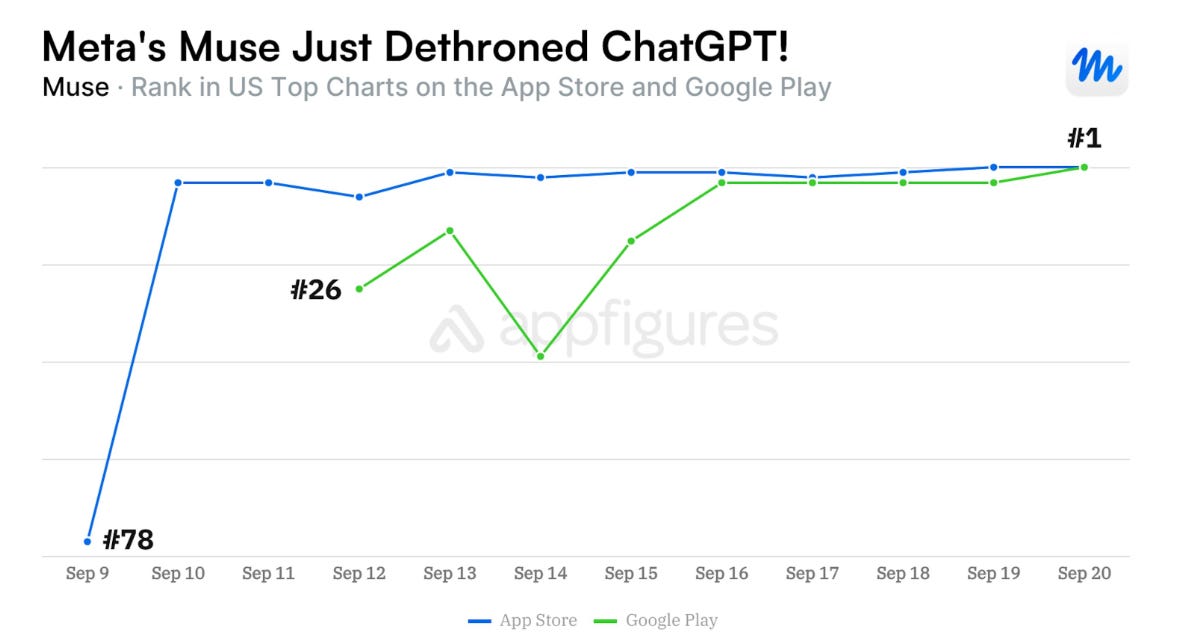
To be fair we have to note that Muse is available across both iOS and Android, while ChatGPT launched on iOS only at the very beginning. Meta also has multiple apps with billions of users (to upsell Muse) and a larger marketing spend available to them.
Conflicted reports on X about the Jev Announcement

Thread about Potential New Use Cases for Jev

Will Jev survive as a Real Product?

Pre GPT ML Engineers are Confused

The Usual Copy-Cat Cadence from a Viral Announcement

Jev asked us to think differently about Old Problems

Confidence scores for business development outreach?


On Using AI as a Tool

Could this unlock AI on the Edge and on Mobile?

Jev can Generate the Best Option

Could Jev Accelerate Automated Advertising?

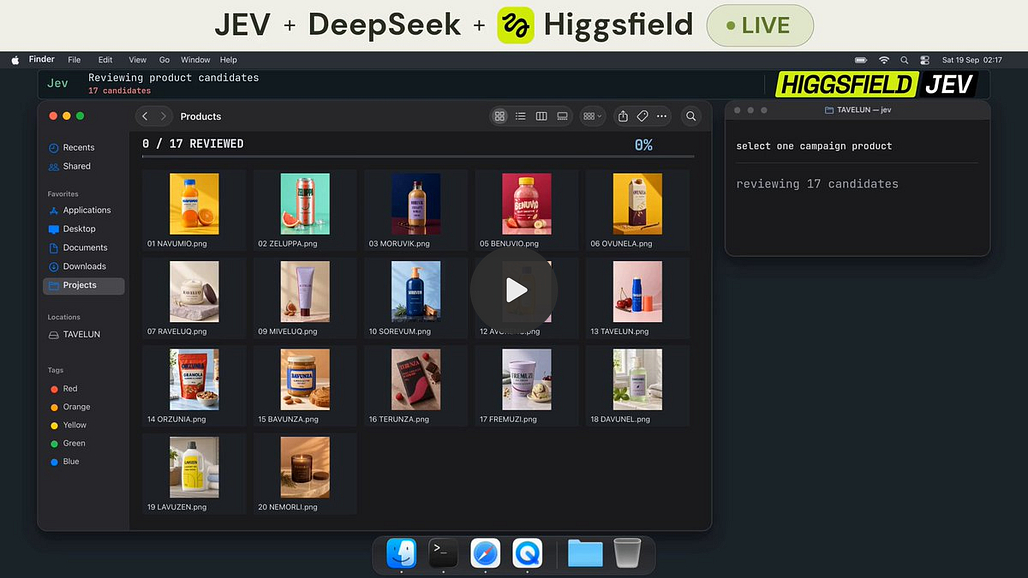
How about HR and Recruiting?


Could Jev accelerate Computer Use and take it to the next level?


How about Design?


And classifying Research papers?


As of today September 22nd, Typesafe AI’s Jev has basically been overwhelmed with signups, they’ve literally had to pause them. Suffice to say it was a successful launch so far.
