


Good Morning
Recently with the Anthropic push back against the U.S. DoD (“Department of War”) issue, a group of quantum scientists have independently published a manifesto rejecting the use of quantum research for military purposes and is seeking signatures from researchers around the world. Read the manifesto. You want to talk about emerging technology? The worlds of National defense, Generative AI, Geopolitics, Robotics Innovation (including things like space-tech & drone swarms) and Quantum computing are quickly converging.
Quantum computing is still in its nascent emerging beginnings. But it’s slowly becoming a field worth following with potential major intersections with AI, hybrid quantum chips, and very specialized accelerators for very narrow tasks related to scientific frontiers like chemistry, new materials, battery tech, cybersecurity and national defense capabilities, among others.
The Three Core Pillars of Quantum
The three rapidly (Q3) emerging pillars of Quantum technology and quantum computing broadly are as I see them are quantum computing, quantum communication, and quantum sensing that could together generate up to $97 billion in revenue worldwide by 2035. This could be around $200 Bn. by 2040.
Quantum Computing
Quantum Communication
Quantum Sensing
I’ve always considered Quantum computing a wild card in how AI Supremacy plays out. I’ve been covering Quantum computing startups, fundraising and the industry for years on my Quantum Foundry Newsletter. When we finally are able to have real machines with millions of qubits (far from today’s reality), it will vastly opens up new possibilities for computing. It’s going to be a journey to get there.
Quantum computing will lend aspects of parallelism that could radically augment AI. Even in terms of Quantum machine learning at the intersection of LLMs, if you think about it, thanks to superposition, a quantum computer can evaluate millions of model parameters simultaneously rather than sequentially. Companies like Nvidia have released NVQLink (a so-called "Rosetta Stone" of hybrid computing), which allows GPUs and quantum processors to communicate with microsecond latency. This hybrid hardware will evolve considerably in the next decade.
A Period of R&D could lead to a Quantum Acceleration period
Classical AI struggles with high-dimensional data and our future AI systems will have access to new emerging computing architectures and paradigms. QML or Quantum machine learning is a new frontier where hard engineering and hybrid utility are evolving steadily in the 2020s. Just as we have frontier labs and AI startups to use AI to design our own chips, so will we will one day I predict also have this for Quantum computers, new kinds of hybrid chips and entirely new computing paradigms. This is not well understood by those in AI, Venture Capitalists or even National tech policy think tanks today. The way Quantum and AI evolves together will enable an altered future that is highly uncertain. Quantum computing even in its infancy is today impacting finance, cybersecurity, advanced materials, battery tech, biotechnology, drug development, logistics & supply chains, among many others.
Qubit Modalities and Quantum Hybrid-Chips
Qubit types are still evolving rapidly although a real breakthrough in Quantum remains elusive. Some say that Neutral atoms (using laser-cooled atoms like Rubidium or Cesium) are arguably the most promising for massive scaling in the next 2-3 years. Meanwhile watch the R&D Nvidia is doing with TSMC. TSMC are owning the infrastructure that are attempting to create a Quantum Bridge. TSMC R&D means TSMC is producing the specialized Nvidia Quantum-X and Spectrum-X photonics switches using their leading-edge nodes (3nm and 2nm) for advanced quantum nodes.
More Quantum Companies going to the Public Market
With yet another Quantum startup going public this February in the SPAC of Infleqtion (ticker INFQ 0.00%↑), investor awareness about Quantum computing will only continue to grow. Quantum, like AI (Anthropic vs. Department of War), is thus becoming a National Defense technology of considerable importance. In cybersecurity, communications and sensing with ramifications in space-technology as well. Also in predicting certain outcomes in high-powered simulations.
I asked Brian Lenahan for his take on where the Quantum computing industry is at, so our AI readers can catch up and be current. Brian writes:

Just as National Defense spending increase for space-tech, some of that might also boost Quantum startups. This is because things like cybersecurity and Quantum sensing have mission-critical implications. The most serious Quantum startup I’m waiting for to go public is Quantinuum. Meanwhile on January 14, 2026, its majority owner, Honeywell, announced that Quantinuum has filed a confidential draft registration statement (Form S-1) with the SEC for an Initial Public Offering (IPO). In Quantum, Europe is not seen as a laggard like it is in scaling major Tech companies and AI, but as a pivotal player. It makes the whole space rather interesting to watch.
Quantum Companies and Qubit Modalites to Watch 2026-2030
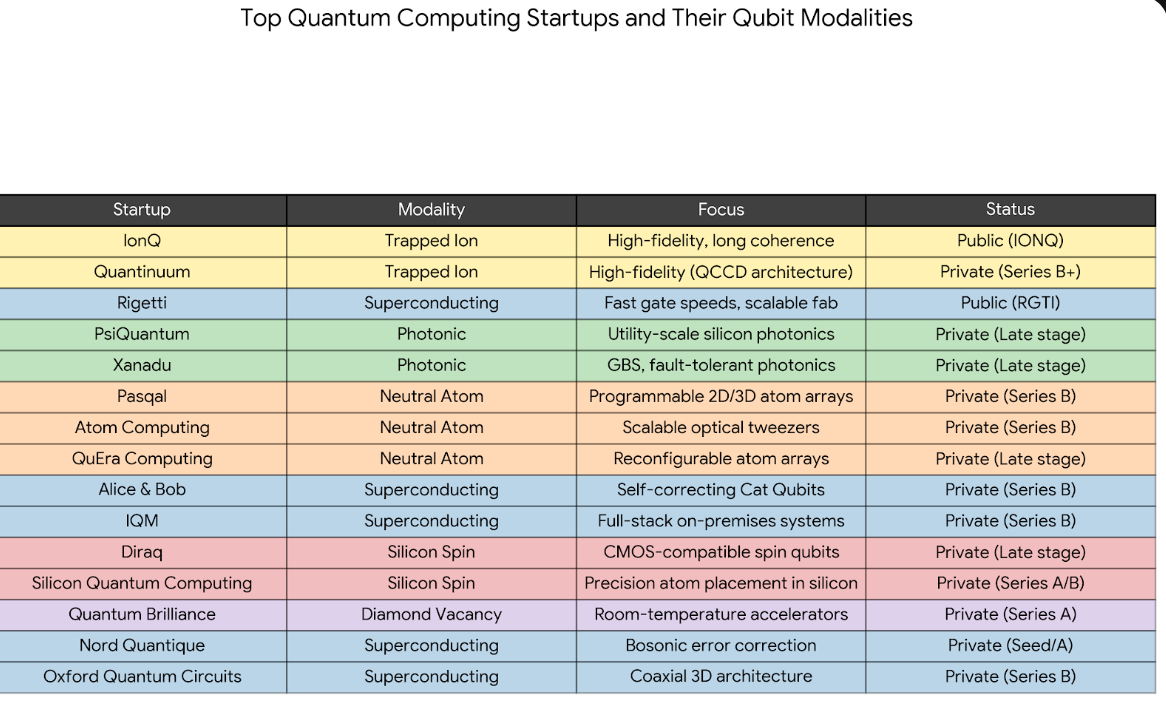
The Venture Capital scene behind Quantum is fairly interesting, as are the areas where China is competitive or even ahead. There’s certainly been some moonshots in Quantum startups, but the future is still fairly uncertain. Government funding of the Quantum industry for National Defense is also a huge driver as well as the impact from huge corporate sponsors.
Most Well Funded Quantum Companies 2026
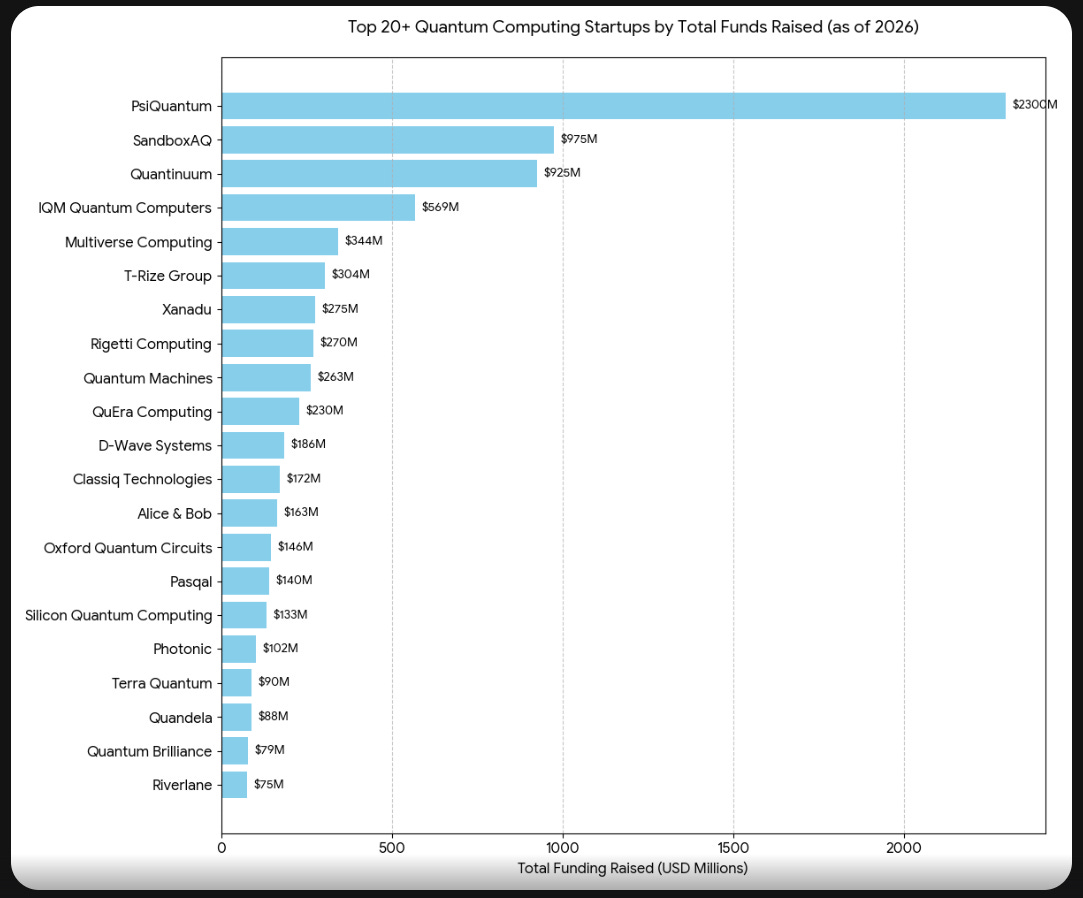
Some of the leaders in terms of funds raised in recent years are:
Quantinuum
Xanadu going public
On January 28th, 2026 Xanadu based in Canada also took steps to begin the process of going public. When Quantinuum and Xanadu go public, they together with IonQ IONQ 0.00%↑ will represent the most promising first three Quantum companies on public markets. This will also mark a period where BigTech will allocate more capex in Quantum and making more strategic acquisitions.
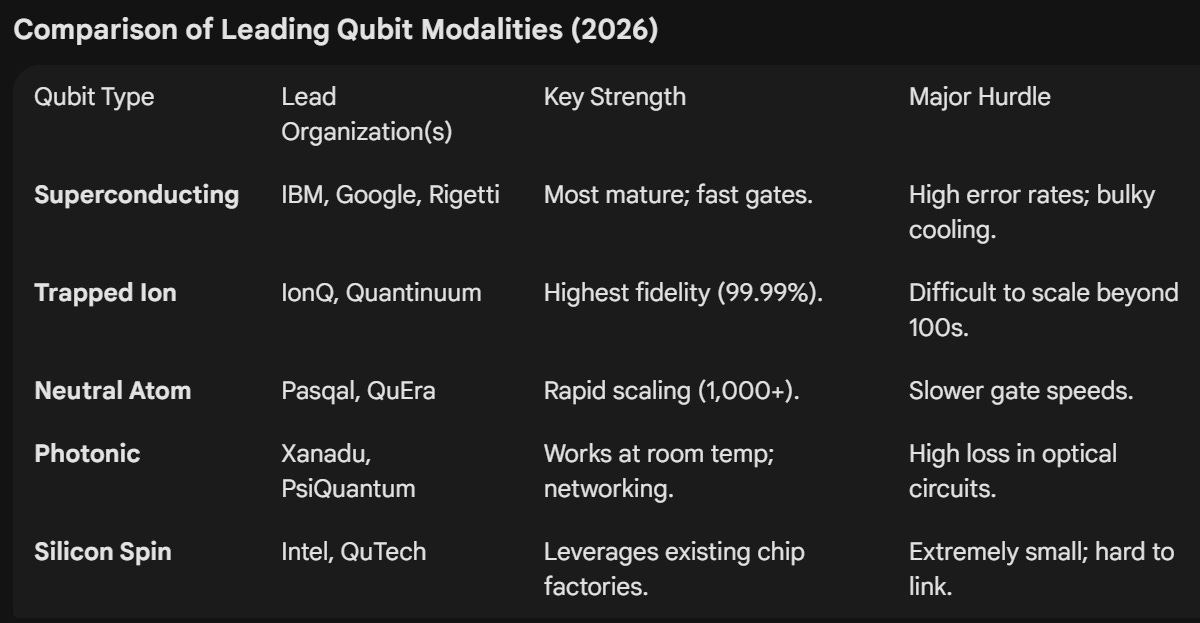
Quantum Modalities
A brief overview:
Topological Qubits
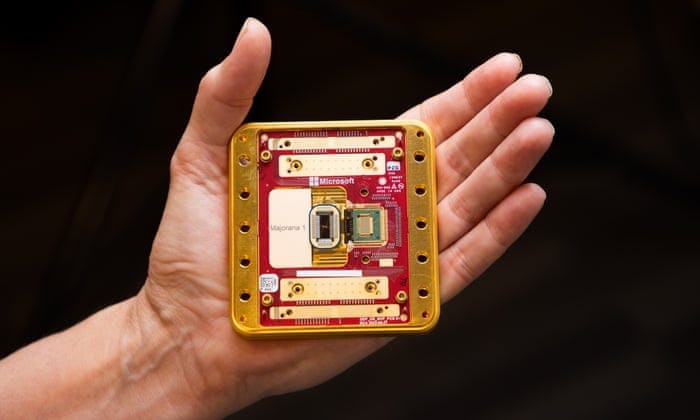
Microsoft has also been working hard on a Modality that is a Moonshot where in brief they are trying to build Topological Qubits using Majorana quasiparticles.
Best Funded Quantum Startups
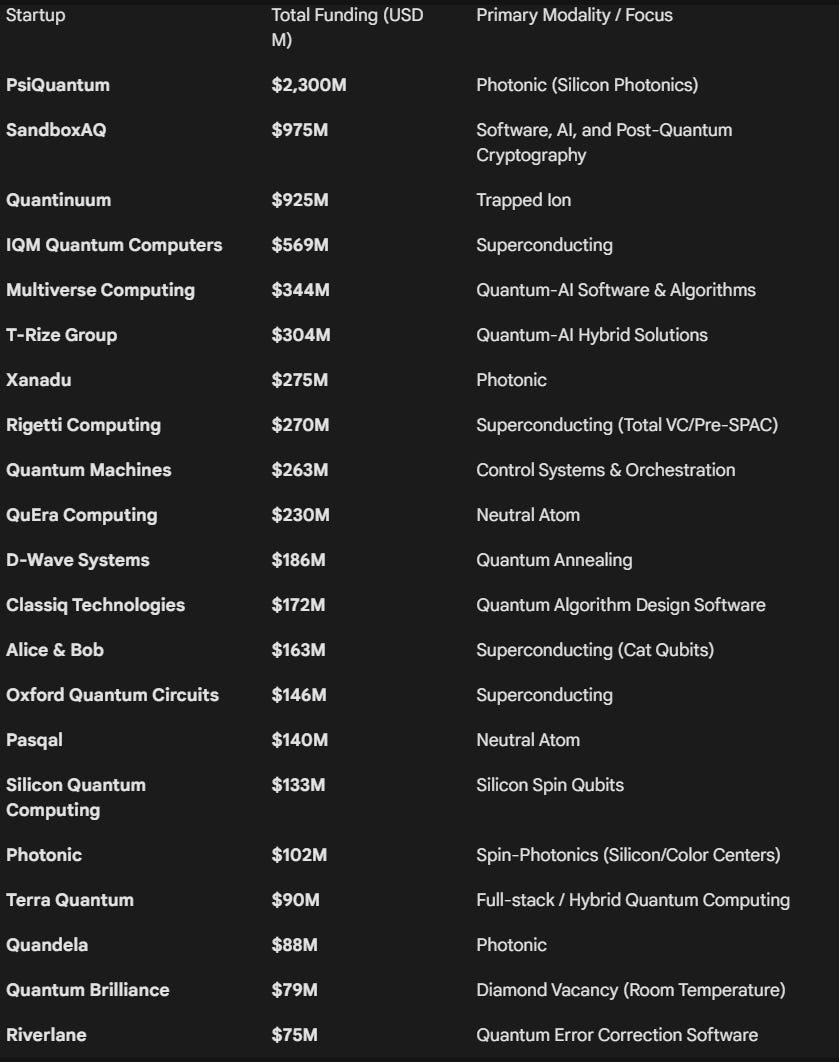
Not all Quantum modalities of qubit approaches have a valid or scalable future. Right now the Neutral Atom and Trapped Ion approaches seem dominant. But that could change.
The State of Quantum: Brian Lenahan
Brian is the founder and chair of the Quantum Strategy Institute (QSI), a collaboration of quantum experts and enthusiasts from around the globe enabling business to understand the technology, its potential and its practical applications.
He’s a Quantum author, strategic analyst and expert I’ve been following for years. He’s a consultant, mentor, think tank leader, workshop facilitator, as well as a 3x Amazon Bestselling author, public speaker and business leader in the space. He has a Quantum strategy for business course here. One of his most reviewed books was called Quantum Boost (2021). If you are curious about the history of Quantum computing read this one (2023).

Where are we today in 2026 in Quantum?
By Brian Lenahan of Quantum Business Newsletter.
In late 2024, I sat down with the quantum leadership team at Microsoft’s Seattle campus along with a group of industry analysts and participated in a compelling focus group followed by a lab tour. The previous year, I had walked through the D-Wave quantum lab in Burnaby, BC to see a quantum computer or “fridge” up close. In Boston, I toured the QuEra lab which includes a lego version of their quantum computer. In fact, I’ve watched the evolution of quantum computing with a mix of cautious optimism and relentless scrutiny as a former bank executive who focuses squarely on results.
So, I have been somewhat amazed and thrilled about 2025. 2025 stands out as the year the field decisively shifted from “promising lab demos” to “credible paths toward practical utility.” Designated by the United Nations as the International Year of Quantum Science and Technology, the recognition amplified global attention, inspired billions of dollars in investment, and research breakthroughs.
What is Quantum Computing?
If you’re an AI enthusiast, think of quantum computing as the next leap beyond classical GPUs and TPUs (Tensor Processing Units). Today’s AI models crunch massive data with billions of parameters using classical bits (0 or 1). Quantum computers (QC) use units in the form of atoms or particles called qubits (or quantum bits) which can be 0, 1, or both at once (thanks to the crazy world of physics called superposition)—like exploring many possibilities simultaneously (think running through a maze in every direction at once rather than a linear, one path-at-a-time approach, to solve the maze faster). QC’s also exploit entanglement, where qubits link such that changing one instantly affects another, no matter the distance. This enables exponential speedups for certain problems that classical computers (even the biggest supercomputers) struggle with, like simulating large molecules for new drugs or optimizing complex AI training for financial portfolios or large cities.
Classical computers will never be replaced by quantum computers because they’re used for different purposes. Think of it this way – today’s computers are good at analysing large amounts of data with few parameters in such functions as accounting, operations, basic drug design and testing, whereas quantum computers are best with smaller datasets but a large number of parameters (or complexity). So, just the hardest problems would leverage a quantum computer.
What’s New?
The Evolution of Sensing
As an industry writer, observer and conference presenter, I have the good fortune of connecting with many of the leaders of quantum companies, and their persistence (and now access to greater funding through both private and public capital) has translated into significant advances. And before you mention the oft-heard predictions of quantum technologies being years or decades away, I point you to one pillar - quantum sensing - in navigation especially – which is already in market today, replacing jammable GPS tech, as an example of quantum’s commercial progress.
If you’ve been on a commercial flight where GPS signals were jammed—leaving the aircraft reliant on less precise backup systems—you’re likely feeling uneasy about aviation safety in an era of increasing electronic interference. But imagine your plane is equipped with Q-CTRL’s Ironstone Opal quantum navigation system. Your confidence would quickly return, because this advanced quantum sensor technology provides positioning that is completely passive, undetectable, and inherently immune to jamming or spoofing. Unlike traditional GPS, which depends on vulnerable satellite signals, Ironstone Opal uses ultrasensitive quantum sensors—enhanced by proprietary AI-powered software—to map subtle variations in Earth’s magnetic field (or gravity in related implementations). This geophysical approach delivers GPS-like accuracy without any external signals that adversaries can disrupt. Real-world flight trials have demonstrated it outperforming high-end conventional inertial navigation systems by up to 94x (or more in some cases), ensuring reliable, secure navigation even in fully GPS-denied environments. In short: when GPS fails, quantum-assured navigation doesn’t just keep you on course—it restores peace of mind.
Quantum and AI
Quantum technologies and AI do indeed have direct relationships. Quantum speedup could dramatically reduce time and energy consumption for training massive LLMs or foundation models (e.g., hours instead of weeks), while many AI tasks (hyperparameter tuning, combinatorial problems in logistics/scheduling, portfolio optimization) map to NP-hard problems where quantum algorithms like QAOA (Quantum Approximate Optimization Algorithm) or quantum annealing show promise. In reverse, AI and Machine Learning is proving essential for building and operating quantum systems, which are noisy and hard to control including error correction and mitigation where neural networks decode error syndromes and reinforcement learning discovers better codes. The combination also can optimize pulse sequences to minimize noise (e.g., Google’s and others’ work on AI-driven quantum control) and AI can aid in discovering new materials or architectures for qubits. Finally, AI can help design better quantum circuits/algorithms.
The Evolution of Computing
The ultimate quantum computer is one with the accuracy of today’s systems (99.99999999999% or better) yet being able to handle much more complex problems (such as mentioned optimizing traffic in a large cities or a financial trading portfolio) with substantially more variables or parameters. It’s true the best today’s QC’s can manage is 99.99%, yet that level is vastly improved from just 24 months ago. And while collectively we are not yet at large-scale, everyday-useful quantum computers, 2025 delivered verifiable milestones in some of the priority challenges fixing errors, scaling hardware, and showing real advantages over classical systems.
The Big Fix: Error Correction Becomes Real (The Key Breakthrough)
Quantum bits are fragile—tiny disturbances like heat, vibrations, or cosmic rays cause errors quickly (referred to as ‘decoherence’). This has been the biggest industry roadblock for years. In 2025, the field crossed a major threshold with quantum error correction (QEC) moving from theory to hardware reality. Google’s Willow chip (105 qubits, superconducting type) achieved the “below-threshold” milestone. By grouping many physical qubits into one reliable “logical” qubit and using clever codes (like surface codes), errors dropped exponentially as more qubits were added. Willow ran a benchmark task in about 5 minutes that would take the world’s fastest classical supercomputer 10^25 years—way longer than the universe’s age. More excitingly, they demonstrated Quantum Echoes, the first verifiable quantum advantage on a real, useful algorithm (out-of-order time correlator), running approximately 13,000 times faster than classical methods. This wasn’t just “faster for fun”—it ties to problems in physics, finance, and potentially AI pattern recognition. IBM advanced with processors like Quantum Loon (testing fault-tolerant parts) and Nighthawk (high-connectivity for complex circuits). Their roadmap targets Quantum Starling by 2029 where 200 logical qubits are expected to be running 100 million error-corrected operations. Microsoft, the same organization I visited, pushed topological qubits (Majorana 1 chip) for built-in error resistance, and novel 4D codes reduced errors dramatically in simulations. To boot, research exploded with 120+ peer-reviewed QEC papers in the first 10 months of 2025 (up from 36 in 2024). Error correction shifted from “maybe someday” to “now an engineering challenge,” meaning bigger systems get more reliable, not less.
Hardware Progress: Many Approaches Racing Forward
Akin to Beta versus VHS in the early era of videotape, or Android vs iOS in today’s world, many “modalities” exist in the world today though no single “best” way to build qubits has emerged. Modalities like superconducting, trapped ions, neutral atoms, photonic and annealing types of quantum computers exist simultaneously. Superconducting computers from companies like Google, IBM, and Rigetti operate like tiny loops cooled to near absolute zero (colder than outer space). Willow and IBM’s Heron showed high fidelity (99.99%+ accurate operations) though nowhere near classical fidelity of up to 15 nine’s. Trapped ions & neutral atoms computers from vendors like Quantinuum, IonQ, and Atom Computing function with ions/atoms held by lasers for high accuracy. Quantinuum’s Helios (launched late 2025) claimed the most accurate commercial system, enabling generative quantum AI. IonQ hit advantages in drug discovery and chemistry simulations. Photonic computers from companies like PsiQuantum use light particles to perform computations. Annealing computers predominantly from D-Wave (my other visit mentioned above) specialize in optimization problems.
Early Wins: Quantum Advantage in Real Applications
2025 saw credible “quantum advantage”—quantum outperforming classical on narrow but useful tasks such as IonQ/Ansys achieving 12% better medical device simulations, Google achieving 13,000x speedup on verifiable algorithms, and Quantinuum & others achieving better accuracy in chemistry, materials, and AI-related tasks. These target drug discovery (simulating molecules exactly), climate modeling, finance optimization, and even enhancing AI (e.g., better randomness for secure models or quantum-inspired training). Quantum sensing (as mentioned above) also progressed starting with MRI’s decades ago to ultra-precise, non-jammable magnetometers for navigation.
Investment, Ecosystem, and Reality Check
Funding surged in 2025 with $3.77B in the first nine months (nearly 3x that of 2024) including PsiQuantum’s $1billion and $800 million to Honeywell-owned Quantinuum. Governments poured in billions with Japan leading the way in 2025. Cloud platforms (IBM, AWS Ocelot, Azure) made experimentation easy. Certain challenges do remain including significant talent shortages (not just PhD’s), high energy/cooling needs, and full fault-tolerance for broad use still 5–10+ years away. But 2025 proved scaling is feasible and physics isn’t the blocker anymore.
