
AI Supremacy

AI Supremacy

🎈 Guest Posts

Neo Labs and The Limits of AI Math & Science

A PhD in Math takes a closer look at LLMs, Paul Erdős and AI's role in maths and science.

Michael Spencer's avatar
Valentino Zocca 🇮🇹 🇪🇺's avatar
Michael Spencer and Valentino Zocca 🇮🇹 🇪🇺
Jun 30, 2026
∙ Paid
AI cracks 80-year-old mathematics challenge — researchers are astonished
Paul Erdős, Nature.

June 30th, 2026. 1

Good Morning,

Can AI further science? How are hugely well funded AI labs like OpenAI trying to prove this? Today’s article explores the fascinating case of the frontiers of Mathematics. I geek out also about AI’s impact on science as evidenced by a new breed of AI startups generally understood as Neo Labs. To me these are moonshots that are typically highly funded AI research labs, often founded by elite ex-researchers from giants like Anthropic, OpenAI, DeepMind, and Google Brain.

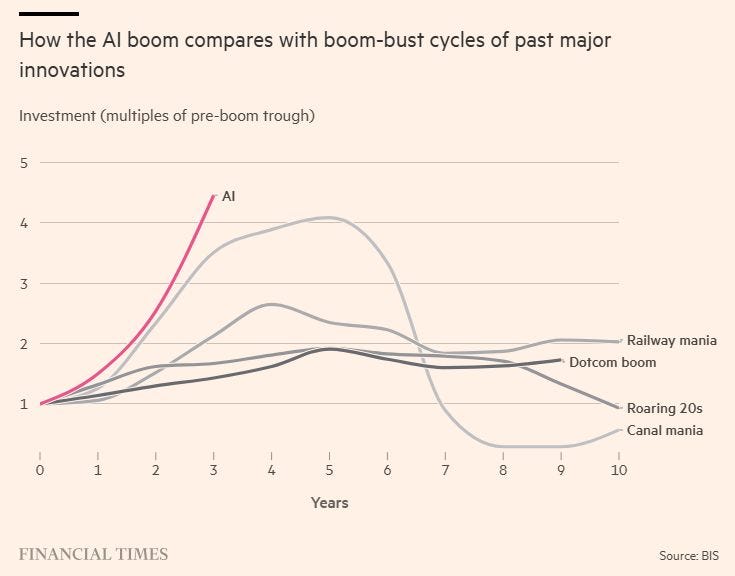
Meanwhile I’m always reading AI and economic reports, and the Bank for International Settlements (BIS) compares the capital trajectory of the current Artificial Intelligence boom against four major historical economic bubbles and innovation cycles.
Image
The Financial Times via the BIS.

While drawing structural analogies to the 1840s railways and the 1990s dot-com era, the BIS highlighted several unprecedented, highly concerning anomalies unique to the 2025–2026 AI investment cycle.

Read the Report

The Exponential View is reporting that the generative AI economy has generated $110 billion in sales over the past 12 months. Check out their State of the AI Economy Report as well for some great summer reading.

View the Infographics

Azeem Azhar’s Newsletter is called Exponential View. Looking at the crossroads of AI and innovation as a publication now for 11 years!

The Exponential Demand for Compute is Accelerating Revenue
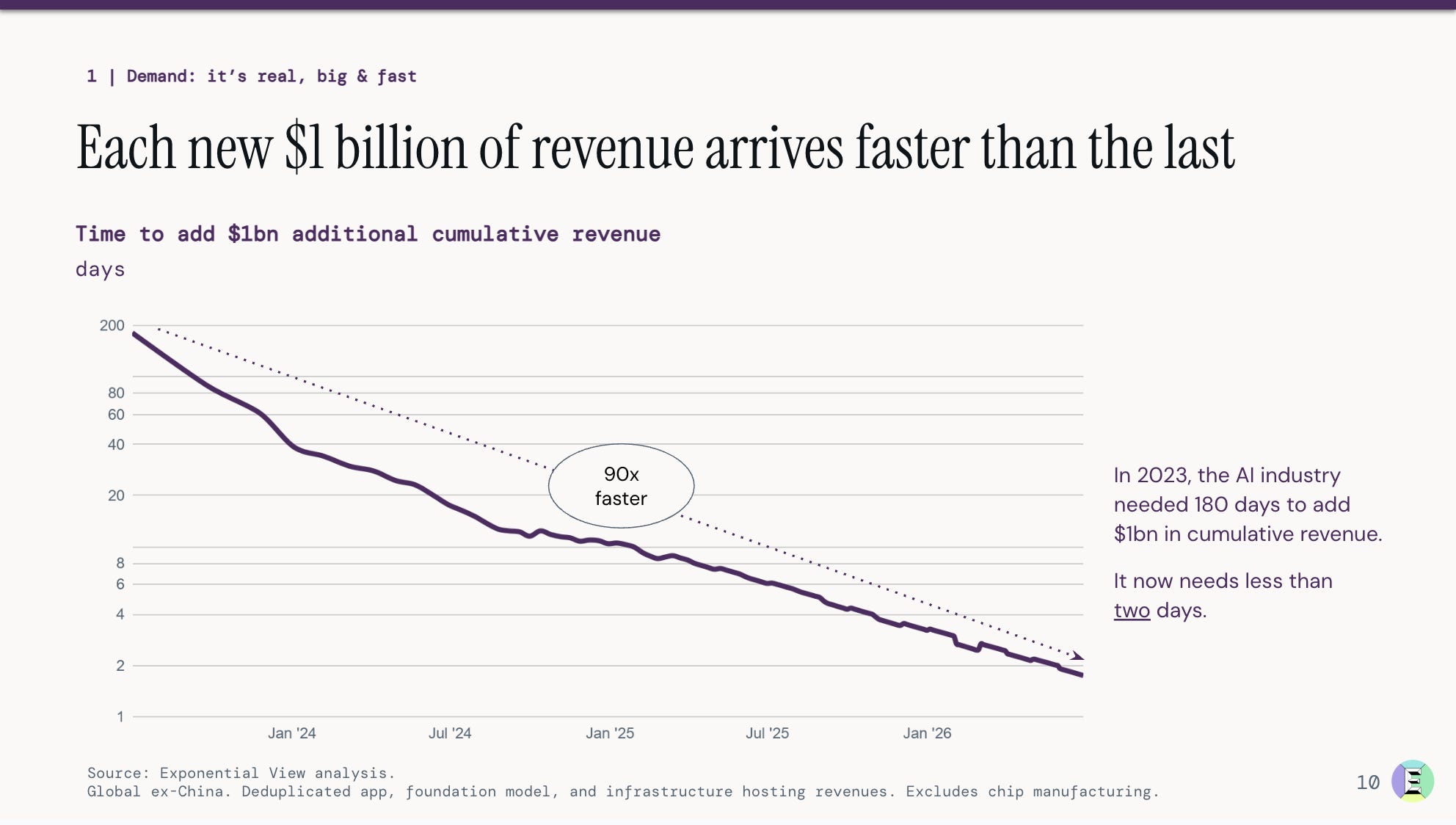
Exponential View. The publication claims that the generative AI economy has generated $110 billion in sales over the past 12 months. It is growing fast. On an annualized basis, the revenue run rate exceeds $175 billion.

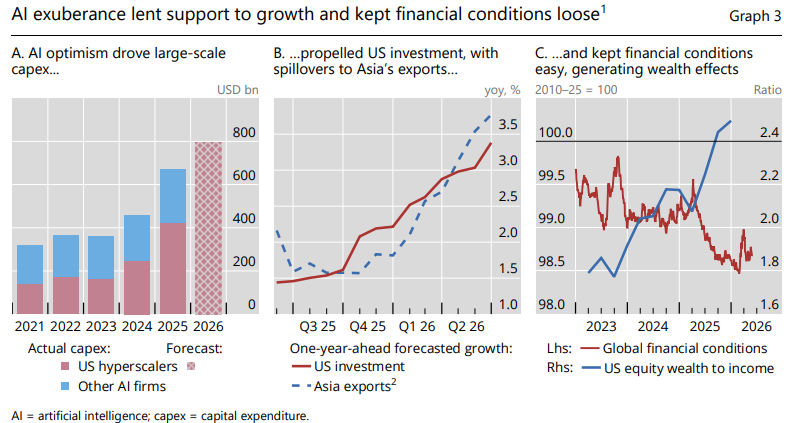
AI Exuberance in an era of Token Maxing and renewed Token Minimalism
2

BIS. BIS refers to the Bank for International Settlements. It is an international financial institution owned by central banks that fosters global monetary and financial stability and acts as a bank for central banks.

The Impact on the Labor Market due to AI Remains Highly Uncertain
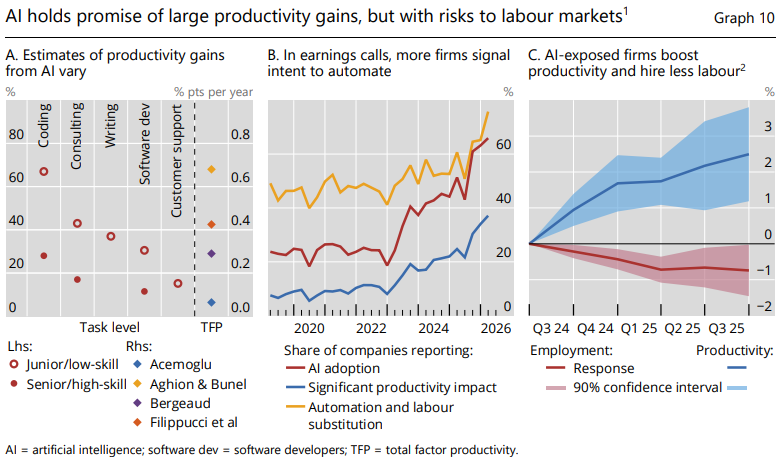
In the near term, the ongoing AI investment boom raises questions about the sustainability of the current economic expansion, according to the BIS.

Key AI News Stories I’m Following & A Sampling of AI Neo Labs (startups)

  • Apple and Microsoft have raised consumer prices (around 20%) on hardware and electronics in part due to the HBM supply chain crisis due to the datacenter build-out.

  • The pace of “Neo Lab” (a new category of AI startup) creation, AI labs designed to focus on pushing AI faster have received considerable recently funding like Mirendil, Engram, General Intuition, Prometheus, Trajectory and more.

  • Mirendil is building "self-accelerating" AI that can do the actual work of an AI researcher. For instance, they train frontier models that are expert at AI R&D and build the product around it.

Mirendil has former Anthropic employees. Read their Mission Statement.
  • Engram (eight months old) is an AI infrastructure startup building a persistent, learned memory layer for artificial intelligence in a bid to improve model efficiency and curb skyrocketing costs. The company says its technology can dramatically reduce the cost of running AI at enterprise scale. The B2B company trains models to study an organization's documents, workflows, and institutional knowledge in advance, compressing that material into what it calls a "learned memory" layer that can be reused across queries. Read their introductory article here.

Engram has a big promise on memory.
  • General Intuition AI is a high-profile frontier AI research lab focused on building Large Action Models (LAMs) and "world models" designed to perceive, predict, and act in real time across virtual and physical spaces. Also that AI can learn from video games. Confusing to me in a nutshell, an agentic model that can generalize from gameplay to simulation to embodiment is General Intuition’s raison d’être. The Series A had some heavy hitters like Khosla Ventures, with participation from Jeff Bezos, Eric Schmidt, and researchers from Google DeepMind and MIT.

  • Prometheus is a prominent AI startup founded in November 2025 by Jeff Bezos and Vik Bajaj (co-CEOs). I wrote about it here. In an era where physical AI and recursive self-learning AI are hot topics, this unique startup Prometheus, is focused on building AI models for physical tasks.It's a massive bet to rearchitect how physical things are made. The prototypical definition of what a Neo Lab is post Anthropic, reimagining what’s possible not just with LLMs, but world models, RSI and training physics based datasets.

  • Trajectory is building the platform for continual learning. Trajectory is betting the rapid iteration cycle that supercharged vibe-coding can help all kinds of companies build AI products that learn continuously. Their core thesis is that software products shouldn't rely on static, frozen AI models; instead, they should act as "living systems" that continuously learn, steer, and improve from real-world user interactions.

Why the “Neo Labs” of 2026 Matter 💡

I’m very enamored tracking all of these AI Neo Labs that are taking on impossible challenges and dreaming them possible. Essentially it’s not just LLMs, but the fusion of World Models, Physical AI, (Quantum computing), with more specialized models and agentic AI’s evolution in science that has got me excited. There’s some optimism now for how this could eventually accelerate science, R&D, innovation and AI laboratories. Sparks of automated AI laboratories and recursive self-learning AI, perhaps?

More AI News I’m Watching 🔍

  • On the topic of AI in science, The Briefing AI for Science by Anthropic, RSVP here. You can attend virtually to join Anthropic leadership, life sciences executives, and leading research institutions for an exclusive look at how Claude is being put to work across science.

  • AI is boosting scientists like Astronomers. How AI and an astronomer’s laptop can bring new galaxies within reach.

  • Agility will become the first humanoid robotics startup to go public when they do a SPAC later this year. Agility (Robotics) is merging with Churchill Capital Corp CCXI 0.00%↑. The Stock is up 60% so far on the news. Their flagship bipedal robot, Digit, is already operationally deployed across nine customer facilities.

  • Self-driving labs are changing how chemists work. Even in the so-called hard sciences, Generative AI is being given the wheel. A slew of start-ups and academic labs are leaning on AI agents and bots, rather than humans, to speed up their chemistry (biology, new materials, drug design, etc…). These Neo Labs are a different animal.

  • AI is everywhere and debt is following close behind: FT: US investment-grade tech companies have issued $362bn since August, per Citi’s numbers, as hyperscalers rushed to borrow. Big Red (Oracle) and the other four (hyperscalers) have issued $188bn of dollar-denominated bonds in just 10 months. It’s going to get a bit insane in the back half of the decade.

When I first read this essay (guest article) by Valentino I was stunned, it really made me think about the future of AI and the limits of science. I had formerly brushed off OpenAI’s announcement. But the clarity of his thought really brought me back. The last time he wrote a guest post for AI Supremacy was back in 2023. Lucky to have such a mind contribute to this publication. Huge respect. Also a longer list of Neo Labs at the end.

The Intelligent Blog

The Intelligent Blog
Unlock the Potential of Your Company's Data by Using the Advice from this Artificial Intelligence Blog. We Empower You to Harness Valuable Information Effectively.
By Valentino Zocca 🇮🇹 🇪🇺

How an AI Cracked an 80-Year-Old Mathematical Problem, and What That Really Means

By Valentino Zocca 🇮🇹 🇪🇺, first published on his blog in June.

A Discovery by Accident?


The Problem: A Deceptively Simple Question

In 1946, the Hungarian mathematician Paul Erdős posed a question so simple to state that it sounds almost trivial: if you scatter n points across a flat plane, what is the maximum number of pairs of those points that can sit exactly one unit of distance apart?

This is not really a question about a handful of points; it is about the behaviour for very large n: what formula links n, the number of points, to the maximum number of unit-distance pairs. The answer is best read as a growth rate, an exponent: the count always grows faster than n, but how much faster? For small n the count outruns n quite comfortably, but as n grows the rate eases, and the exponent governing it drifts slowly downward toward 1, the count stays only barely faster than linear.

Erdős supplied both a ceiling and a floor. For the ceiling, he showed the count can be no larger than roughly n^(3/2), because the unit-distance graph cannot contain certain forbidden configurations (two unit circles meet in at most two points). That bound was later improved to n^(4/3) by Spencer, Szemerédi, and Trotter, which became the standing record. For the floor, he found a strong construction, though not the obvious one. A plain integer grid, with rows and columns one unit apart, produces only about 2n unit pairs, barely more than the number of points itself. The powerful construction is a carefully scaled square grid, analyzed with tools from number theory (counting how often integers can be written as sums of two squares); it attains a count growing like n^(1 + c/log log n), for some fixed positive constant c, one plus a correction term that fades to nothing as n grows, a rate only just faster than linear. On the strength of that construction, Erdős conjectured that no arrangement could do substantially better: that the grid was not merely achievable but optimal.

For almost eight decades, this conjecture stood. The square grid remained the working benchmark. Nobody found a cleverer arrangement, and nobody managed to prove the conjecture was true. It sat in that uncomfortable mathematical limbo: almost certainly right, completely unproven, untouched.

The Difficulty: Why Nobody Solved It

User's avatar

Continue reading this post for free, courtesy of Michael Spencer.

Or purchase a paid subscription.
Valentino Zocca 🇮🇹 🇪🇺's avatar
A guest post by
Valentino Zocca 🇮🇹 🇪🇺
Subscribe to Valentino
© 2026 Michael Spencer · Market data by Intrinio · Privacy ∙ Terms ∙ Collection notice
Start your SubstackGet the app
Substack is the home for great culture