


Good Morning,
I’m still reeling from the AI Boom showing signs of a potential bubble collapse.
To put it into context global and U.S. stock markets just posted their worst week since March 2020 during the week that ended November 20, 2026, driven by a sharp unwinding in AI, Neo Clouds and semi stocks.
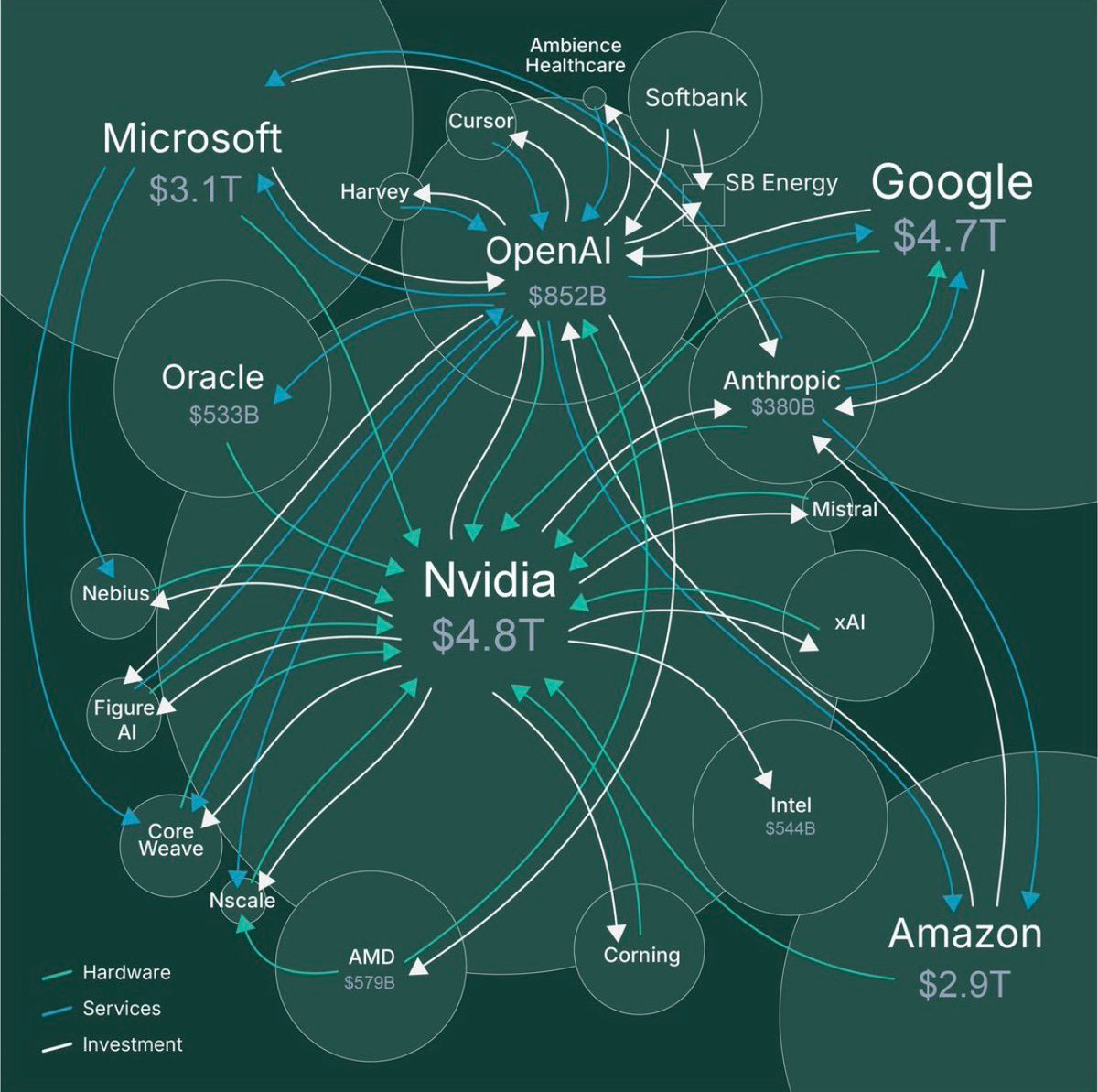
Circular financing
Concentration risk
Lack of ROI of Generative AI
Unscrupulous dark budget & margin debt ($1.5 Trillion in 2026)
AI corruption and political upheaval
Capex and rising compute costs
Audio Version:
Why not listen on the go: 40 minutes, 40 seconds.
If Nvidia’s controversy is to blame, circular financing and a lack of ROI are top concerns now facing the Generative AI hype train. It’s painful to behold, but Nvidia is facing multiple Federal, State, and internal investigations following the implosion of Nvidia’s stock rising from the resignation of Jensen Huang and the surrounding shady dealings (including a kind of Corporate Nepotism I might add).
This moment in time is a good opportunity and fitting timing to introduce my readers to Andi Roach whose work I have been tracking with some riveted and secret enthusiasm while the manufactured tech optimism on social media is taking a hit. Andi Roach is a rather unique independent researcher, writer, and creator of The Complex Rebel. Drawing on 13 years in enterprise technology, she examines how power and financial incentives shape behavior, reinforce institutional systems, and redistribute risks and consequences across the broader economy.
Nvidia’s situation is certainly an abysmal indication of how far entrenched circular financing abuses and potentially criminal violations go in the high-powered AI economy. This is a watershed moment. All of this changes how we view Anthropic’s IPO as well I might add with its own brand of Silicon Valley controversy. Something is off in AI and suddenly in recent weeks the AI bear position has become more mainstream and as AI sentiment has degenerated significantly in 2026.
Introducing: The Complex Rebel
Why Listen to Andi
One of the reasons Andi’s work intrigues me is how she is able to combine macro and interdisciplinary studies. A former global business strategist and trauma/Complex PTSD (C-PTSD) specialist, she combines systems thinking, psychology, and corporate/financial analysis to examine how power, hierarchy, and trauma operate across institutions and society.
Unfortunately the AI trade and Nvidia in particular, has some similar trauma.
LinkedIn - TikTok - About (click on the links)
Hierarchical Trauma Systems
Andi based out of Chicago has a fairly appealing working systems framework HTS. She developed Hierarchical Trauma Systems to examine a recurring pattern: the separation of power from the cost of its decisions. Through essays and cultural critique, she translates those dynamics into language people can use.
I personally find this psycho-macro framework rather appealing.
For realism and accountability in AI and systems I really like reads like Raphaëlle d'Ornano, Luiza Jarovsky, PhD and Maria Sukhareva. In fact, many of the women writing about AI on Substack are some of the more interesting critical analysis and critical voices on the topic. I don’t think reading Marcus, Zitron or Burry necessarily gives you the entire picture, with all due respect.
For me it’s difficult to see Nvidia and Anthropic rebounding (at least in the immediate future) from what we just witnessed on the stock market on Friday. This is no ordinary correction.
More than a Bear Market Correction
This could very well be the AI bull market bubble popping. I say this after the extreme downturn of the Friday AI trade. Like historically - on Friday, November 20, 2026, the NASDAQ Composite fell 5.28%, the NASDAQ 100 was down 5.61% and the VIX (fear index) peaked at 39.63. Anything about 30 is rather unusual. This could easily go from something that happens about once a year, to something that happens about once a decade. We’ll know soon enough. Follow the stocks of NVDA 0.00%↑ and ANT 0.00%↑ and you will know the score.
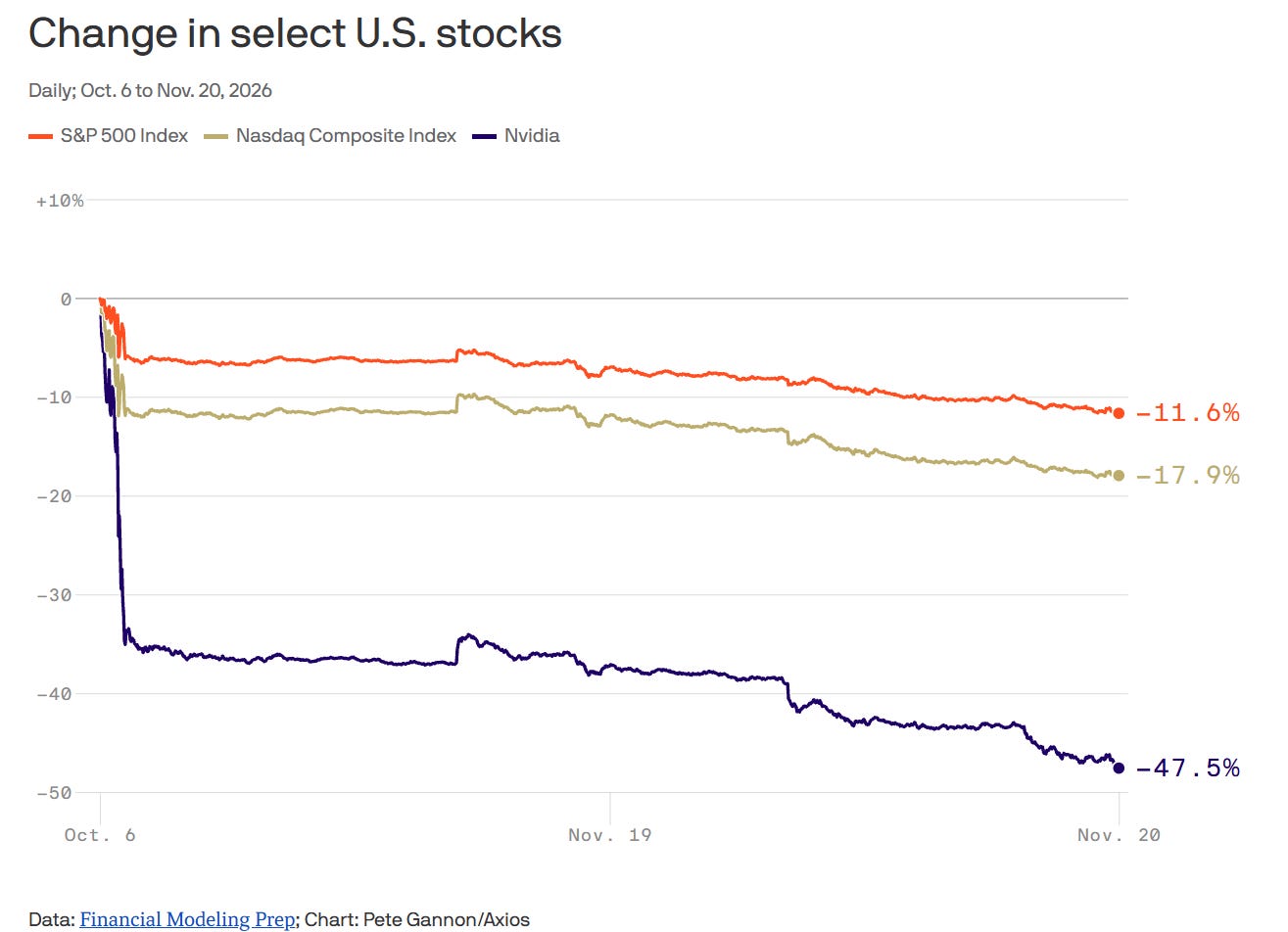
Circular Financing, Margin debt and a lack of ROI from Generative AI is starting to raise and heighten fears.
Andi’s work is more than simply thinking out loud, she trailblazes writing about power, hierarchy, and the systems shaping your life in the AI era. Something American voters have said loud at the ballots and clear matters to them. It matters to us Non-American watching all of this as well. AI power should not be abused.

The Complex Rebel, to the best of my knowledge, examinse corporate consolidation, political dark money, and the financial mechanics of the AI economy. Which is an awesome thing to write about. I wish more people wrote about these topics and like this. It’s highly relatable.

We need investigative journalism, analysts and system thinkers who talk about these elitist agendas because they are spilling over into every aspect of our lives. To some degree without our consent. How Substack Politics and Substack Tech intersects isn’t always optimal. The conversation and news cycle around AI remains full of intrigue.
I pride myself in trying to find a variety of different guest contributors all with their unique voices and angles to give you the very best coverage of AI News and current events in the space. If these sorts of topics and holistic coverage matters to you please enjoy and share.
We need to support independent bloggers, analysts and thinkers.
Selections of the Complex Rebel
Please take a look at the following articles:
Meet Your Overlords: The Next Phase Of The AI Economy Is In Your Electricity Bill
The White-Collar Problem (see the viral video)
Meet Your Overlords: The Influence Economy
Supporting the Complex Rebel and Andi’s work is just $60 a year.
As Venture Capital, PR interests and BigTech lobbying begins to dominate journalism and social media online, I’m seeing all of this in my day job with freaking regularity pushing the internet into a dumpster fire of lower quality and less signal/more noise. This is not the best lens to understand what’s going on, so thank god for Substack. There are still some traces here of genuine introspection.
Dark Psychology of Circular Financing
Now with a breakdown of cybersecurity and the internet’s infrastructure with all of these tech outages recently, it’s a good time to keep score of all the ways and what might end up being the costs of Generative AI to society? They keep adding up. For investors and shareholders this could get wild.
Some context of the financial costs of the last week.
For the trading week ended Friday, November 20, 2026, U.S. equities lost nearly $6 trillion in market value—with roughly $2.4 trillion wiped out on Friday alone as the S&P 500 fell 8.61%
Things are so bad in Asia, Taiwan has moved to significantly tighten short-selling.
Anyways enough of my ranting, let’s get to Andi’s post. It’s 5,000 words or 35k characters. She asked me if I thought it should be edited or trimmed down much, but in this case I want this voice to be heard in its natural state.
I believe we need to question everything about Generative AI and the new fads American Venture Capitalism pushes upon the world.

Meet Your Overlords: An Introduction to the AI Economy
Profit is real, demand is complicated, and the risks travel a lot further than you think.
As of November 20, 2026. Company figures come from each company’s latest quarterly filing unless noted; market values are as of the dates shown. That day, Reuters, citing two people briefed on the matter, reported an SEC inquiry into Nvidia’s accounting practices, and Nvidia’s stock finished the week down 23%. Nvidia’s figures below are as the company reported them.
Introduction
Staying up to date on the latest headlines is a feat in itself these days. And when it comes to a topic as complex as the AI economy, it’s hard enough to make sense of what’s happening, let alone figure out how you’re supposed to feel about it. Just look at last week:
“Anthropic targets valuation of up to $1.4 trillion in stock market flotation” — The Guardian, November 10.
$1.4 trillion is good, right?
“Sam Altman warns Samsung executives of volatility: ‘AI demand has been double-counted’” — Financial News (South Korea), November 11.
What does that even mean?
“Nvidia CEO Jensen Huang resigns in blow to AI boom he helped foster” — Reuters, November 12.
Uh oh…
And then, of course, we discovered that one man’s affair (make that affairs, one reportedly with a suspected Chinese “spy”) could send one of the world’s most valuable companies into a tailspin. Nvidia lost approximately $573 billion in market value in the week Jensen Huang resigned, proving that when a company is large enough, its CEO’s, uh, “personal crisis” can quickly become a problem sitting in your retirement account.
If you’re already bought into AI, you’ve probably been following these headlines religiously. But if you aren’t, you may be quickly finding out that whether you want to be or not, you’re already a participant in the AI economy.
So… congrats?
You participate through your retirement account, your rising electricity bill, and living through your third “AI transformation” at work this year (also known as “layoffs”). These are decisions made in boardrooms you’ll never see, made by executives you’ll never meet, and they’re actively shaping the conditions of your everyday life.
Yet, we’re still spending more time talking about what AI can do than the economy being built around it.
Circular Financing
You may have heard the term circular financing to describe how the companies selling AI are also investing in, financing, or promising to purchase from the very same companies buying from them. And it’s a helpful way to understand how the money moves. But, drawing these relationships as a circle doesn’t fully represent the shape of the AI economy.
Yes, the money loops back around, but those transactions also finance data centers and create debt. Then that financing enables even more expansion; it supports growing valuations, which attracts new investors, and that allows companies to borrow more money and make commitments for years into the future.
The consequences don’t stay inside the circle. Financial gains, ownership, debt, dependencies, and consequences accumulate and change across the system. The next round of decisions begins from the conditions left behind by the last. Circular financing explains how the money moves. The spiral explains what the money changes.
The AI economy is a spiral.
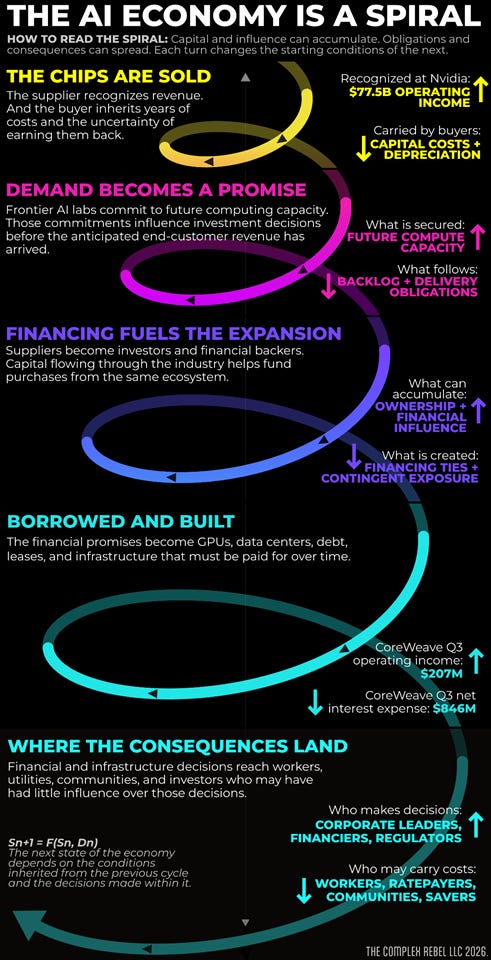
Each revolution can push financial exposure further outward, reaching institutions, investors, utilities, workers, and communities that weren’t part of the original decision-making process.
Who makes the decisions, who realizes the profits, and who carries the risk can look very different depending on where you stand. The closer you are to the center, the more influence you may have over the decisions; at the edges, you may just be trying to survive the fallout.
And unlike a circle, a spiral doesn’t return to the same starting point. Every decision changes the conditions for the next loop. Money gets invested, companies grow, infrastructure gets built, and new financial obligations are created. The companies benefiting from that expansion can gain more resources and influence over what happens next, while the businesses and people carrying the costs have to adapt to decisions already made. And because the benefits and burdens aren’t distributed equally, neither is the power to shape what happens next.
To understand how this works, we have to start where some of the largest profits are realized and follow the money out.
At the Core: Where the Profit Is Realized

Nvidia designs the chips powering the AI economy. On November 17, it reported $115.8 billion in quarterly revenue, $77.5 billion in operating income, and a ~67% operating margin. That’s 67 cents in profit for every dollar of sales, before taxes and other non-operating items.
Do the rest of the companies in the AI economy make this kind of profit?
Absolutely not.
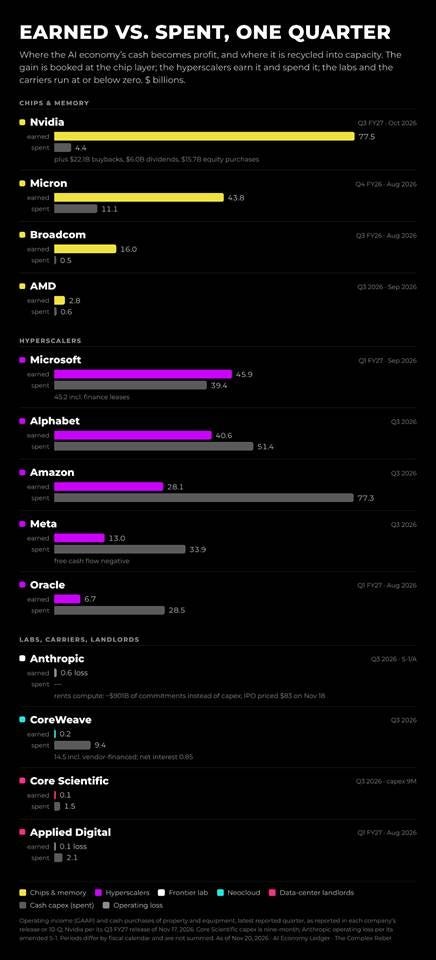
Yes, Nvidia has competitors like AMD, Broadcom, and Micron, which supply different types of processors and other technology. But Nvidia’s early market lead and years of investment left it uniquely positioned for the AI boom. An enormous part of the industry depends on its hardware and software, giving Nvidia tremendous pricing power and influence over the market. Their revenue is another company’s expense, and profitability starts looking very different depending on which side of the transaction you’re standing on.
Nvidia can recognize revenue and profit on a sale long before the company purchasing its equipment has recovered the cost of that investment.
When Nvidia delivers its product, satisfying the accounting requirements for a sale, the revenue is recorded immediately. Even if they collect payment later, Nvidia doesn’t have to wait six years to recognize the sale from equipment that the buyer on the other side of that transaction might depreciate over that time. And for a company like CoreWeave, buying Nvidia equipment is only the beginning.
It has to finance the purchase, install the hardware, get the systems operational, and find the customers to generate enough revenue over time to recover its investment.
CoreWeave currently depreciates the GPUs it buys over an estimated six-year useful life.
That means the accounting expense is spread across the years the equipment is expected to be used. The actual money needed to buy it, whether supplied by investors, lenders, customers, or the company itself, has to be available much, much sooner. And the costs to finance that money arrive with it.
So, Nvidia makes its sale and then uses the resulting earnings to invest in the next opportunity. The company buying the equipment, like CoreWeave, has to keep generating revenue just to justify the purchase, while also managing the possibility that newer technology, changing prices, or slowing demand could make that investment less valuable than expected.
One company’s profit becomes another company’s long-term bet.
Demand Is the Launchpad

Frontier AI developers like OpenAI and Anthropic build the models that people and businesses use. Running these models requires a huge amount of computing capacity, which they purchase from cloud and infrastructure providers. And demand for those services is real. Consumers pay for subscriptions. Just like businesses pay for enterprise services, and developers pay to integrate the models into their products. But companies are building infrastructure to support current demand plus how much demand they expect to have in the future.
And there’s a big difference between demand and anticipated demand.
Take OpenAI. In October 2025, it committed to purchase an additional $250 billion in Microsoft Azure services. That’s a massive commitment based on—what, exactly? Certainly not $250 billion in cash OpenAI already collected from customers who will eventually use that computing capacity.
The agreement reflects expectations about future demand, future revenue, and OpenAI’s ability to finance those purchases along the way. Microsoft, in turn, can use that commitment to inform its own infrastructure and investment decisions. And Microsoft isn’t OpenAI’s only infrastructure provider. OpenAI also contracts with Oracle, CoreWeave, and other companies to secure the computing capacity it expects to need.
Then what happens?
One AI developer commits to buying infrastructure services. Then multiple suppliers get expectations of future revenue. Those suppliers then buy the equipment, build the infrastructure, get financing, and make their own commitments to deliver the services. One AI developer’s forecast becomes another company’s business opportunity—and potentially another company’s financial obligation. And with every new commitment, companies put more money and infrastructure behind the expectation that this future demand will actually materialize.
Demand Double Counting
Which brings us to a rather concerning headline from South Korea’s Financial News. According to materials obtained from an October 31 meeting with Samsung executives, OpenAI CEO Sam Altman acknowledged that parts of the AI market had “double-counted” demand, particularly around memory chips and data centers. By his count, the big increase in demand comes from just two companies: OpenAI and Anthropic.
So, what does that actually mean?
On November 16, on stage at a Semafor conference, the explanation came from Altman himself: every chip supplier is planning to sell to the same few buyers, and those buyers won’t be buying from all of them.
Several suppliers can build for the same customer. Not all of them get the business. And we’ve already watched it happen.
By early 2025, about 2 gigawatts of planned Microsoft data-center projects had disappeared from the pipeline, according to analysts at TD Cowen, who traced most of it to Microsoft’s decision not to take on more of OpenAI’s training work. OpenAI took that business to other providers, including Oracle. Then in March 2026, the planned expansion of Oracle and OpenAI’s flagship Texas data center fell apart, with financing talks stalled and OpenAI’s own capacity plans shifting. A $150 million deposit from Nvidia reportedly held the space while Meta weighed taking it instead. (By Oracle’s account, the rest of its OpenAI build is proceeding as planned.)
Other buyers showed up for some of that space, so none of this proves the demand is fake. It shows that demand can move while the buildings can’t.
And then account for what companies report to investors. At the end of September 2026, Microsoft reported $677 billion in commercial remaining performance obligations. Oracle reported approximately $664 billion at the end of August. CoreWeave reported $132.5 billion in revenue backlog at September 30. These companies use different accounting measures, but the numbers generally describe revenue they expect to recognize from customer commitments over time (they are not guaranteed profits, and they do not tell us how much additional demand will come from the people and businesses ultimately buying).
These totals include different customers, products, time periods, and contractual terms. And we can’t just add them all up and say they’re all OpenAI or assume they prove double counting. But they definitely should raise a few eyebrows. Because how much of the demand traces back to the same customer expectations of future growth and how would we ever be able to tell?
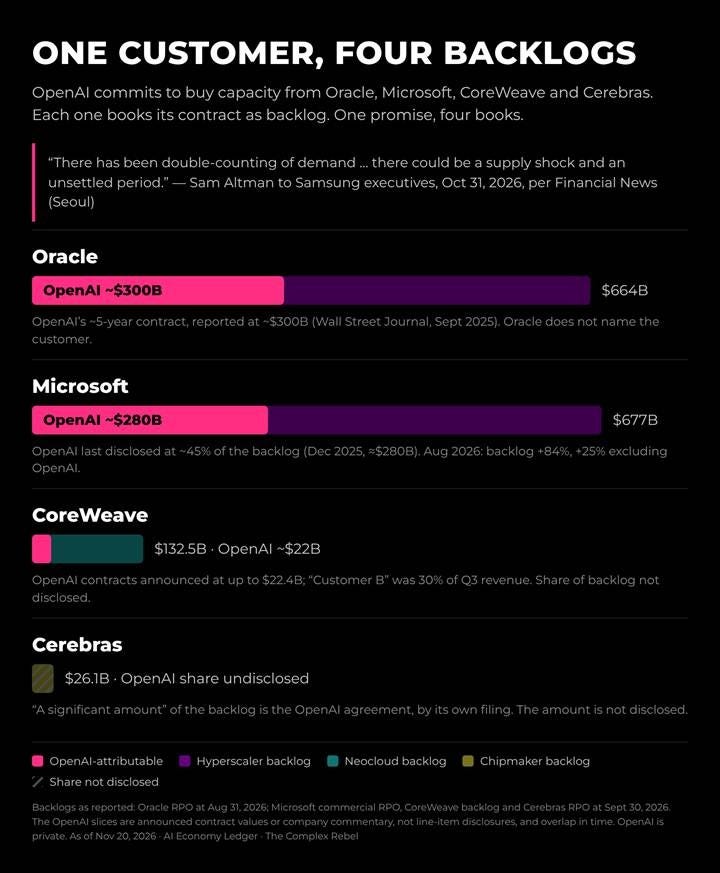
A commitment to purchase computing capacity isn’t the same as a customer actually using and paying for that capacity. And the suppliers building infrastructure around those commitments still need to deliver their services, cover their costs, and collect the revenue in the process. And that financial exposure can be a massive risk. A large customer contract can help an infrastructure provider get that financing for expansion. But the provider still needs to buy equipment, build or lease facilities, and take on financial obligations before it earns that expected revenue.
And that risk becomes especially important for companies borrowing heavily to support a handful of huge customers. Because if demand is slower than expected, or one customer changes their mind, those companies still have to pay the financing and operating costs of the infrastructure they committed to build.
The commitment creates business for the next company—and—it influences what that company finances, purchases, and builds. The system loops back around, but the starting point has changed. Each agreement shapes the conditions for the next.
Financial Rocket Fuel: The Bank of Nvidia
Nvidia’s customers need money to buy its chips. And Nvidia is all about supporting them to make that happen. Hence the nickname, The Bank of Nvidia.
In its November 17 financial disclosures, Nvidia reported approximately $61.7 billion in privately held equity investments and $44.2 billion in marketable equity securities. Those figures represent the carrying values of investments (not cash profits Nvidia collected from selling them, and not every investment directly finances a chip customer), but the scale shows just how far Nvidia’s financial interests extend beyond selling hardware. And its involvement doesn’t stop there.
Nvidia also agreed to provide guarantees capped at $105 billion to support the development of SB Energy’s PORTS-Pike data-center campus in Ohio, which plans to lease computing infrastructure to OpenAI. The guarantees take effect in phases as the buildings become ready for service, and Nvidia would face payment obligations if certain conditions trigger them. But that’s also what makes the arrangement notable. Nvidia can use its financial strength to support an enormous infrastructure project before the expected revenue from that project materializes.
And in August, Nvidia announced partnerships with Apollo, BlackRock, Blackstone, Brookfield, Goldman Sachs, and KKR to develop financing platforms aimed at mobilizing more than $500 billion in third-party capital for AI infrastructure over time. The company selling the technology is helping organize the capital that will finance the infrastructure needed to purchase and use more of it.
The supplier helps create the financial conditions that make the next round of growth possible.
And other companies are following suit. Amazon invested $8 billion in Anthropic convertible notes between 2023 and 2025. In its September 2026 financial statements, Amazon valued its remaining convertible notes at approximately $146.2 billion. A pretty incredible paper gain, which they don’t need to realize to benefit from that holding. They also invested another $10 billion in Anthropic preferred stock during 2026.
Amazon also happens to provide cloud computing services Anthropic needs to develop and operate its models. So, Anthropic receives capital to fund its growth. Amazon earns revenue from cloud services and stands to benefit if its Anthropic investments increase in value. And Anthropic’s demand for computing capacity helps justify additional infrastructure spend. These arrangements depend on interconnected expectations about future growth of the same market.
One company’s growth creates revenue opportunities for another, while the financing behind that growth can give the supplier a direct stake in its customer’s success.
And we’re talking about huge amounts of capital flowing through these relationships. On November 16, Federal Reserve Governor Michael Barr described more than $100 billion in cumulative equity investments by major chipmakers and hyperscalers into AI developers and cloud startups. He also noted those investments represent a relatively small share of the largest companies’ balance sheets, but they can be critical to the smaller companies receiving the money. Because the same financial relationship can mean very different things depending on which side of it you’re standing on.
Accounting rules require a company to disclose when a single customer makes up 10% or more of its revenue, which is why we know CoreWeave accounts for 93% of Core Scientific’s. But the test is measured against a company’s size. The same contract that is nearly everything to the smaller company can be a rounding error to the larger one. Microsoft doesn’t break out what it spends with CoreWeave. Nvidia doesn’t name its customers at all. So the public can see the dependence, but only from the side that’s carrying it.
A large supplier can invest in a customer, earn revenue from selling it equipment or services, and potentially benefit from the value of its ownership stake increasing. The customer gains access to capital—and—it also takes on the risk of generating enough future revenue to sustain its growth.
The infrastructure providers supporting those customers face their own financial obligations as well. Nvidia’s guarantees create contingent exposure, and of course, equity investments can lose value. But they also have different resources, access to capital, and the ability to absorb a setback.
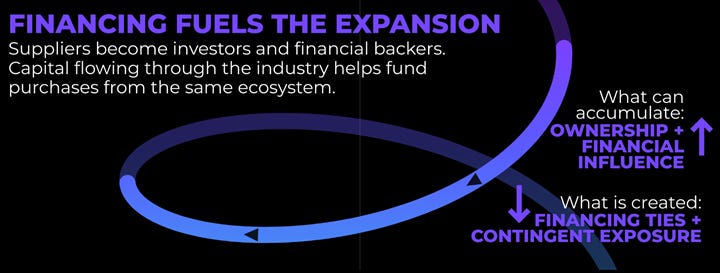
A successful investment increases a company’s financial resources. A large computing contract can help another company get financing. That financing supports additional construction, creating more orders for equipment and more business for the companies supplying it. Suppliers become investors. Customers become financial partners. Financial institutions develop new ways to fund the expansion.
That’s how the spiral starts reinforcing itself.
The companies accumulating profits, ownership, and financial influence gain more opportunities to shape where capital flows next. Meanwhile, other participants accumulate the obligations required to deliver on those expectations. The broader system becomes more and more dependent on continued growth.
Meanwhile, someone still has to take on the obligations required to turn those financial commitments into actual computing capacity. And at some point, all that money has to become something physical.
Where Financing Becomes Physical
While “the cloud” sounds like some wonderfully weightless place floating around in space, it’s actually super physical. We’re talking massive buildings filled with processors, cooling systems, and thousands of servers using extraordinary amounts of power. And someone has to finance the construction long before those assets generate all the revenue companies expect them to produce.
JLL estimates that data-center construction will average $11.3 million per megawatt globally in 2026, before companies even install the computing equipment. For AI infrastructure, the technology fit-out can add as much as another $25 million per megawatt. Securing enough power can take years, on timelines set by utilities and regulators rather than the developers themselves. Which helps explain why even companies like Meta, with billions in profits and years of experience building data centers, increasingly turn to outside developers and financiers–a strategy that spreads the risks and costs of construction across the companies supplying capital, equipment, real estate, and electricity, often through contracts that extend years into the future.
Enter CoreWeave, a specialized cloud provider, or neocloud, which rents computing capacity to AI developers and other customers that don’t want to own the infrastructure themselves.
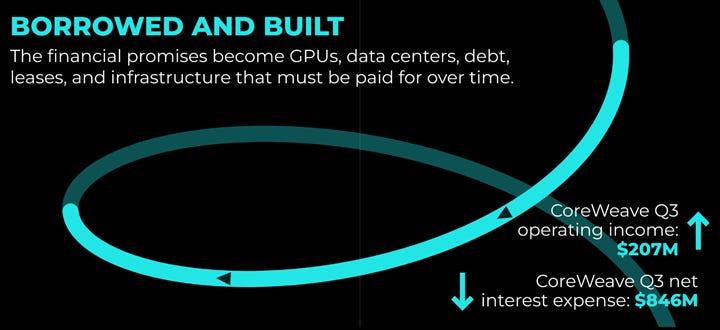
In its third quarter, CoreWeave generated $3.66 billion in revenue, up 168% year over year, with $207 million in operating income, $846 million in net interest expense, and a $709 million net loss. The company earned an operating profit, but its net interest expense alone was more than four times that amount. By September 30, CoreWeave carried approximately $47.5 billion in debt principal against $132.5 billion in revenue backlog.
Backlog is essentially revenue that CoreWeave expects to earn delivering computing services under customer commitments. But CoreWeave still needs to deliver the capacity, cover its operating expenses, and collect payments to do that over time. And with tens of billions in debt, the company has considerably less margin for error when refinancing becomes difficult or the demand supporting its expansion falls short of expectations.
Which brings us right back to Nvidia.
CoreWeave builds its GPU infrastructure around Nvidia hardware, and Nvidia has a financial stake in CoreWeave’s continued expansion. In January 2026, Nvidia invested another $2 billion in CoreWeave stock. The companies also entered a capacity agreement in September 2025, initially valued at $6.3 billion, giving Nvidia access to qualifying computing capacity that CoreWeave doesn’t sell to other customers. So Nvidia sells the hardware, owns a stake in the company buying it, and provides a contractual backstop for some of its unsold capacity. The agreement helps support CoreWeave’s business, and it also creates exposure for Nvidia if CoreWeave can’t sell that capacity elsewhere.
But their financial positions within that arrangement are wildly different. Nvidia generates enormous profits selling the technology that powers the expansion. CoreWeave borrows billions to purchase and operate that technology, depending on a future where it has enough computing revenue to recover its investment and service its debt.
CoreWeave carries financial exposure from its relationship with Nvidia, while making commitments that create dependencies for the companies supplying the physical infrastructure beneath it. Take Core Scientific for example. They’re a former cryptocurrency miner that now develops and operates data centers for AI infrastructure. In its third-quarter disclosures, Core Scientific reported that just one customer accounted for 93% of its total quarterly revenue. And that customer was CoreWeave.
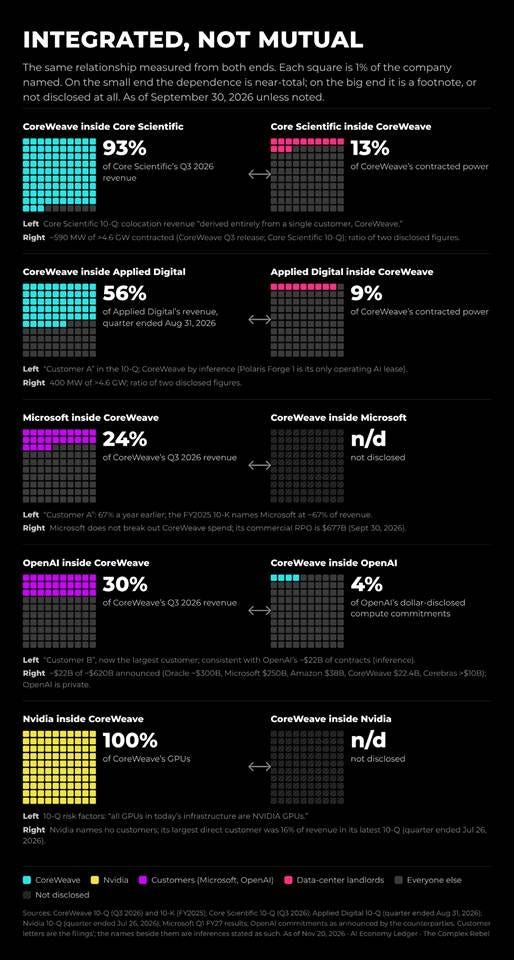
In May, Core Scientific raised $3.3 billion through senior secured notes carrying a 7.75% interest rate, using the proceeds in part to refinance earlier borrowing and establish debt-service reserves. They also contracted approximately 590 megawatts of capacity to CoreWeave, representing only about 13% of CoreWeave’s more than 4.6 gigawatts of contracted power. And while revenue for Core Scientific and contracted power for CoreWeave measure different things, they show an imbalance in the relationship: Core Scientific depends on CoreWeave for nearly all its current revenue, while CoreWeave uses infrastructure from many different providers.
So, what happens if CoreWeave delays a project or runs into financial trouble?
Core Scientific already took out loans and built the infrastructure for their customer making up almost all of their revenue. At September 30, only 485 megawatts of its 590-megawatt commitment to CoreWeave had begun generating billable revenue. The remaining capacity was still moving through construction and commissioning. And its ability to absorb a setback depends heavily on the financial health of the one customer it relies on.
In the meantime, CoreWeave faces its own dependencies on AI developers, hardware suppliers, lenders, and investors. It can hold bargaining power over one provider while being financially exposed to decisions made by its own customers and financiers. The same company can absorb instability from one part of the economy and create financial consequences for another.
Then, we need to talk about time. We mentioned previously that CoreWeave depreciates computing equipment over an estimated six-year useful life. Customer payment terms, their lender’s repayment schedule, and other agreements may be on completely different schedules. They have to manage overlapping timelines regardless of what happens to demand, plus take into consideration the six-year depreciation estimate doesn’t actually guarantee six years of profitable use.
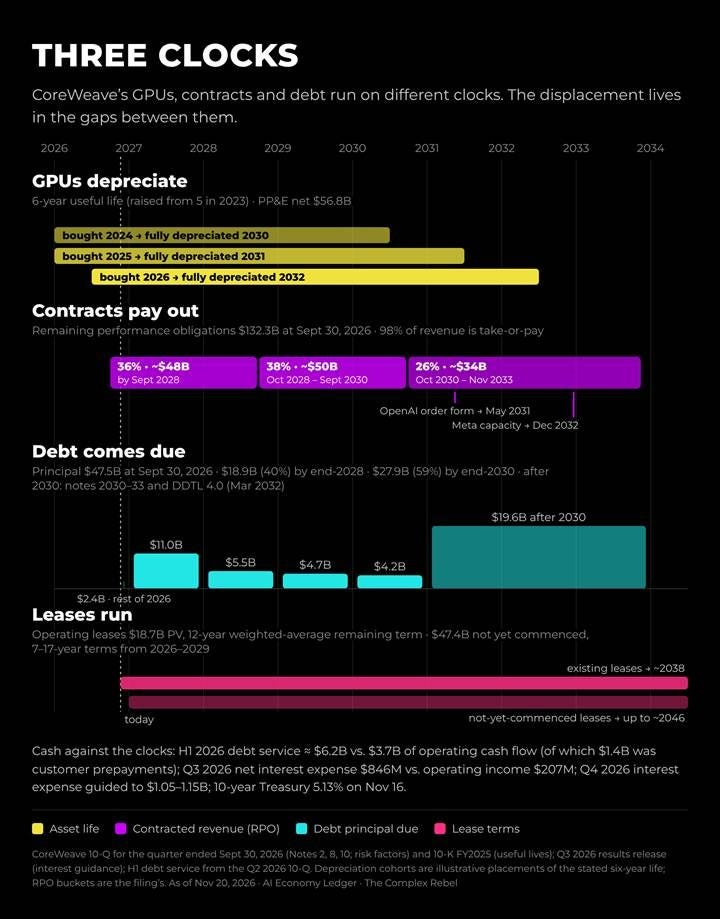
A company can face instability for a variety of reasons—changing demand, cost of capital, new regulations, whatever—and not every company has the same ability to respond. The financial exposure remains even when the expectations that justified it change.
And suddenly, the separation between who makes the decisions and who bears the consequences becomes much easier to see. An AI developer’s forecast influences a cloud provider’s plans to build infrastructure. The cloud provider signs contracts, buys hardware, and gets financing. Infrastructure developers commit capital to facilities that may take years to complete and even longer to pay off. By the time those decisions become physical assets, multiple companies have tied their financial futures to expectations that originated somewhere else in the system. Each relationship creates opportunities for some participants and obligations for others, changing the financial conditions under which they make their next decisions.
The farther we move from the original chip sale, the more companies, creditors, physical assets, and long-term commitments become involved. And the consequences don’t necessarily end at the businesses that signed the contracts.
Where It Lands
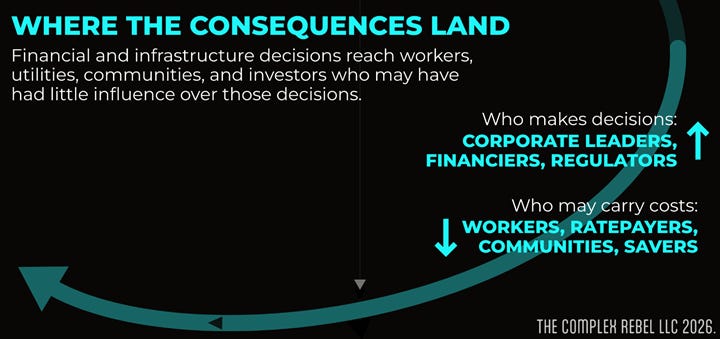
The financial gains are easy enough to see because they’re sitting on Nvidia’s income statement. Lenders earn interest under their agreements, and investors watch their holdings appreciate, sometimes dramatically. But we’re measuring the economic benefits of AI by how much money the industry makes.
How much value is the technology actually producing?
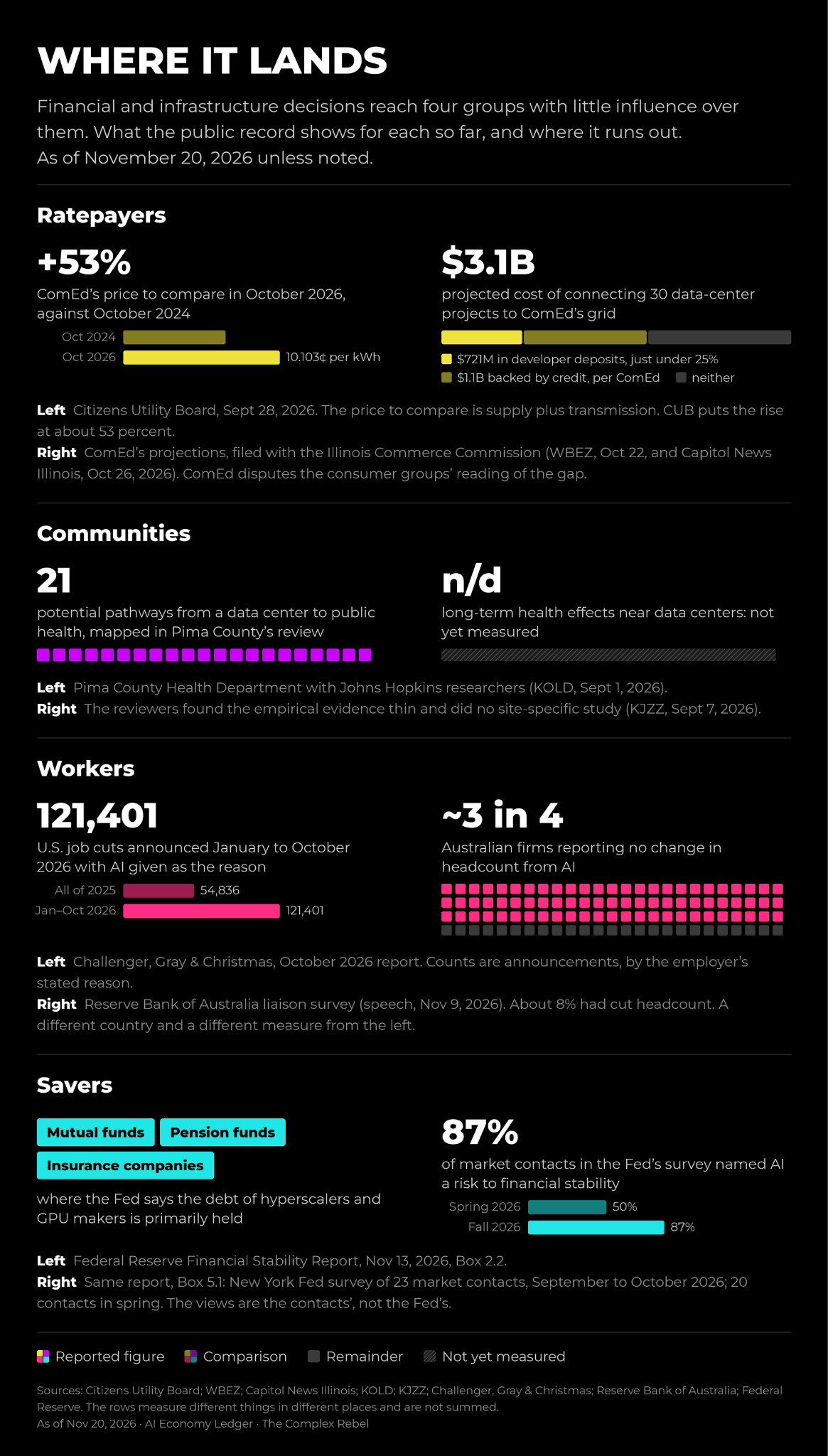
In a November 9 speech, the Reserve Bank of Australia reported that approximately 35% of businesses in its liaison survey saw no productivity gains from AI, while another 30% reported only minor improvements. Others reported moderate or significant gains, so the technology clearly has practical applications. But those benefits remain uneven, and we’re still only learning how benefits will materialize while AI suppliers are bringing in record profits.
And the costs are being realized too. We just have to follow the infrastructure a little farther.
When a company commits to building or leasing a new data center, that facility needs power, and lots of it. Utilities and grid operators factor anticipated demand into forecasts and investment plans, potentially requiring new electrical infrastructure. Who ultimately pays depends on contracts and regulatory decisions made in each market. Infrastructure built around anticipated demand has the potential to leave behind decades of expenses, even if the projects that originally justified those investments never materialize.
In Illinois, consumer advocates reported that ComEd’s October 2026 electricity supply price was 53% higher than two years earlier, with increased data center demand as a major contributing factor. WBEZ reported that ComEd has $3.1 billion in anticipated grid infrastructure costs associated with 30 projects. Meaning consumers could inherit some of those costs if projects fall through. ComEd disputes that characterization, and the eventual allocation will depend on these agreements and regulatory decisions.
Who got to make the decision?
Data-center developers negotiate locations, contracts, and construction, while utilities and regulators get to decide how electrical infrastructure is built and how to recover those costs. Us people at home have a lot less say in those decisions, and we end up living with the consequences.
And then there are the costs that don’t arrive as bills.
Researchers working with Pima County and Johns Hopkins identified air quality, water consumption, noise, heat, and health impacts that warrant assessment around data-center development. A company can calculate its electricity and construction costs down to the dollar while the surrounding community faces questions about clean water, air pollution, noise, and long-term health effects that are considerably harder to quantify.
Then there’s employment.
A corporation can announce an AI-driven efficiency initiative, cut payroll expenses, and report cost savings before anyone knows whether the technology actually delivers better outcomes. Challenger, Gray & Christmas counted more than 121,000 U.S. job cuts through October where the employer gave AI as the reason, more than twice last year’s full-year total. Yet the RBA’s own survey of Australian firms found headcount unchanged by AI at roughly three in four of them. The announcement and the technology are not the same thing. The executives making those decisions have much more control over the timing and allocation of resources than the workers who have to live with the loss of stability, loss of income, and increased workloads for the workers left behind. The workers must adapt to conditions they did not make.
Businesses reorganize around AI tools; employees learn new systems, change how they work, or leave altogether. Software providers respond to what companies purchase, investors finance the businesses they expect to grow, and employers make new decisions based on the outcomes of their earlier investments.
And the financial risks extend even further. The Federal Reserve’s November Financial Stability Report identifies rapid growth in AI-related borrowing, circular financing networks, and complex financial obligations as potential sources of instability. The same report locates most of the hyperscalers’ and chipmakers’ debt in mutual funds, pension funds, and insurance companies. That’s how those exposures can reach the retirement accounts of people who never chose to finance the AI buildout.
The gains and the costs aren’t realized by the same people, in the same places, at the same time.
And those differences are important because the system doesn’t reset after each round of investment. Companies adjust their business plans, workers change how they earn a living, households adapt to higher costs, and infrastructure providers continue servicing commitments they made under earlier assumptions. The people and institutions absorbing those consequences enter the next round with different resources, obligations, and choices than they had before. And the system continues investing, borrowing, building, and adapting.
The Integrated Economy
Editor’s note: I include some notes in my “Addendum” section after the piece as well.
