


If you care about what AI is doing to the economy, labor market, or future of jobs you might want to share this.
The U.S. economy should be uplifted by AI - if it were a real AI revolution, but is it? I’ve been thinking about the impact of AI on the labor market, jobs and the U.S. economy. A few things don’t sit quite right with me. I do resonate and enjoy reading the insights of Michael Burry who has taken Substack by storm over the course of the last six weeks. Follow him also on X here.
Where is the so-called “AI revolution” that I keep hearing about? 🤔 The labor market is not looking so good.
Substack Post: “The AI revolution is here”. 🌊
My comment:
“It is surprising “how non-durable AI leads have been” historically which suggests we might have a new computing architecture and paradigm BEFORE we even fully scale or see the full fruition of LLMs. It’s entirely possible this is the capital allocation failure of gigantic proportions.
Yet the entire AI infrastructure rollout of data centers assumes this will not change, and generative AI will remain the dominant model. All before AI is even showing legitimate return on investment or an economically viable productivity boost (outside of coding).”
Read some of the commentary from the expert panel (which I agree and disagree with but won’t go into here):


Check out LinkedIn’s report: LinkedIn Jobs on the Rise 2026: The 25 fastest-growing roles in the U.S.
Is it time for us as professionals to audit all of our professional and high-value skills in this changing jobs landscape? What might replace career ladders and job hopping for our youngest workers?
While the panel covered some interesting ground, what they neglected or omitted to talk about or cover is the most telling part for me personally:
I’m more specifically interested on the Generative AI impact on jobs, labor market, U.S. economy and geopolitical situation. 2026 is an uncomfortable period where the tension between AI boom, AI bubble and labor market volatility is going to rattle some of us and impact perhaps if not our own families, our communities and people we know. I’m not an AI booster, rather I try to remain a bit more grounded. I try and do my best to follow the data. Most reports on which jobs would be vulnerable to AI even six months ago are either out of date, or just plain wrong. The impact of AI on jobs, industries, Tech companies and the labor market is dynamic:
When AI writes almost all code, what happens to software engineering? 🔎 Read about it.
Are layoffs in Tech an early indicator of what other industries will experience?
Is AI deteriorating the U.S. Labor market?
The widespread impact of Generative AI on the labor market remains highly uncertain. I want to go over some of the points that concern me deeply. The lack of job creation from this technology that is supposed to be “generative”, appears staggering. Many aspects of how automation occurs in the decade ahead aren’t being talked about. I’m concerned Generative AI is not showing the right kinds of ROI or broad based return on investment for society as a whole. Harvard economist Jason Furman said back in 2025 that AI investments accounted for nearly 92% of U.S. GDP growth in the first half of 2025. Yet consumer sentiment is near all-time lows of our generation.
How we evaluate AI models is also evolving. Even the era of old-school AI benchmarks for models is over. We need to begin to evaluate Generative AI in the actual real world. The AI boom isn’t translating very well yet.
Meanwhile:
Labor’s share of US GDP drops to a record low in data back to 1947, BBG reports. The labor share, the portion of US econ output that goes to workers in the form of wages and salaries, fell to 53.8% in Q3 2025. - Source.
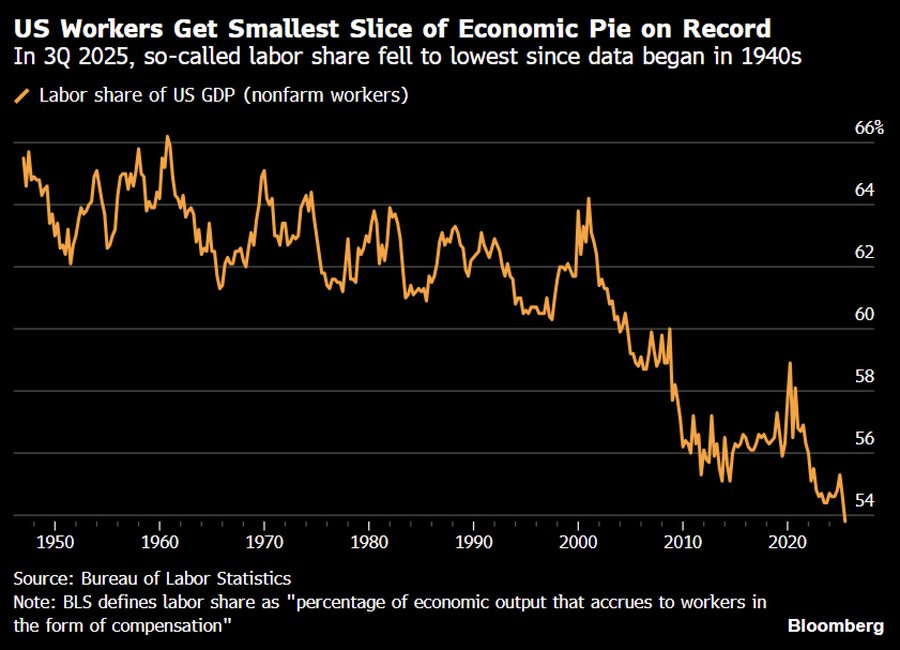
U.S. workers are getting a smaller and smaller slice of the economic pie. What does it mean? Likely winner-takes-all dynamics accelerated by the Gen AI Boom.
Is the K-Shaped Economy the new U.S. reality?
But metrics like GDP or traditional unemployment rates are aren’t telling the full story. Stagflation and an AI-pressed labor market is a terrible environment to those pursuing the old-school American dream. The AI boom on every metric possible is increasing a profound wealth inequality that increases social unrest indefinitely as democracy and capitalism both show signs of strain, less rule of law, transparency and regulation.
“2025 showed the Highest Q4 Layoffs Since 2008; and the Lowest YTD Hiring Since 2010.”
- Challenger, Gray and Christmas, January 8th, 2026. - Source.
The U.S. is Negative Jobs Growth
You can’t hide the obvious.
Based on the most recent data from the Bureau of Labor Statistics (BLS) as of January 2026, the U.S. economy has had a volatile final quarter.
In the last three months (October–December 2025), the U.S. added a net total of (negative) –67,000 jobs. It’s not a revolution, if it’s not creating jobs and value for all of society.
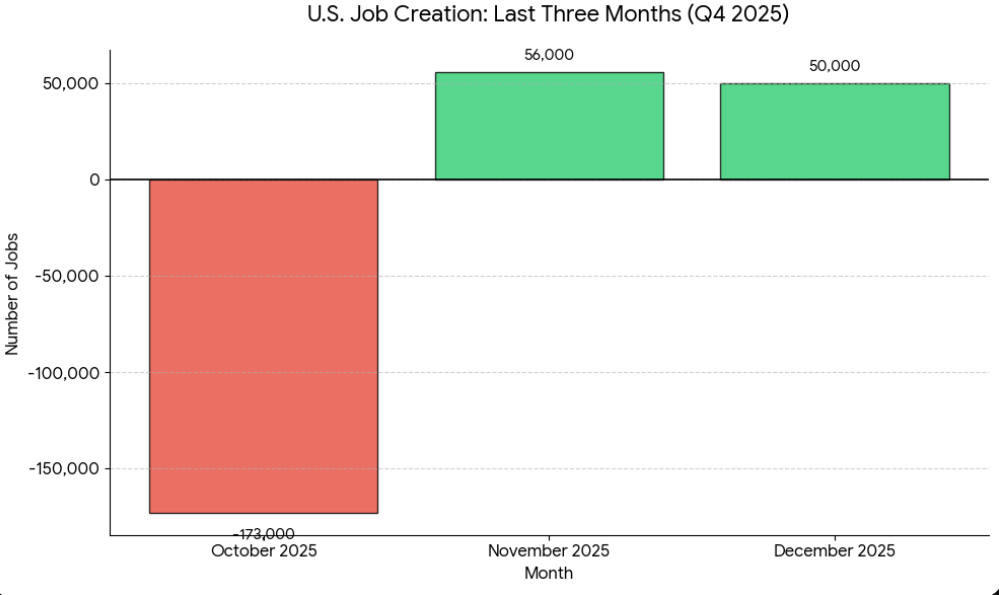
There are some indications that Generative AI is adding pressure to a K-shaped economy that could lend momentum to growing troubles in the “affordability crisis” already in full play politically within the U.S.
Multiple revisions, a Government shutdown and massive layoffs in 2025 show how bad the situation is in the jobs data.
The affordability crisis is about to get much louder in 2026 as wealth inequality means young people are being shortchanged their future. Read the latest employment situation summary of early January, 2026.
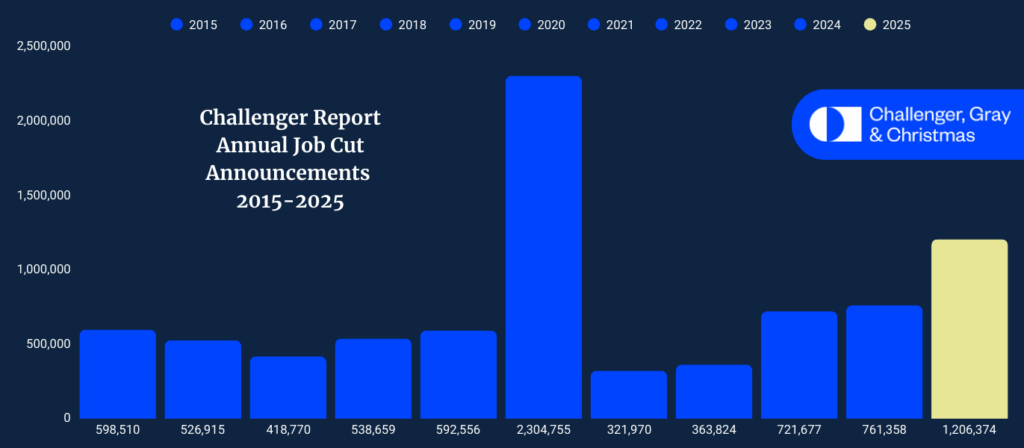
A Torrent of Tech Job Layoffs has begun 2025-2030
Layoffs in the Tech sector are an early indicator.
In 2025, we saw a total of 170,630 Tech job layoffs. The anticipation to impress on Earnings (to keep the AI hype going) will means BigTech will have to do a lot more layoffs in 2026. Eventually margins will be compressed as the demand for compute keeps rising exponentially. More agents, reasoning models and usage tends to do that.
See the most recent layoffs in tech: (not a promotion)

Tech Layoffs should continue at a rapid pace in 2026 as capex and Earnings pressure increases to unprecedented levels.
Is AI accelerating Tech layoffs? In 2024, we saw just 95,000 U.S. tech layoffs. New energy deals by Meta, Google and Microsoft bulldozing datacenter projects at warp show two contrasting worlds colliding. Higher energy prices will significantly impact the affordability crisis. As BigTech increases capex, they will need to make more cuts and layoffs. They will need to take out more corporate bonds and debt. Meanwhile, Venture Capital firms are getting more powerful with the Trump Administration making favorable deals for the companies they have invested in. Less immigration and more U.S. talent retiring means a huge gap in talent pool in the labor market. As far as I can tell (and I’m not an economist) rising unemployment is almost inevitable in this scenario.
Contrary to many of the AI reports of the last few years, Generative AI is not creating many new jobs. The job resdesigns favoring AI workflows mean less demand for those same positions within companies (including entry level positions and middle managers). These two things combined mean those lucrative tech jobs might begin to dry up.
If Generative AI were a Revolution, wouldn’t you expect to see the tech creating more new jobs?
Where indeed is the return on investment from this technology. Most Americans don’t work in Silicon Valley. Generative AI might also harm the prospects of many small businesses and solopreneurs as they face a new wave of sudden competition of professionals who have been laid off and deskilled out of their former positions and careers.
If as some argue we are just in the early stages of the AI revolution, when (and where) could we expect those new kinds of jobs or positive productivity gains to show up?
Why “where is the ROI” - is not the right or only question
In fact, the labor market in the U.S. has me very worried. If it weren’t for healthcare jobs, during the last eight months we’d be net negative for jobs. The AI Infrastructure push seems to be benefitting mostly BigTech, their earnings and the wealthy who are most exposed to their equities.
The biggest Venture Capital funds are thriving with Government policy that suits their capital objectives. It’s almost like picking the winners and insider trading, but what about the impacts on the general population? How permanent is the K-shaped economy the U.S. seems to be gravitating towards? How will AI be contributing to the efficiency drives that make the financial elite, even richer? And what is the end-game as AI itself becomes more political in the U.S.?
Wealth inequality is not being balanced in this era of Monopoly Capitalism and late stage U.S. reserve currency status in America (🇺🇸) which could have long-term detrimental impacts on the U.S. economy and quality of life of its citizens and consumers. In 2025 there were some signs that the value of a college education had deteriorated with young people not being able to keep up with loan repayments or find related jobs upon graduation in a timely manner.
The AI boom doesn’t seem to be impacting the labor market or delivering real productivity gains outside of Technology engineering and product teams (PMs) (so called first adopters). AI’s potential economic gains have mostly so far been seen and concentrated in AI coding’s steady improvements. But let’s not mistake that for scaling to the rest of society and jobs.
ROI from Gen AI doesn’t seem to be uplifting People 🤯
My thesis thus far is that overall ROI for society and the economy of Generative AI impact is likely “net negative” after three since ChatGPT. The impact on culture, rule of law, human leadership or trust in the internet and our institutions has been decidedly negative.
U.S. demographics, poor policy, inflation even before AI, is setting up a very inadequate labor market for the U.S. to thrive in the decade ahead.
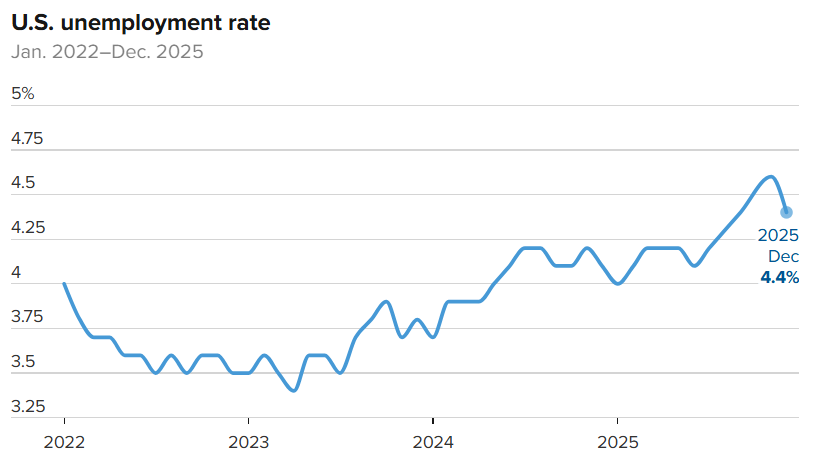
Nearly two years ago Marc Andreessen argued that AI wouldn’t increase unemployment, but we’re going to find out soon if and why he was wrong. Generative AI simply isn’t creating many new or great permanent or sustainable jobs. Nor does the U.S. have the talent to supply them without massive immigration. In 2026 I see the labor market deteriorating further with AI not augmenting us but mostly hurting job seekers, young people and the Middle and lower class. The U.S. labor market is especially worrisome:
The 2026 U.S. Labor Market is Totally Dysfunctional
Generative AI and going into debt to build more datacenters is a fairly harmful environment for a labor market teetering on the brink. Job creation is anemic and Generative AI is making it worse:
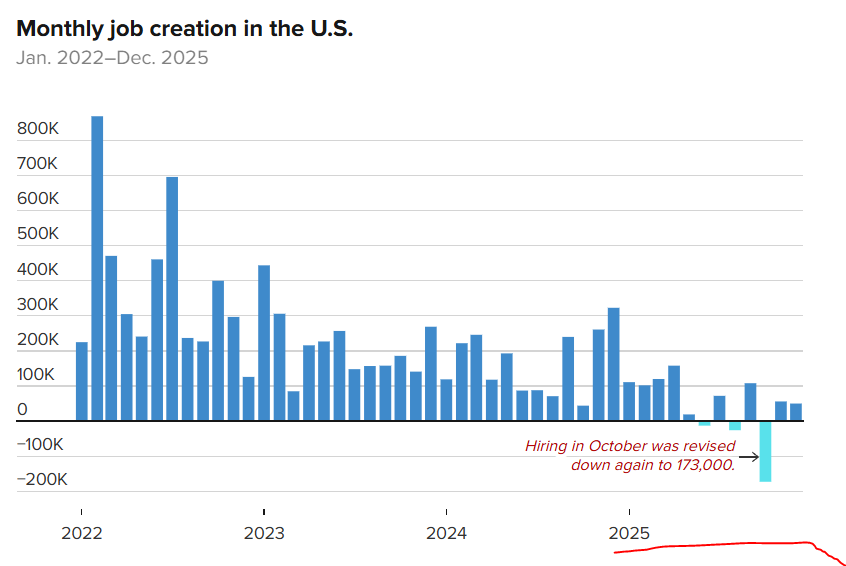
Less jobs have been created since ChatGPT went live
More jobs roles are being redesigned (for AI native workflows) that require less positions
Hiring is stagnant while Tech layoffs have been surging (see below)
Demand for entry level jobs in some domains have been reduced
In BigTech behemoth companies, middle manager roles have been significantly purged
Some major companies will be disrupted as more innovative firms progress faster
The U.S. talent pool has been diminished (both from retirements and less immigration)
Jobs data was significantly obscured during and since the prolonged U.S. Government shutdown of 2025 (hard to trust after this point)
Immigration has been Slowed by 75% or More
The Trump Administration has in recent times decimated the pipeline for talent from immigration.

Nearly 80% of of billion-dollar companies today had an immigrant founder or an immigrant in a key leadership position.
In the final three months of 2025 (October–December), immigration to the United States experienced a drastic slowdown, shifting from a period of historic growth to a net population decline.
Based on data from U.S. Customs and Border Protection (CBP) and reports from the Pew Research Center, the current pace of entries is roughly 80% to 90% slower than the peaks seen in 2023 and 2024. I don’t have to tell you that with plummeting and low fertility rates and having less immigration isn’t a great long-term strategy for a consumer economy. The U.S. simply doesn’t have the internal talent to fill highly technical industries like new Gen AI roles, AI engineers, semiconductor workers, cybersecurity, quantum computing or even the best global entrepreneurs (that typically come from first generation immigrants).
Demographic changes (aging population) and Immigration alone would hurt the labor market, but combined with AI - to me the dislocation is going to be entirely harmful to citizens, consumers and the U.S. economy.
People, Fei-Fei Li said, “need to hear the facts.” - Source.
Recent moves by the Trump Administration on the Fed, make me wonder if I can even count on good factual data in 2026 from Government sources related to things like jobs and the U.S. economy. Even the recent U.S. GDP numbers look a bit wacky. The U.S. seems to be taking a page out of China’s book more and more so.
New Jobs created are down since the Advent of Generative AI
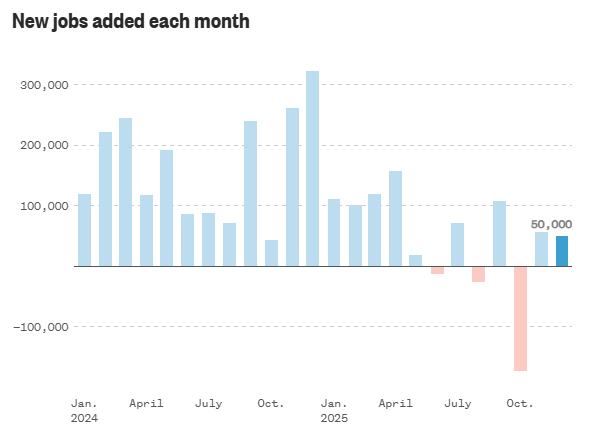
Tariffs, less immigration, mass deportations and AI are a poor combination for most Americans looking for work. Those who are laid off are finding it more difficult and slower to find new positions. U.S GDP growth and the reality of most Americans are in stark contrast as we head into 2026.
If Generative AI were an “AI Revolution”, it would be creating more jobs than are disrupted. But the Tech optimists say it could take far longer for this to be the case. But it’s not clear how that even takes place nor if real ROI at the scale promised, ever manifests. If my fears are correct, that could be rather uncomfortable for U.S. workers and a Middle Class in decline relative to inflation and rising costs of living.
Plundering the hard assets of others, and propping up an AI boom narrative might also be related to bigger systemic issues for the United States. It’s also possible the AI boom isn’t so much about creating real opportunity for workers as it appears to be about power.
