Cursor's Wild Trajectory to being a Vibe Working Leader
Vibe Working: How AI Plugins Across Cursor, Claude Code & Cowork Are Changing How We Work. Why Cursor is destined to lead Enterprise AI.
🌟 In Partnership with Roboflow. Grateful to have occasional sponsors that enables this article to be free for all.

Among all the very well funded AI coding startups, Anysphere’s Cursor really does stand alone as the best in class. Since their seed round by OpenAI Startup Fund (i.e. Sam Altman) and Series A led by a16z, it’s hard to fully appreciate what they are building as a leader in Enterprise AI.
Cursor has achieved one of the fastest growth trajectories in the history of SaaS, reaching $2 billion in ARR (Annual Recurring Revenue) as of early 2026. It took Anysphere just 33 months from its founding in 2022 to surpass the $2 billion ARR milestone in February 2026.
The ARR was evident right from the start. But their pivot to Enterprise was the major driver. They have reputedly doubled their revenue in the last three months (December, 2025 to February, 2026). Even in the early days there were signs this was going to be good product.
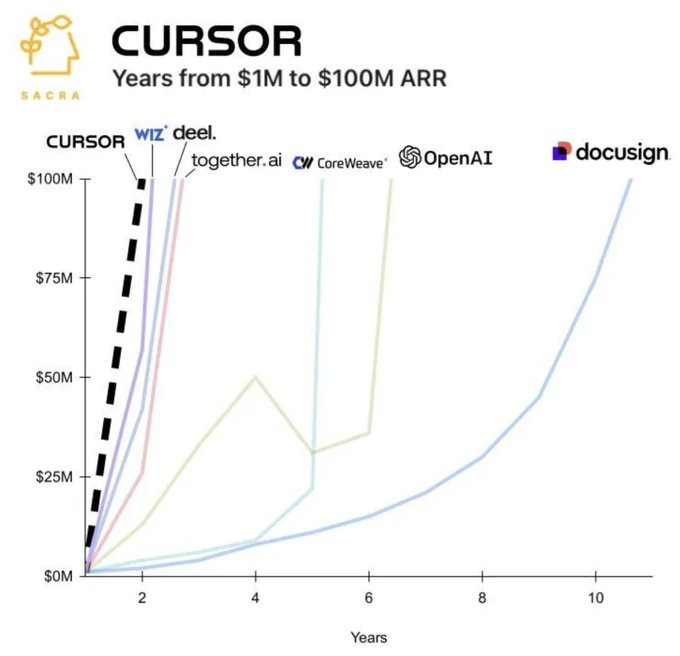
Cursor are now in talks to raise at a $50 Billion valuation. I believe Cursor and not OpenAI will end up being Anthropic’s biggest Enterprise AI competitor. I asked Daria Cupareanu to look into their plugins, marketplace and so forth. You might recall she wrote about Claude Cowork plugins in February.
Share this post if you know someone that would be interested in this guide and overview of Cursor’s momentum.
AI Blew my Mind
Guides, how-to AI systems and introductions.
Make the Most of Claude AI
OpenClaw Use Cases That’ll Make You Rethink What AI Agents Can Do
Claude Cowork Scheduled Tasks: 6 Ways I Automated My Work on Repeat
Cursor News
Cursor AI has undergone a massive transformation in early 2026, shifting from a "smart editor" to a platform for autonomous cloud agents.
Recent blog: Securing our codebase with autonomous agents
Cursor’s Automations feature launched on March 5th. Their plugins on February 17th. Read docs on plugins here.
Now they have launched security automations, like an Agentic Security Review that catches security problems in new code before it goes live.

Why I’m so Bullish on Cursor
Cursor is one of the fastest-growing startups ever in the AI/dev tools space scaling at just the right time in history of Generative AI. They are backed by the likes of Google and Nvidia. Their CLI is already legendary but it’s how they are adapting to Enterprise AI that raises their ceiling so much.
Cursor’s Enterprise Ceiling is Without Limit
Cursor is currently one of the fastest-growing SaaS companies at a time when legacy SaaS companies have had a massive loss of confidence. The threat of Claude Code and Opus 4.5 did something to this young startup, it made them leap ahead. 2026 is the key year for Anysphere’s development as a company.
Cursor was founded in 2022 by 4 MIT graduates—Michael Truell, Aman Sanger, Sualeh Asif, and Arvid Lunnemark. Now in 2026, Cursor makes about 60% of its revenue from Enterprise customers where large engineering organizations (like those at Nvidia, Uber, and Shopify) transitioned from pilot programs to full-scale deployments. Anysphere is just one year younger than Anthropic and by far the most promising AI coding startup getting into Enterprise autonomous agents.

Cursor has demonstrated unprecedented scaling in the AI dev tools space, outpacing competitors like GitHub Copilot or Devin. I believe Cursor’s Enterprise AI suite will become a peer of that of Anthropic. In short, I don’t see them as just an AI coding startup any longer.
“Anysphere’s (Cursor) annualized recurring revenue (ARR) has skyrocketed from $200 million in mid-2025 to over $2 billion by early March 2026, doubling in just the last three months alone.”
How Product Managers use Cursor has been eye opening in recent months. Claire Vo Podcast interview really caught my attention on this.
Automations already run thousands of times per day inside their own codebase! The March 5th, 2026 video on Automations:
Prediction: Anysphere Becomes a Peer of Anthropic
Like Claude Code and Cowork Plugins I envision Anysphere developing products for vibe workers at real companies and not just Tech companies or for SWEs, PMs and the like. The moment Cursor became an Agentic AI company in February, it changed their trajectory in Enterprise AI.
Users can trigger the agents from the web, Cursor’s desktop app, on a mobile device, through the messaging platform Slack or on Microsoft’s GitHub. But that’s just the beginning, as their marketplace of integrations and plugins expands rapidly in the months ahead. As they build their own in-house agent and coding models.
Cursor has over 1 million developers as DAUs in early 2026.
The company has approximately 360,000 paid individual subscribers.
They have over 50,000 enterprises including more than 64% of the Fortune 500.
They most recently doubled their revenue in just 3 months to $2 Bn. ARR.
There’s now enough data in early 2026 to say that Anysphere will be among the Big Three BigAI companies of the 2030s. All to say knowing how to use Cursor and its CLI, marketplace and automations might be good skills to have.
Let’s get down to the applied section of this how-to guide.
Vibe Working: How AI Plugins Across Cursor, Claude Code & Cowork Are Changing How We Work
AI plugins are turning Cursor, Claude Code, and Cowork into full workflow engines. Welcome to vibe working — where AI does the busywork across every role.
Cursor launched plugins. Anthropic did the same thing weeks earlier. What’s going on?
On January 30th, Anthropic launched plugins for Claude. The plugins work both in Claude Code (their agentic coding tool) and in Cowork (a non-coding version designed for knowledge work, which I’ve been testing and writing about since launch).
After this, stocks fell so hard that analysts coined a term for it: the “SaaSpocalypse“. And not just software. IT services, financial services, professional services, all got hit.
The logic was straightforward. If AI can connect directly to the tools businesses run on, read the data, and run full processes across multiple services on its own, then the value of a lot of standalone products and services starts to look different.
Two and a half weeks later, on February 17th, Cursor launched its own plugin marketplace with partners like Figma, Stripe, Linear, and others. Same concept. Same type of system. A second major AI platform making the same bet.
Both are building toward the same thing: AI that moves from something you chat with to something that runs your workflows, connected to the tools you already use.
In this article:
What plugins are and why they matter
How Cursor, Claude Code, and Cowork plugins compare
How to install and use plugins in your work (with demo videos)
Examples across sales, product, marketing, and project management
What “vibe working” means and where this is going
What are plugins and why do they change how we work this much?
Until now, working with AI has been copy-paste. You take information from one app, paste it into ChatGPT or Claude, get a result, then manually move that result into another app. You’re the middleman between AI and the tools you use in your work.
Plugins remove you from that role. They bundle skills and other instructions that teach the AI how to connect to your services, what data to extract, how to interpret it, and what to do with it.
That’s what makes it different from a simple integration. The AI doesn’t just get access to a tool. It gets the instructions for how to use it to run full processes across your tools. Start to finish.
Cursor, Claude Code, and Cowork plugins compared
All three now have plugins, what’s different is how you work with them:
Claude Code — runs in the terminal. Has the largest plugin ecosystem: partner-built plugins (tool connections) plus community-built ones that teach the AI specific processes like frontend design or security guidance (that work as saved expertise).
Cursor — runs in its code editor. Launched its marketplace with most of the same plugins already available in Claude Code, and will (definitely!) expand from there.
Cowork — runs in the Claude desktop app, designed around visual interfaces and slash commands. Covers job functions like sales, legal, finance, marketing, HR, and you don’t necessarily need to connect them to tools. You can also use them just as saved expertise.
Regardless of which environment you use, the way you interact with plugins is the same: you install them and the AI gains new capabilities.
These are the plugins available today across these platforms:
Look through them and notice which tools you already use. Once you know what’s available for you, putting them to work is simpler than you’d expect.
How to install plugins
You can browse Cowork and Claude Code plugins here and Cursor plugins here.
After you find the ones you want to use, here’s a demo of how you install them in each of the three platforms (it’s very simple):
🎬 Watch the video: 2 min, 43 seconds
How to use plugins in your work
Once they’re installed, you can use a single plugin or multiple ones in the same conversation, depending on what you need.
Using plugins across Cowork, Claude Code, and Cursor
In Cowork, you use plugins by typing slash commands in the chat. They run specific processes for you using saved expertise. You can customize them to match how you work or create your own. You also connect your tools separately (like Notion, Slack, or Google Drive), and once connected, any plugin can use them. (I walked through how they work and how to build your own step by step here.)
With Cursor and Claude Code, the value is in the tool connections. Install a Stripe plugin, and you stop copy-pasting data or exporting files. You just type what you need.
Combining multiple plugins
The best part is that multiple plugins work together in the same conversation. Your tools communicate with each other because they’re all tied to an AI that sees everything inside all of them. You describe what you need, and the AI handles the connections.
Work that used to mean exporting from three tools, spending half a day making sense of it all, and finding connections across the data now takes minutes.
Here’s what that looks like across different roles:
Sales: Research prospects in Apollo, check their engagement signals in Common Room, pull their payment history from Stripe, and draft personalized outreach.
Product: Check Stripe data for abandoned carts, pull onboarding behavior from Amplitude, combine both to find where users drop off in your app, and redesign the onboarding flow in Figma.
Project management: Pull sprint data from Linear, cross-reference it with project docs in Notion, and share the status update in Slack.
Marketing: Pull user behavior data from PostHog, identify which campaigns drive the most signups in Amplitude, and plan your next content calendar in Notion.
Plugins in action: a real demo
🎬 Watch the video: 3 min, 37 seconds
In this demo, I connected the Notion plugin to both Claude Code and Cursor, gave them the same prompt, and watched both search my Notion, analyze my prompt library, and create new pages with recommendations for future content. Then I used Cowork and the /competitive-analysis slash command from the marketing plugin to compare AI blew my mind with The Rundown and save the results to Notion.
Why this matters beyond engineering
AI coding tools are becoming AI working tools. And they’re more accessible than they sound.
At their core, Cursor, Claude Code, and Cowork are all chat interfaces. You type what you need, and the AI does the work across your tools.
The difference is that these environments were built for complex, multi-step processes, not just one-off questions. That’s what makes them powerful for business, not just development.
And these processes aren’t one-time tricks. You can save them and repeat them. That churn analysis you ran across Stripe and Amplitude? Save it and run it again next month with one command. That sprint report that pulls from Linear, formats the data, and sends it through Gmail? Save it as a process and trigger it whenever you need it.
That’s what “vibe working” means. Not chatting with AI for a one-off answer. Working inside an AI environment where your tools are connected, your processes are saved, and the AI already knows the steps because the plugins taught it.
Read more of this Author
37 Claude Skills Examples to Transform How You Work (From 23 Creators)
The Claude Skills That Finally Made AI Write Like Me (And How to Build Yours)
Claude Cowork: 10 Use Cases I Tested + 67 More by Profession
Claude Cowork Plugins: What They Are, How to Build One (+ My Writing Plugin, Fully Broken Down)
Claude Cowork Scheduled Tasks: 6 Ways I Automated My Work on Repeat
Addendum
Anysphere’s marketplace and plugins means Enterprise AI leaders will now evolve rapidly in the late 2020s. It will be a period of unprecedented growth where Anthropic, Anysphere, Google and OpenAI can all be major winners.
Deedy Das made this chart of all the companies Nvidia’s CEO called “AI Native” in the GTC Keynote yesterday, but there will be few winners like the best Enterprise AI companies.
Anysphere’s Series D notably included Nvidia and Google Ventures (GV). A primary goal of the Series D capital was to reduce reliance on third-party compute (like OpenAI) by deepening partnerships with Nvidia and Google to build out their own specialized stacks.
Now with rumors that they are already starting the next funding round nearly doubling their market valuation in mere months, the sky is the limit for Cursor and the tools Anysphere will build. While originally a favorite of individual "vibe coders," Cursor is now reportedly used by over half of the Fortune 500, including major firms like Uber, Spotify, and Instacart. This positions Cursor along the same trajectory for vibe-working as Claude Code.
According to reports from Bloomberg and Seeking Alpha published around March 12, 2026, Anysphere is reportedly in preliminary talks with investors for a new round that would value the company at approximately $50 billion. This is escape velocity from the likes of Google Antigravity, Github Copilot, OpenAI Codex, Replit and others. Anysphere is going to be a transformative company in the Enterprise AI space that few will be able to rival.
Anysphere only has around 400 employees, so they don’t have the bloat of an OpenAI or an Anthropic yet. Being engineering and talent heavy and focused, they can continue to build the best products in the industry including the vibe-worker customer base. In short, this isn’t just a company for the disappearing role of the Software Engineer.
Cursor No Longer Just a Coding Assistant
I see a scenario where Anysphere becomes Anthropic’s key competitor. Think about it, Cursor goes from $1B to $2B in 3mos, while Claude Code went $0 to $2.5B in 8mos.
Cursor as one of the fastest-growing startups in the era when coding got a lot better means they might become the original vibe-working platform. There’s no other possible conclusion as of March, 2026. Anthropic’s Opus 4.5 was the model that broke through into the Agentic future. More important in the big picture than what GPT-4 was to chatbots.
Cursor’s agents can also run in parallel on their own virtual machines and the company will scale just at the peak of the Agentic AI hype narrative. Developers, and increasingly Product Managers, can hand off more complex tasks to Cursor’s updated agents, and those agents can test and iterate on those features until they are complete.
Cursor’s pivot to Enterprise AI is what clearly differentiates them now. This pivot to Enterprise like occurred as a strategic shift that began around late 2024 and fully took over as their primary growth engine throughout 2025. They have overtaken OpenAI Codex in ARR quite a while ago, a company founded 7 years before them.
As of right now, Claude and Cursor appear like the Enterprise AI and vibe-working tools of the future. Getting to know Claude Code and Cursor’s ecosystems inside-out might be a good idea.
Thanks for reading!


What Stripe did for payments I see Anysphere doing for Vibe working tasks.
They have a real chance of building a very sustainable ecosystem full of integrations, plugins and an interoperable agentic Enterprise AI solution. Product managers and non-coders using Cursor is really just the beginning.