👋 Hey there, I’m Mike. Each week I share AI articles at the intersection of tech, business, society and the future. If you want to support the channel or gain full-access to my work, go here. Read Archives | See Substack Notes | Visit our community Chat | Visit Homepage. A lot of the West is missing the flurry of IPOs out of China. But how to understand their multiple Stock markets in the AI boom?
Good Morning,
As we get ready for the end of summer a lot is happening in buzzy AI related IPOs, at home but also in China. AI Supremacy publication is dedicated to covering the U.S. vs. China in AI and emerging technology. I’m always on the lookout for new people doing serious coverage.
X.PIN
X.PIN is a Newsletter that covers China’s tech frontiers with deep dives on topics ranging from AI, robotics, EVs to manufacturing and emerging tech. The publication is brand new on Substack, about five months old. Chaping (差评) is actually over a decade strong. It was originally started in 2015 as a WeChat Official Account.
Two of its primary authors here are CT Zhao and Han Chen, please give them a follow if the China AI and tech angle appeals to you. If you follow China and their role in the future of tech you and how it’s impacting Chinese society as a whole, you won’t regret subscribing to their publication:

I asked X.PIN to help introduce my readers to the China stock market scene in the AI boom. This is a rabbit-hole of great interest for China watchers, investors and for those of us trying to have a global understanding of AI and tech.
They cover AI, tech but also the impact with society which I admire. Learn more about the brand. Some of the Chinese IPOs I’m tracking of 2026 are:
For me when DeepSeek IPOs in late 2026 or early 2027 it will be the start of a brave new world. Here is a selection of some of X.PIN work who are incredibly popular on WeChat, among other Chinese platforms. They’ve also made an IPO Atlas.
X.PIN’s Substack Notes are a great way to keep in touch with China AI and tech news. Substack has in 2026 become stronger with voices inside of China doing excellent coverage like Poe Zhao and Tony Peng. So the list is growing of available angles to better understand China Tech and AI.
Their writing tone is accessible and their topics are a bit off-the-beaten track and not your regular Tech coverage, in a good way. Tony Peng also has a China AI Index website to track China AI News and relevant IPOs that complements all of this for readers that want to follow more granular details.
Selection of Recent Articles
Is AI Breaking China’s University?
The DeepSeek Doctrine
Who Pays for AI? How America and China Are Monetizing AI Differently
The End of China’s AI Boyfriends
“Chaping (差评), literally meaning "bad review" or "negative review," is one of China’s most unique tech-focused digital media publications out of Hangzhou, Zhejiang, with a reputation on cutting, sharp, and accessible commentary on the technology industry, consumer electronics, internet culture, and the digital economy.”
So, let’s get into it:
Charting the Incredible China AI Boom
If you are reading this article, you have probably already witnessed Unitree Robotics’ listing on Shanghai’s STAR Market.
Or, more likely, you did not.
That is exactly the point.
This story is not really about one robotics company. It is about an entire market that most global investors rarely see: China’s AI-driven technology rally.
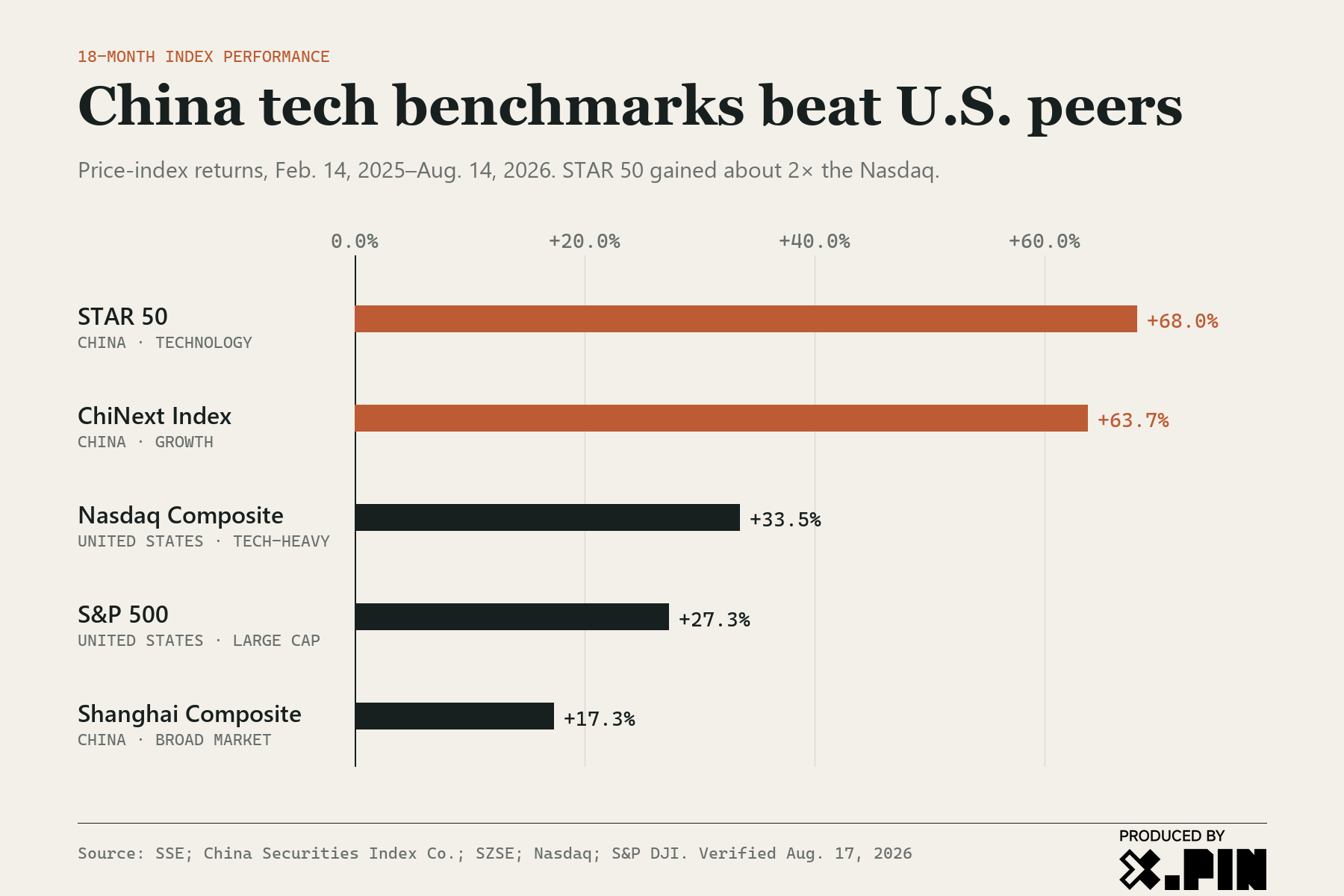
Over the past 18 months, the Shanghai Composite Index has risen 17.3 per cent. That is a respectable return, but it has not beaten the S&P 500 or the Nasdaq. The real gains have happened elsewhere, among the technology companies listed on ChiNext, Shanghai’s STAR Market and the Hong Kong Stock Exchange.
Once you move beyond China’s broad market indexes, the picture changes considerably. Some Chinese AI-related indexes have even outperformed the Nasdaq over the same period.
So why has the rally attracted so little attention?
The simplest answer is that global financial media rarely covers China’s technology market in any systematic way. But there is another problem: even Chinese investors cannot easily buy many of the companies driving it.
To trade ChiNext stocks, mainland investors must maintain average daily assets of RMB 100,000 (about $14,800) for 20 trading days and have at least two years of trading experience. Access to the STAR Market requires RMB 500,000 (about $74,000), two years of experience and additional risk assessments.
These restrictions exist because both markets are considered far more speculative than China’s traditional main boards. For foreign retail investors, access is even more limited. Many ChiNext and STAR Market companies cannot be purchased directly at all.
If investors cannot buy the companies behind China’s AI boom, why should they pay attention?
The answer is ETFs.
Hong Kong-listed exchange-traded funds provide one of the simplest ways for foreign investors to gain exposure to China’s technology market. These products track indexes such as the STAR 50 and ChiNext. Over the past 18 months, several have delivered strong returns.
The two themes attracting the most attention are communications infrastructure and semiconductors. Some Chinese semiconductor ETFs have gained more than 110 per cent over the period.
That would be impressive in any market. But foreign investors already have easier alternatives. The VanEck Semiconductor ETF gained roughly 95 per cent over the same period, while the iShares Semiconductor ETF rose around 85 per cent. Both contain familiar companies such as Nvidia, TSMC, ASML and Broadcom.
For most investors, buying those funds is much easier than researching an unfamiliar Chinese semiconductor company through financial reports and news published in another language.
That is why ETFs are the natural starting point. Before choosing individual Chinese AI stocks, investors need to understand the broader cycle. Index funds offer a way to follow the market, capture some of the upside and learn how Chinese technology stocks behave without constantly monitoring a single company.
Understanding China’s AI Indexes
Stock indexes are usually designed to represent a particular industry or part of the economy.
ChiNext was created for entrepreneurial and high-growth companies that may not qualify for China’s traditional main boards. The closest comparison is the Nasdaq, although the two markets are far from identical.
The STAR Market is more specialized. Established in Shanghai in 2019, it focuses on frontier industries such as semiconductors, software, biotechnology and advanced manufacturing. It is essentially a dedicated financing market for technologies that China considers strategically important.
Semiconductor indexes narrow the theme even further, concentrating on chip designers, manufacturers and equipment suppliers.
Together, these indexes capture much of China’s AI investment story. But their composition changes. STAR Market companies are reviewed quarterly, while ChiNext is adjusted every six months. As companies enter and leave, the investment thesis can shift with them.
The largest holdings therefore matter. They show where Chinese investors believe the next technology cycle is forming.
ChiNext: From Electric Vehicles to AI Infrastructure
The five largest ChiNext holdings include CATL, Innolight Technology, Eoptolink Technology, East Money Information and Sungrow Power Supply.
CATL remains the defining company of the index. The battery manufacturer represents China’s previous technology cycle: the electric-vehicle and renewable-energy boom of 2020 to 2022. Sungrow, one of China’s largest solar-inverter manufacturers, belongs to the same story.
When renewable-energy valuations collapsed after 2023, ChiNext entered a difficult period. Many investors believed its growth story had already peaked.
The market began to recover after Chinese state-backed funds intervened in late 2024. But the next real catalyst came from somewhere unexpected: American spending on AI infrastructure.
As US technology companies poured money into data centres, Chinese suppliers of supporting hardware became new market favourites. Optical-communications companies were among the biggest winners.
Innolight and Eoptolink manufacture optical modules, which connect AI servers inside data centres. Their rise reflects a simple fact. The United States may dominate advanced AI chips, but an AI system requires much more than GPUs. It also needs networking equipment, printed circuit boards, optical modules, cooling systems, storage and power infrastructure.
China remains a major supplier of many of these components. American AI spending can therefore create substantial orders for Chinese manufacturers, even as the two countries compete over advanced technology.
To understand ChiNext, it is not enough to ask whether AI is growing. The more important question is which Chinese industries are entering a new capacity-expansion cycle, and which companies are gaining weight inside the index.
Those changes often create the largest opportunities.
STAR Market: China’s Semiconductor Bet
The STAR Market’s five largest holdings include Cambricon Technologies, Advanced Micro-Fabrication Equipment Inc. China (AMEC), Hygon Information Technology, Semiconductor Manufacturing International Corporation (SMIC) and Montage Technology.
The market was created in 2019, at the height of the US-China technology rivalry. Its purpose was clear: to provide capital for companies working in industries China considered strategically important, especially semiconductors, software and advanced manufacturing.
The timing mattered. China was facing growing restrictions on advanced technology imports from the United States. Semiconductor independence was no longer simply an industrial goal. It had become a national priority.
Cambricon came to symbolize that ambition.
Founded in 2016, the company develops AI chips intended to compete with Nvidia’s accelerators. Chinese investors saw it as more than another semiconductor start-up. It represented the possibility that China might eventually build its own AI computing infrastructure.
This gave semiconductor companies a special position on the STAR Market. Investors were not valuing them only on revenue and profit. They were also pricing in geopolitical expectations.
That optimism did not last uninterrupted. The global semiconductor cycle weakened between 2021 and 2022, and many Chinese chip companies suffered sharp valuation declines. Cambricon continued to report losses after its listing, damaging investor confidence. By 2023, the STAR Market had fallen heavily as enthusiasm for semiconductor independence faded.
The recovery began in 2024. State-backed funds increased support for the broader stock market, while global AI investment created a new semiconductor cycle. Chinese investors returned to companies involved in AI chips, manufacturing equipment and domestic substitution.
By 2025, the STAR Market had become one of the clearest expressions of China’s AI infrastructure boom. Cambricon’s return to profitability and stronger demand at SMIC helped push the index higher.
The risk is equally clear. The STAR Market is heavily concentrated in semiconductors. If AI hardware spending slows or the global chip cycle turns down again, the market will suffer more than a broader technology index.
Two companies capture the entire argument. Cambricon represents China’s ambition to design competitive AI chips. SMIC represents its ability to manufacture advanced chips despite US restrictions.
Together, they reveal both the potential and the limitations of China’s semiconductor strategy.
Semiconductor ETFs: More Upside, More Risk
Chinese semiconductor ETFs take the same thesis and concentrate it further. Their largest holdings typically include NAURA Technology, AMEC, Cambricon, SMIC and Hygon.
These funds cover not only chip designers and manufacturers, but also companies producing the equipment required to make semiconductors. AMEC manufactures chipmaking equipment, while NAURA is one of China’s most important domestic suppliers.
The investment logic is straightforward. If China succeeds in building a more independent semiconductor supply chain, these companies should be among the largest beneficiaries.
But concentration works in both directions. When semiconductor shares rise, these ETFs can outperform broader technology indexes. When the cycle turns, their losses can accelerate just as quickly.
For foreign investors, they are probably the purest available bet on China’s semiconductor-independence campaign.
How America’s AI Boom Lifted Chinese Stocks
The connection between American AI spending and Chinese technology stocks may appear contradictory.
The United States leads in advanced AI chips, cloud computing and frontier models. China faces restrictions on many of the technologies required to compete.
So why did Chinese AI stocks rally?
There are two main reasons.
The first is that AI requires much more than chips. Large-scale AI deployment also needs optical modules, printed circuit boards, advanced packaging, cooling systems, storage and power infrastructure. China remains highly competitive in many of these areas.
Investors buying Innolight or Eoptolink are not betting that China will replace Nvidia. They are betting that every Nvidia chip will require thousands of other components around it.
The second reason is self-reliance.
When US-China tensions rise, Chinese investors tend to favour companies involved in domestic substitution. The logic is easy to understand: if foreign technology becomes unavailable, a domestic alternative becomes more valuable.
The danger is valuation. Many companies associated with self-reliance trade on expectations of what they may eventually become rather than what they currently earn.
Cambricon, for example, has traded at more than 250 times forward earnings. Nvidia has generally traded at around 40 to 60 times earnings.
That does not necessarily mean Chinese investors are irrational. It means they are placing a very high price on the company’s potential future role.
The difficult part is knowing when that future has already been priced into the stock.
The IPO Machine Behind the Boom
China’s AI rally has also produced a wave of technology IPOs.
Most companies choose one of three destinations: ChiNext, the STAR Market or Hong Kong. The mainland markets have stricter approval requirements, with regulators paying close attention to technological innovation and revenue growth.
Once a company lists, however, price movements can become extreme. Newly listed ChiNext and STAR Market companies face no daily price limits during their first five trading days.
That creates a peculiar market. Institutional investors and early shareholders can push prices sharply higher during the first week, while retail investors rush to buy what they hope will become the next technology champion.
From my own tracking, Cambricon’s IPO lottery had a winning probability of around 0.05 per cent. CXMT’s was roughly 0.47 per cent. Unitree Robotics’ was around 0.018 per cent.
The odds really do resemble a lottery. The returns sometimes do as well. Some Chinese technology IPOs have produced short-term gains of around 200 per cent.
But a successful IPO is not necessarily a successful long-term investment.
Many Chinese technology stocks rise sharply after listing, then decline over the following one to three years as investors wait for earnings to catch up. Companies trading at 300 to 500 per cent above their IPO valuations can eventually fall by 50 to 70 per cent.
The current AI boom and abundant market liquidity have interrupted that pattern, at least for now. But investors should remember that China’s stock market has historically been better at financing companies than rewarding shareholders.
In many cases, investors are using their own money to fund technology that may not produce profits for years.
What IPO Fundraising Reveals
Fundraising size offers another useful clue.
Chinese AI-model and robotics companies often struggle to raise more than $1 billion. The companies that exceed that threshold usually have existing revenue, established customers or clear strategic importance.
CXMT is one example. Innolight and Sanhua Intelligent Controls fit the same broader pattern.
The market may speculate heavily on futuristic AI products, but the largest pools of capital still tend to flow toward companies with proven industrial capabilities.
This creates a hierarchy within China’s AI market.
Foundation-model companies usually choose Hong Kong because they need large amounts of capital and access to international investors. The best-known examples are Zhipu AI and MiniMax.
Zhipu received investment from Prosperity7 Ventures, a fund backed by Saudi Aramco. MiniMax attracted capital from IDG Capital.
Investors in these companies care less about another benchmark score than about a much more basic question: can the company build a sustainable business?
MiniMax initially focused on consumer products, including its AI companion app Xingye and the Hailuo video model. Those products did not fully convince investors.
Zhipu placed greater emphasis on coding and enterprise applications, making it look more like a Chinese version of Anthropic. Its share price has risen dramatically since listing.
Before companies such as Kimi and DeepSeek reach the public market, Zhipu is the most visible listed bet on whether China can build a profitable foundation-model company.
Where China’s AI Money Actually Goes
AI hardware companies are easier to understand if we divide them into four groups: semiconductor equipment, semiconductor components, memory and storage, and AI devices.
Equipment companies such as NAURA, AMEC and Piotech build the machines required to manufacture chips. They do not need to produce the final AI processor themselves. They sell tools to the companies that do.
This business model has one major advantage: every domestic chip manufacturer needs equipment. As US restrictions limit China’s access to advanced foreign tools, local suppliers become more strategically valuable.
Component companies benefit from a different part of the cycle. Innolight, Eoptolink and suppliers linked to Unimicron gain from the construction of AI data centres. They are not replacing Nvidia or TSMC. They are selling the supporting hardware that AI infrastructure cannot operate without.
Memory and storage provide perhaps the clearest example of how China values industrial capacity.
CXMT is China’s largest DRAM manufacturer and one of the country’s most strategically important semiconductor companies. Unlike many AI start-ups, it already operates a large manufacturing business.
Its IPO demonstrated something important. Chinese investors are willing to award extremely high valuations to companies that combine national importance with actual industrial capability.
The final category is AI terminal manufacturing: smartphones, glasses and other devices that bring AI directly to consumers.
This market is much less certain. AI phones and glasses may eventually become enormous businesses, but adoption remains unclear. For now, investors are often paying for possibilities rather than earnings.
Physical AI: Exciting and Dangerous
The most difficult companies to value are those connected to physical AI: humanoid robots, autonomous vehicles, robotaxis, lidar and industrial robotics.
They represent one of the most ambitious visions of AI. They also tend to have the weakest financial performance.
The reason is simple. Software can scale quickly. Physical products cannot.
Once trained, a foundation model can serve millions of users. A robot still requires factories, components, assembly, testing, maintenance and deployment in the real world.
That creates a large gap between technological promise and financial reality.
Chinese robotaxi companies offer a good example. Pony.ai and WeRide represent some of China’s strongest autonomous-driving technology, but profitability remains distant. Their shares fell roughly 50 per cent within 18 months of listing in Hong Kong.
The market is not asking whether autonomous driving is impressive. It is asking whether these companies can build profitable businesses before investors lose patience.
Lidar suppliers face a similar problem. Hesai Technology produces sensors used in autonomous vehicles. Lidar was once treated as an essential technology for self-driving cars, but suppliers came under pressure as automakers began cutting costs.
Hesai’s shares fell more than 90 per cent after its IPO. The technology was valuable. The company’s pricing power was not.
Humanoid robots are more difficult still.
Companies such as Unitree have attracted enormous attention by producing functional robots at relatively low prices. But manufacturing humanoids at scale remains extremely challenging, and much of the expected demand does not yet exist.
Investors are betting on a market that may take another three to five years to mature.
The physical-AI companies that perform best usually have real businesses beyond the AI narrative. Sanhua Intelligent Controls is a good example. It supplies robotic actuators, but it is also an established Tesla supplier with existing industrial revenue.
Its valuation does not depend entirely on robots finding jobs.
What Foreign Investors Can Buy
After looking through China’s AI market, one conclusion becomes obvious: access matters almost as much as opportunity.
Most overseas retail investors cannot directly buy ChiNext or STAR Market stocks. Their realistic options are Hong Kong-listed Chinese AI companies, Hong Kong-listed ETFs and companies available through international trading programs.
Foundation-model companies such as Zhipu and MiniMax offer the highest potential returns, but also the greatest risk. Their valuations can move dramatically after a new product release, customer announcement or partnership.
AI hardware companies are generally easier to analyse because many already have industrial customers. Iluvatar CoreX, Biren Technology and Innolight depend on continued spending on AI infrastructure, but at least the source of demand is visible.
Some AI application companies already have functioning business models. CloudMinds provides robotic services, while computer-vision companies in the Horizon Robotics mould sell technology into existing industries. Their returns may be less spectacular than those of speculative AI-chip companies, but their businesses are easier to understand.
Physical-AI companies remain the most difficult category. Investing in robotaxis, humanoids or lidar requires belief not only in the technology, but also in a commercialization timeline that may keep moving further away.
China’s AI rally is real. The harder question is deciding which companies are producing earnings, which are producing useful hardware, and which are still producing little more than a very expensive story.
But the story does not end here. China’s technology IPO wave is still unfolding. We have compiled a list of companies that could potentially go public next, offering investors a preview of where the next AI and hardware opportunities may emerge.
Part II: How to Actually Buy Into China’s AI Boom
1. A Global Investor’s Map of Chinese Stocks
“Chinese stocks” is not one market. It is at least four markets layered on top of each other, each with its own rules about who is allowed to buy in.
Mainland China has five boards. The Shanghai and Shenzhen Main Boards list large, established companies. ChiNext, on the Shenzhen exchange, was built for growth companies; its closest (imperfect) analogue is the Nasdaq. The STAR Market, on the Shanghai exchange, is narrower still: a dedicated financing venue for semiconductors, software, biotech and advanced manufacturing. The Beijing Stock Exchange, smaller and less liquid, focuses on early stage innovative companies.
Hong Kong has its own Main Board, where most large Chinese tech listings now land, and GEM, a smaller board for early stage companies.
Access to each of these depends on who you are:
For overseas investors specifically, STAR Market and ChiNext shares reached through Stock Connect are limited to eligible institutional professional investors; this is not a retail channel. QFII/RQFII status offers a separate route into the same stocks, but that is an institutional license that a fund applies for, not something an individual investor signs up for directly.
The practical routes into mainland China from outside the country are: Stock Connect (the Shanghai Hong Kong and Shenzhen Hong Kong links, generally used through a Hong Kong or international broker with Connect access), and QFII/RQFII status (Qualified Foreign Institutional Investor / RMB Qualified Foreign Institutional Investor), which is really an institutional license, not something an individual applies for directly. A small number of large Chinese tech names also trade as ADRs on US exchanges, though most AI hardware and semiconductor names covered in Part I do not have a US listing at all.
For most global retail investors, that leaves two realistic paths: Hong Kong listed individual stocks (buyable through almost any broker with HK market access), and Hong Kong listed ETFs that hold the mainland stocks you can’t buy directly. For many global retail investors, ETFs are the simplest, and sometimes the only practical, way to access companies listed on mainland boards.
2. The ETF Menu
Saying “buy an ETF” isn’t useful advice unless you know which ETF. Here are some of the actual Hong Kong listed products global investors use to get this exposure, by theme:
STAR Market exposure: CSOP STAR50 ETF (3109.HK) was the first Hong Kong listed ETF to track the STAR 50 Index when it launched in 2021. It is a physical, non derivative fund that holds the underlying STAR Market shares directly, giving international investors direct exposure to Shanghai’s STAR Market. Bosera STAR50 ETF (2832.HK) tracks the same underlying index through a different manager.
ChiNext exposure: CSOP SZSE ChiNext ETF (3147.HK) is a synthetic ETF that uses derivatives to replicate the performance of Shenzhen’s ChiNext board, denominated in RMB. That’s a structurally different product from the STAR 50 funds above, which is exactly why it’s worth checking a fund’s structure and not just its name.
Semiconductors: Global X China Semiconductor ETF, listed with both a USD counter (9191.HK) and an HKD counter (3191.HK), tracks a FactSet China semiconductor index spanning chip design, equipment and manufacturing.
AI and robotics: Global X China Robotics & AI ETF (2807.HK) is built specifically around companies central to China’s robotics and AI development and adoption.
A caution worth repeating to readers: two funds that both call themselves a “China Semiconductor ETF” can hold almost entirely different companies. One may be roughly 40% equipment makers, another 30% foundries, another mostly AI chip designers, another closer to a traditional broad semiconductor basket. Before buying, look at the top ten holdings and the fund’s structure (physical vs. synthetic), not just the name.
Now that we know how to access the market, the harder question is what to own. The answer starts with the supply chain.
3. Buy the Supply Chain
“China AI” is not one trade. Underneath that label are at least six distinct businesses, each exposed to a different part of the cycle, with different margins, different customers and different risk. Breaking it apart this way is also the only way individual stock analysis stops being a stock list and starts being an argument.
AI Compute. Chip design, foundry capacity, and the equipment and hardware that makes both possible.
Cambricon is the purest bet on China building its own AI accelerators. It only turned its first annual profit in 2025, but the numbers since have been extraordinary: half year 2026 revenue reached ¥5.996 billion, up 108% year on year, with net profit of ¥2.311 billion, up 122%, already more than its entire 2025 net profit in six months (its Q1 specific figures are consistent with this pace but should be checked against the original filing before publication). And yet, on the first trading day after that half year report, the stock fell more than 6%. By August 2026 its trailing P/E stood above 250 times earnings, a valuation that prices in years of continued hypergrowth, not just the growth already delivered.
SMIC is the other side of the compute story: not designing chips, but making them. Its low double digit revenue growth and 20% gross margin look almost sleepy next to Cambricon, and that’s the point. SMIC trades at a far more industrial valuation, a fraction of Cambricon’s multiple, because the market is pricing something different: advanced Chinese foundry capacity operating under export restrictions, not a software style growth story.
Two other names round out this layer. Hygon Information Technology pairs a domestically developed CPU with a GPGPU class accelerator (the DCU) built for broad compatibility with the CUDA software ecosystem, a different bet than Cambricon’s from scratch architecture, aimed at customers who want AI acceleration without rewriting their software stack. Foxconn Industrial Internet sits at a different layer entirely: it doesn’t design chips, it assembles the servers and racks that carry them, as a lead manufacturing partner tied to Nvidia’s GB series rollout. Estimates of its share of that assembly market vary widely by source: brokerage research has put it anywhere from roughly a third to over 40% of global AI server output, which is itself a reminder that market share figures in this space are analyst estimates, not disclosed facts, and should be treated as a range rather than a number. Inspur is the domestic facing version of the same idea: China’s largest AI server integrator by shipment volume, selling primarily into the domestic cloud and enterprise market rather than into Nvidia’s global supply chain.
AI Networking. The optical modules, switches and connectors that move data between AI servers.
Part I explained why AI spending reaches far beyond GPUs. Innolight shows what that looks like in financial statements. Its first half 2026 revenue reached roughly ¥41.8 billion with net profit of about ¥13.7 billion, up roughly 240% year on year. A single quarter of 2026 profit (over ¥5 billion in Q1 alone) already exceeded its entire 2024 net profit. By its own half year filing, close to 95% of its revenue is now international. Supply chain analysts have linked its customer base to the largest US cloud providers, with concentration estimates putting its top five customers at around three quarters of sales, figures that should be checked against the company’s own disclosure before publication, since exact customer level breakdowns vary by report and are rarely named directly by the company itself. The stock has risen by several thousand percent since early 2023, and its market cap has at times ranked among the largest on the ChiNext board, briefly overtaking SMIC’s.
Eoptolink is Innolight’s closest domestic peer: the world’s second largest maker of high speed optical modules, with an early lead in LPO (linear pluggable optics), a lower power module architecture that several major cloud customers have reportedly been evaluating as an alternative to traditional DSP based modules. The investment case rhymes with Innolight’s: explosive revenue growth tied to a small number of large overseas customers, and a stock price that has already priced in years of continued hypergrowth.
A smaller, higher margin name in the same layer is Tfc Optical Communication (天孚通信, 300394.SZ), which makes the passive and active optical components that go inside modules like Innolight’s and Eoptolink’s rather than the finished modules themselves. Its 2025 revenue grew 59% to ¥5.16 billion with net profit up 50% to ¥2.02 billion, and its gross margin, above 53%, is roughly double what a module assembler typically runs, because Tfc sits one layer further upstream, closer to the component IP. Overseas revenue was about 74% of the 2025 total. It’s a useful pairing with Innolight and Eoptolink: same AI networking theme, same customer concentration and currency risks, but a different position in the value chain and a structurally fatter margin.
AI Infrastructure. Power, liquid cooling, PCBs and the physical plant an AI data center needs to actually run.
Envicool, China’s best known liquid cooling systems maker for data centers, is worth including here precisely because its 2026 story complicates the simple “AI infrastructure = easy money” narrative. Full year 2025 revenue grew 32% to ¥6.07 billion, but net profit growth had already slowed to 15%. Its first quarter 2026 report then showed revenue still up 26%, but net profit collapsing more than 80% year on year to single digit millions of RMB, a swing the company’s own filing attributed to a combination of foreign exchange losses, rising credit impairments and negative operating cash flow (worth confirming against the original 2026 Q1 report before publication).
Sugon (中科曙光, 603019.SH) sits one level up the stack: servers, high performance computing and, through its stake in the liquid cooling specialist Zettabyte (曙光数创), infrastructure cooling itself. Its growth is far more measured: full year 2024 revenue actually fell 8.4% while net profit rose 4%, and its first quarter 2026 report showed revenue up 24% with net profit up 22%. Next to Envicool’s volatility, Sugon reads almost boring. In a sector this prone to single quarter blowups, that may itself be the more interesting data point.
Two more names extend the infrastructure layer beyond cooling. Hu Dian (WUS Printed Circuit, 沪电股份, 002463.SZ) makes the high layer count PCBs that go inside AI servers and switches, a component more removed from the AI cooling headlines but one every AI server needs, and one whose growth is tied more mechanically to unit shipment volumes than to any single customer’s story. Runze Technology (润泽科技) is a different kind of infrastructure bet entirely: not a hardware maker, but a third party data center operator. Its customer concentration is unusually explicit and unusually high: per its own 2025 annual report, ByteDance is its largest client, and its top five customers together account for more than 90% of revenue. That’s a risk worth naming plainly, in the same spirit as Innolight’s customer concentration numbers above: Runze’s growth (Q1 2026 revenue up 53.6%, net profit up 35.4%) is riding ByteDance’s AI buildout about as directly as a stock can. Runze has also moved fast on liquid cooling, with roughly 100,000 high density racks delivered to date.
The lesson from putting all four of these side by side: being the right company in the right theme, AI infrastructure demand is real and growing, does not protect a stock from a single quarter’s cost overruns or a single customer’s spending pause wiping out most of the story. What changes is how violently that shows up, and that comes down to the scale, diversification and customer base of the business.
AI Software. Foundation models and the applications built on top of them.
Zhipu listed on the Hong Kong Main Board in January 2026 (2513.HK), an IPO that raised several billion Hong Kong dollars and valued the company at roughly HK$51 billion. For full year 2025, revenue grew 132% to ¥724 million, with second half revenue up 180% versus the first half: genuine commercial acceleration. But gross margin fell from 56.3% in 2024 to 41.0% in 2025 as lower margin cloud API revenue grew faster than higher margin on premise deployments, and full year 2025 R&D spending of ¥3.18 billion was 4.4 times that year’s total revenue. None of that stopped the stock from rallying sharply through the first half of 2026. As of [confirm exact date before publication], it was up roughly 700% since listing, pushing its market cap past HK$400 billion at its peak. Those figures move by the day and should be refreshed to the actual publication date, but they illustrate a valuation moving almost entirely independently of the underlying revenue base.
MiniMax listed on the Hong Kong Main Board in the same window, at an IPO valuation of roughly HK$50 billion, and its market cap likewise expanded into the hundreds of billions of Hong Kong dollars shortly after listing. Between them, Zhipu and MiniMax are the two most direct ways for a global investor to take a position on whether China can build a profitable foundation model business at all, as opposed to a profitable business built on top of one, which is a different and generally safer bet.
iFlytek (科大讯飞, 002230.SZ) is that safer bet’s clearest example: an application layer AI company with two decades of revenue history, not a pre revenue model lab. Its 2025 numbers tell a story of real but uneven progress: revenue grew 16% to roughly ¥27.1 billion and net profit rose nearly 50% to ¥839 million, yet the company posted a net loss again in the first quarter of 2026 (¥170 million, narrower than a year earlier), a pattern management attributes to the seasonal weighting of its education and government contracts toward the second half of the year. Its large model API and MaaS platform revenue grew 263% year on year, striking, but off a small base of roughly ¥385 million. iFlytek is a useful reminder that “application layer AI already has revenue” doesn’t automatically mean “application layer AI already has stable profit.” The underlying business is real, the government and education contracts are real, and the company is still working out how much of that revenue converts into consistent earnings.
Physical AI. Humanoid robots, autonomous driving, and the components underneath them.
Part I already traced the sharpest split in this category: real technology sitting next to distant profitability, visible in how far lidar and robotaxi operators have fallen from their IPO prices. Part II’s contribution here isn’t to repeat that argument. It’s to go one layer down, into the component suppliers that get paid regardless of which robot brand eventually wins.
Sanhua Intelligent Controls remains the cleanest illustration of the “technology vs. economics” divide in this category: it supplies robotic actuators, but its valuation doesn’t depend on robots finding jobs, because it’s also an established Tesla automotive supplier with real, current industrial revenue.
Tuopu Group is frequently named as a lead Tier 1 supplier of linear actuator assemblies for Tesla’s Optimus program, though that claim currently comes from supply chain research and brokerage reports, not from any official statement by Tesla. That distinction matters: this is market intelligence and industry due diligence, not company or Tesla disclosure, and it should be treated with the same caution as any unconfirmed customer relationship until Tesla or Tuopu itself names the arrangement directly. What is confirmed is that Tuopu’s existing automotive actuator business already generates real, current revenue, which is what makes the Optimus opportunity an add on to an existing business rather than the entire investment case, following the same structural pattern as Sanhua.
Green Harmonic (绿的谐波, 688017.SS) sits a layer further from any single customer. As China’s leading maker of harmonic reducers, the geared “joints” inside a humanoid robot’s limbs, it sells into the humanoid robotics ecosystem broadly rather than to one robot maker, which is a different risk profile than being a single company’s named Tier 1 supplier: less upside if any one customer’s program takes off, but also less downside if that customer’s timeline slips.
Orbbec (奥比中光, 688322.SS), a 3D vision sensor maker, occupies the perception layer: the “eyes” a humanoid robot needs to navigate a real environment. Together they round out a three layer picture of the humanoid supply chain: perception (Orbbec), actuation (Sanhua, Tuopu), and the reducers connecting them (Green Harmonic).
The investment lesson doesn’t change from Part I: real technology can sit next to a commercialization timeline that keeps moving. What changes is the object of analysis: not “will humanoid robots succeed,” but “which layer of the supply chain gets paid regardless of which robot brand wins,” and how much of each company’s revenue already exists today versus how much is still owed to a program that hasn’t shipped at scale.
AI Consumer Devices. Phones, glasses and other AI enabled hardware.
The most hyped names in Chinese AI glasses (RayNeo, Rokid, XREAL) are still private and racing toward IPOs, which means the most direct way to invest today is through their listed supply chain, and the two clearest examples sit at opposite ends of “how real is this yet.”
Crystal Optech is the cautionary one. Its core business remains heavily dependent on Apple’s supply chain (optical filters, prisms), with 2025 revenue of ¥6.93 billion (+10.4%) and net profit of ¥1.17 billion (+13.8%), a steady, unglamorous compounder. Its emerging AI optics product lines, glass substrates for AI storage and next generation waveguides for smart glasses, are what investors are actually excited about. But in June 2026, after the stock posted three day gains exceeding 20% on AI glasses enthusiasm, the company issued a filing clarifying that those specific new product lines were still in pre mass production validation or early customer sampling, and had not yet contributed meaningful revenue. The theme was ahead of the business by a wide margin.
Goertek (歌尔股份, 002241.SZ) is the other end of the same trade: a company where AI glasses revenue is already real. It is the primary contract manufacturer for Meta’s Ray-Ban smart glasses, with a reported majority share of that assembly market, and its own AI hardware revenue reportedly reached around ¥7.8 billion in 2025 with company targets well above that for 2026. Full year 2025 revenue was roughly flat at ¥96.6 billion, but net profit rose 48% to ¥3.94 billion, and first quarter 2026 revenue and profit both grew again.
Luxshare Precision (立讯精密, 002475.SZ) is Goertek’s closest rival in the same assembly layer: the number two contract manufacturer for AI glasses and VR headsets, and a supplier for Apple’s Vision Pro. Where Goertek’s AI hardware story centers on the Meta Ray-Ban line, Luxshare’s is more diversified: alongside AI glasses and VR assembly, it has also moved into AI server supply chains, including high speed copper cabling and liquid cooling connectors for Nvidia’s GB series racks. That diversification is the pitch. Luxshare isn’t a pure AI glasses bet the way Crystal Optech is, so a slowdown in any single AI hardware category matters less to its overall business.
At a market cap in the ¥80 billion range in mid 2026, Goertek trades at a far more modest multiple than Crystal Optech precisely because more of its AI story is already showing up in the income statement rather than in the pipeline. Read together, Crystal Optech, Goertek and Luxshare are variations on the same bet: AI glasses and AI hardware assembly becoming a real consumer and enterprise category, priced at different stages of proof, and diversified across different parts of the value chain.
This was a guest post by X.PIN and their talented writers. Check them out in more detail:
For more China AI and tech coverage also check out:
Recode China AI
Hello China Tech
Thanks for reading!


